
Forklift Turning Radius Explained: Why It Matters in Warehouse Layout Planning.
A forklift can fit inside a warehouse aisle and still not have enough room to work properly.
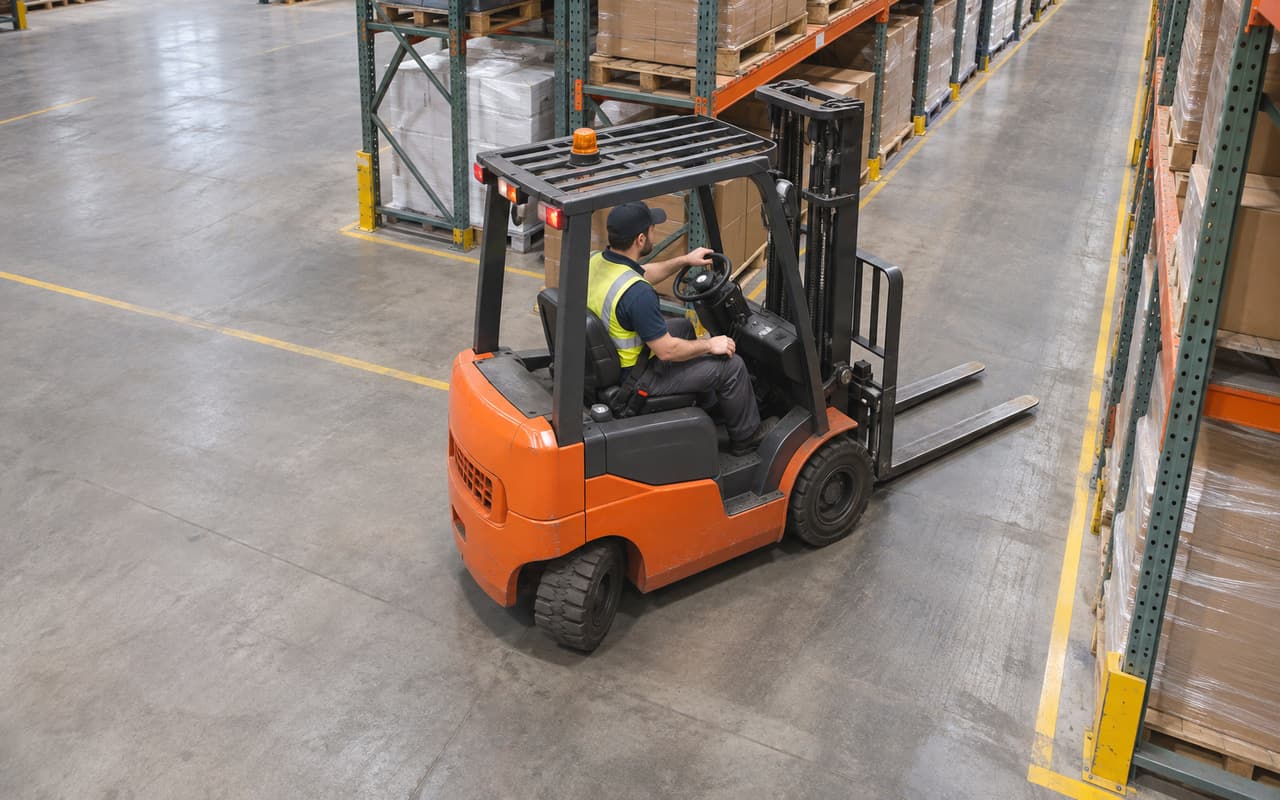
A forklift can fit inside a warehouse aisle and still not have enough room to work properly.
That is where many warehouse layouts go wrong.
A forklift does not simply move forward and backward. It has to turn into aisles, approach racks, pick up pallets, reverse with loads and position those loads safely. If there is not enough space for these movements, even a well-planned warehouse can quickly become slow, crowded and difficult to operate.
This is why forklift turning radius should be considered before finalizing rack positions, aisle dimensions or even the forklift itself.
Forklift turning radius is the space a forklift needs to complete a turn. It affects warehouse aisle width, rack placement, forklift maneuvering space, storage density and overall warehouse layout planning.
For warehouse managers, plant managers and procurement teams, understanding this measurement can help avoid an expensive mistake: selecting a forklift first and discovering later that it cannot move comfortably through the available space.
What Is a Forklift Turning Radius?
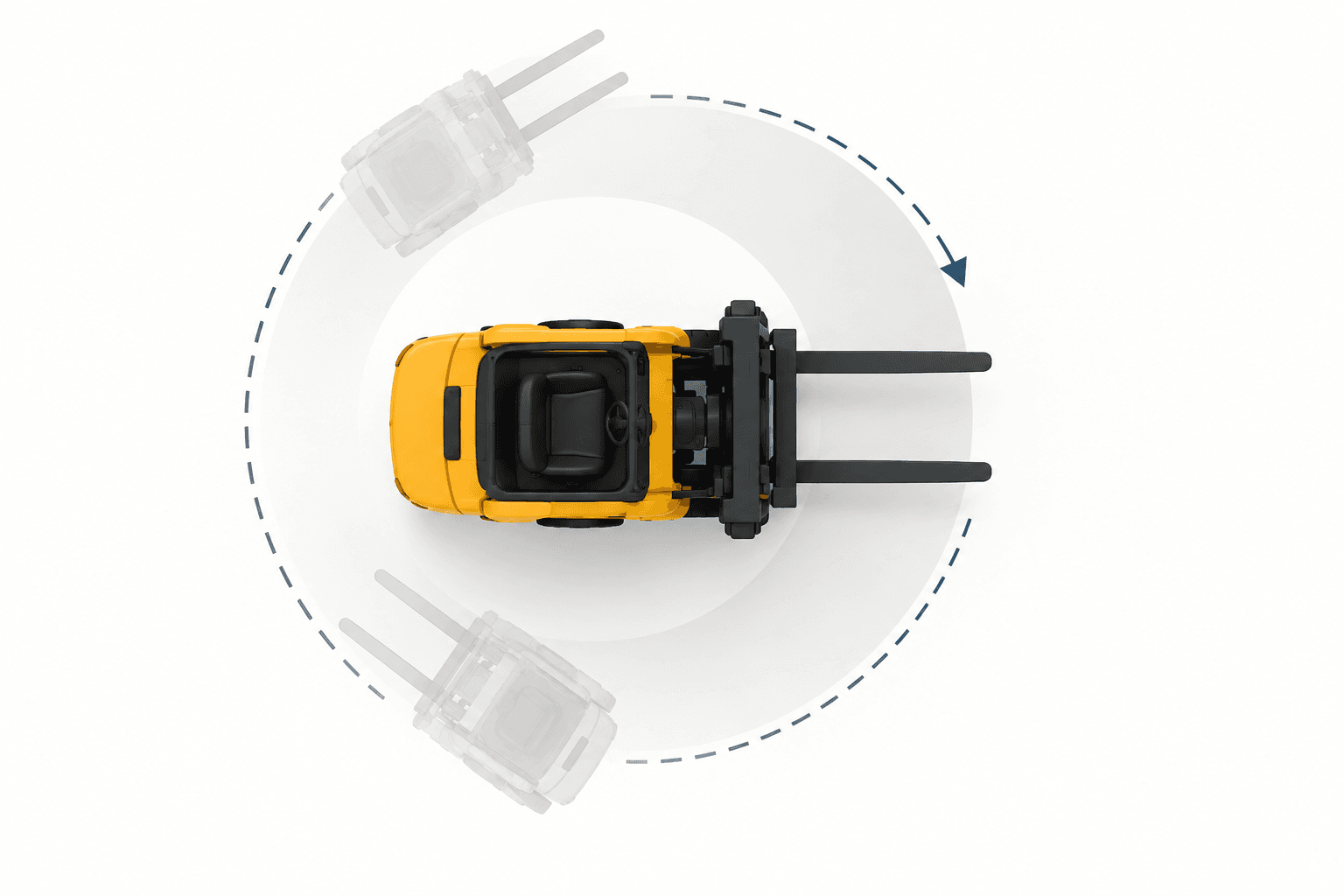
Forklift turning radius is the radius of the path a forklift follows while making a turn. In simple terms, it tells you how much floor space the forklift needs to change direction.
A smaller turning radius generally means the forklift can maneuver in tighter spaces. A larger forklift, longer wheelbase or different steering design may require more room.
However, one important point is often missed: forklift turning radius is not the same as the total aisle width required to handle and stack a pallet.
The actual space required also depends on forklift dimensions, load dimensions, pallet position, rack design and operational clearance.
Turning Radius vs Turning Circle
The terms forklift turning radius and forklift turning circle are sometimes used as if they mean the same thing.
Turning radius normally refers to the distance from the turning centre to a point on the forklift's turning path. A turning circle describes the complete circular space created by that movement.
For warehouse planning, the important question is not only, “Can the forklift turn?” It is, “Can the loaded forklift complete the required movement without contacting racks, pallets, walls or other equipment?"
Outside and Inside Turning Radius
During a turn, different parts of a forklift follow different paths.
The inside wheels travel around a smaller curve while the outside part of the forklift moves through a larger path. Warehouse planners therefore need to think about the complete turning envelope, especially the outer rear portion of a counterbalance forklift.
This rear movement is important because forklifts commonly steer from the rear. An operator may clear an obstruction with the forks while the back of the truck swings closer to a rack or column.
Turning Radius vs Right-Angle Stacking Aisle Width
This is one of the most important differences to understand.
A forklift turning radius tells you about the truck's turning geometry. Right-angle stacking aisle width tells you how much space is required for the forklift to approach a rack, make a 90-degree movement and place or retrieve a load.
Manufacturer guidance commonly treats these as separate specifications. Toyota, for example, recommends using the basic right-angle stacking measurement together with load length and additional clearance when estimating minimum aisle width.
So, when planning a warehouse, do not select an aisle width from the forklift turning radius alone.
Why Is Forklift Turning Radius Important in Warehouse Layout Planning?
The connection between forklift turning radius and warehouse layout planning is simple: every additional amount of maneuvering space takes up floor area that could otherwise be used for storage, movement or production.
But making aisles too narrow can create even bigger problems.
Aisle Width
A forklift needs enough room to travel through the aisle and enough additional space to turn into a pallet position.
If the forklift aisle width is too narrow, operators may need to make several forward-and-reverse corrections before reaching the correct position. Over hundreds of pallet movements, those small delays can significantly affect productivity.
Rack Placement
Warehouse racks should not be positioned according to forklift width alone.
A truck that is physically 1.2 metres wide may require considerably more space when it turns with a pallet. Rack-to-rack distance therefore needs to account for the full operating movement.
The load matters as well. A long pallet extending in front of the forks changes the space required during a turn even though the forklift's published turning-radius specification itself has not changed.
Storage Density
There is always a balance between storage density and maneuvering space.
Wide aisles make forklift movement easier but use more floor area. Narrower aisles can increase rack capacity but may require equipment designed specifically for tight space.
This is why warehouse layout and equipment selection should happen together rather than as two separate decisions.
SKEGA's warehousing approach also focuses on keeping material movement efficient through solutions such as pallet trucks, stackers, scissor lift tables and material carts. Its Warehousing & Logistics page specifically addresses vertical space utilization, pallet movement and dock efficiency. Warehousing & Logistics solutions.
Safety and Productivity
Poor maneuvering space can increase repeated reversing, sharp steering movements, pallet damage and the risk of contact with racking.
It can also reduce visibility around intersections and create more interaction between forklifts and pedestrians.
A slightly wider operating area may appear to reduce storage capacity, but if it helps forklifts move smoothly and safely, the overall warehouse can perform more efficiently.
How Do You Calculate a Forklift's Turning Radius?
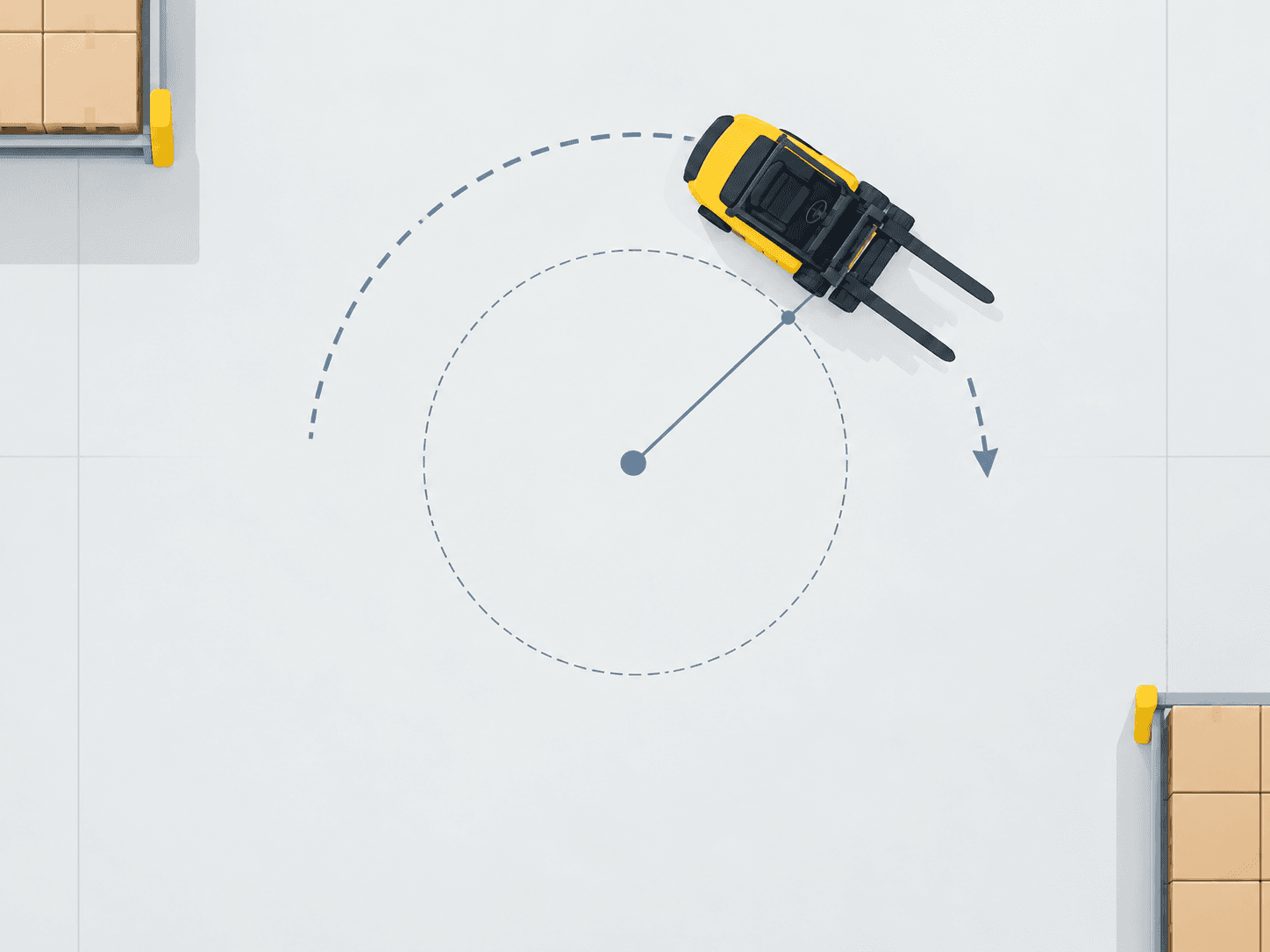
One of the most searched questions is how to calculate forklift turning radius.
The safest answer is: use the turning radius stated in the manufacturer's specification for the exact forklift model whenever possible.
There is no single universal forklift turning radius formula that accurately represents every forklift.
Wheelbase, steering angle, axle layout, overall length and truck design all influence the final number.
A simplified vehicle geometry calculation can help engineers understand turning behaviour, but it should not replace manufacturer data when designing an actual warehouse.
Forklift Aisle Width Calculation
For warehouse planning, aisle-width calculation is usually more useful than trying to calculate turning radius independently.
One manufacturer planning method uses:
Basic Right-Angle Stacking Width + Load Length + Operating Clearance = Estimated Minimum Aisle Width
Toyota gives an example of this approach and recommends adding clearance to the right-angle stacking and load measurements. It also advises users to verify the final requirement for the specific application.
Suppose, only as a planning example, a forklift specification gives a basic right-angle stacking requirement of 2,200 mm. The load projects another 1,000 mm and the application needs additional operating clearance.
The final aisle requirement would therefore be considerably greater than the forklift's physical body width.
The exact clearance should not be copied blindly from another warehouse. Load shape, rack protection, attachments, operator requirements and site conditions should all be considered.
Always verify final aisle dimensions and turning requirements against the exact forklift model's manufacturer specification and your actual operating conditions before finalizing the warehouse layout.
Forklift Turning Radius Diagram: What Should It Show?
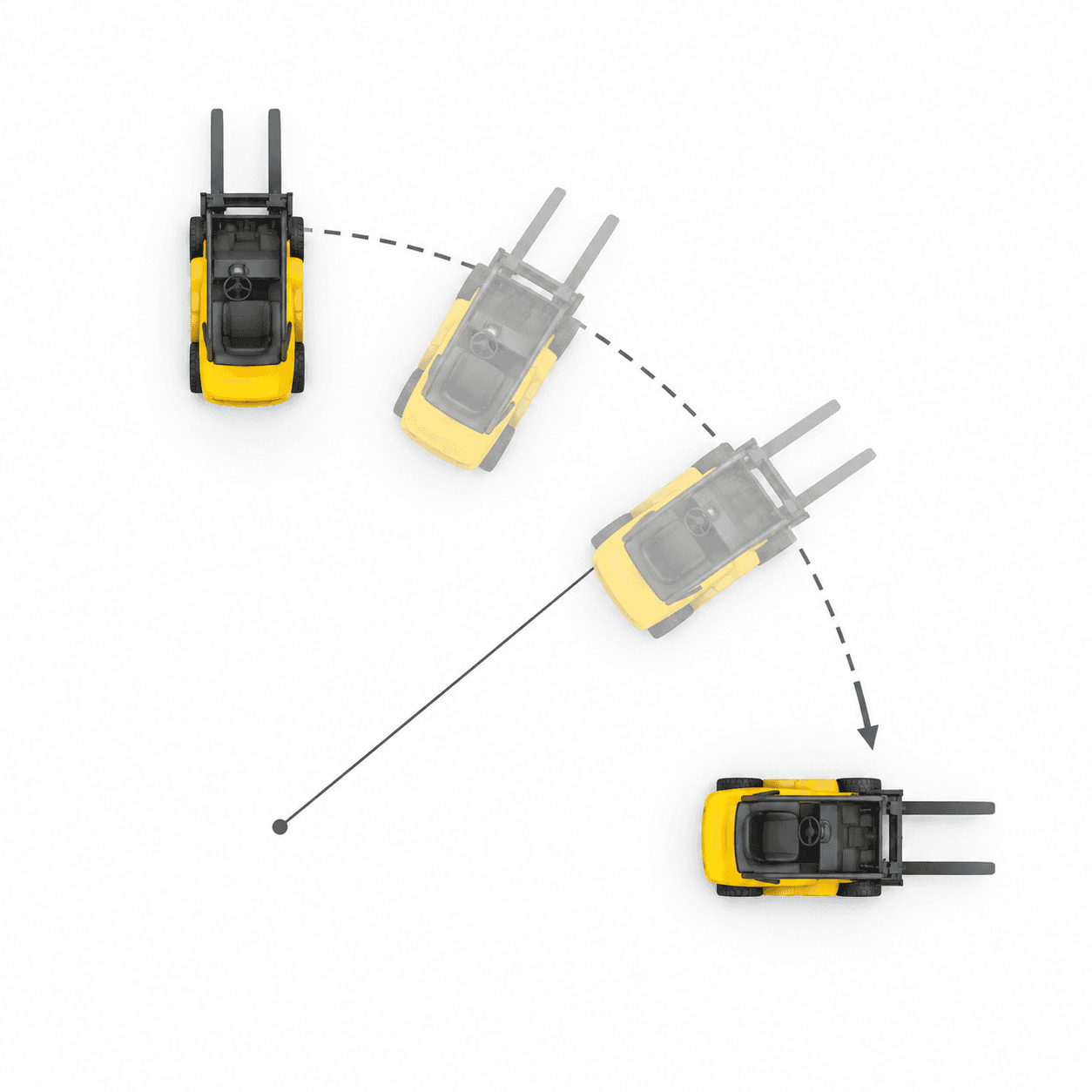
A forklift turning radius diagram can make warehouse planning much easier than looking at specifications alone.
A useful diagram should show the forklift body, turning centre, inside turning path, outside turning path, rear swing, forks, pallet, rack face and available clearance.
Warehouse planners who work in AutoCAD may also use a forklift turning radius CAD block or equipment drawing to test movements directly inside the proposed layout.
However, the CAD drawing should match the exact equipment being considered. A generic forklift turning radius CAD file can be useful during early planning but should not be treated as the final technical specification.
Likewise, when downloading a forklift turning radius PDF, check the model number and configuration before using the figures in a warehouse design.
Forklift Turning Radius vs Aisle Width
These two measurements are closely related but they answer different questions.
| Measurement | What It Tells You |
| Forklift width | Physical width of the truck |
| Forklift turning radius | Space used by the forklift during a turn |
| Turning circle | Complete turning envelope |
| Right-angle stacking aisle | Space needed to turn and handle a load at 90 degrees |
| Operating clearance | Additional working space around the maneuver |
So, how wide should a forklift aisle be?
There is no single correct width for every warehouse.
The minimum aisle width for a forklift depends on forklift type, truck dimensions, pallet dimensions, load overhang, turning geometry, racking layout and operating clearance.
A warehouse carrying short standard pallets may have different requirements from a plant moving long metal sections, machinery components or oversized products.
This is why simply searching for “standard forklift aisle width” and applying the first number you find can create problems.
What Factors Affect a Forklift's Turning Radius?
Several design features influence forklift maneuverability.
Wheelbase is an important factor. A longer wheelbase generally changes the truck's turning geometry and may require more room.
Overall forklift length also matters because more vehicle body has to move through the turn.
Steering design can make a major difference. Three-wheel electric forklifts, four-wheel forklifts and counterbalance forklifts do not all behave in exactly the same way.
Rear counterweight design can affect the area swept by the back of the forklift. Fork length, attachments and load dimensions also influence the real maneuvering envelope.
The forklift load centre is especially important for capacity and stability. While changing a pallet does not necessarily change the published unloaded turning radius of the truck, it can change the space needed to complete a loaded warehouse maneuver.
That distinction matters when comparing forklift specifications.
How Does Forklift Design Influence Maneuverability?
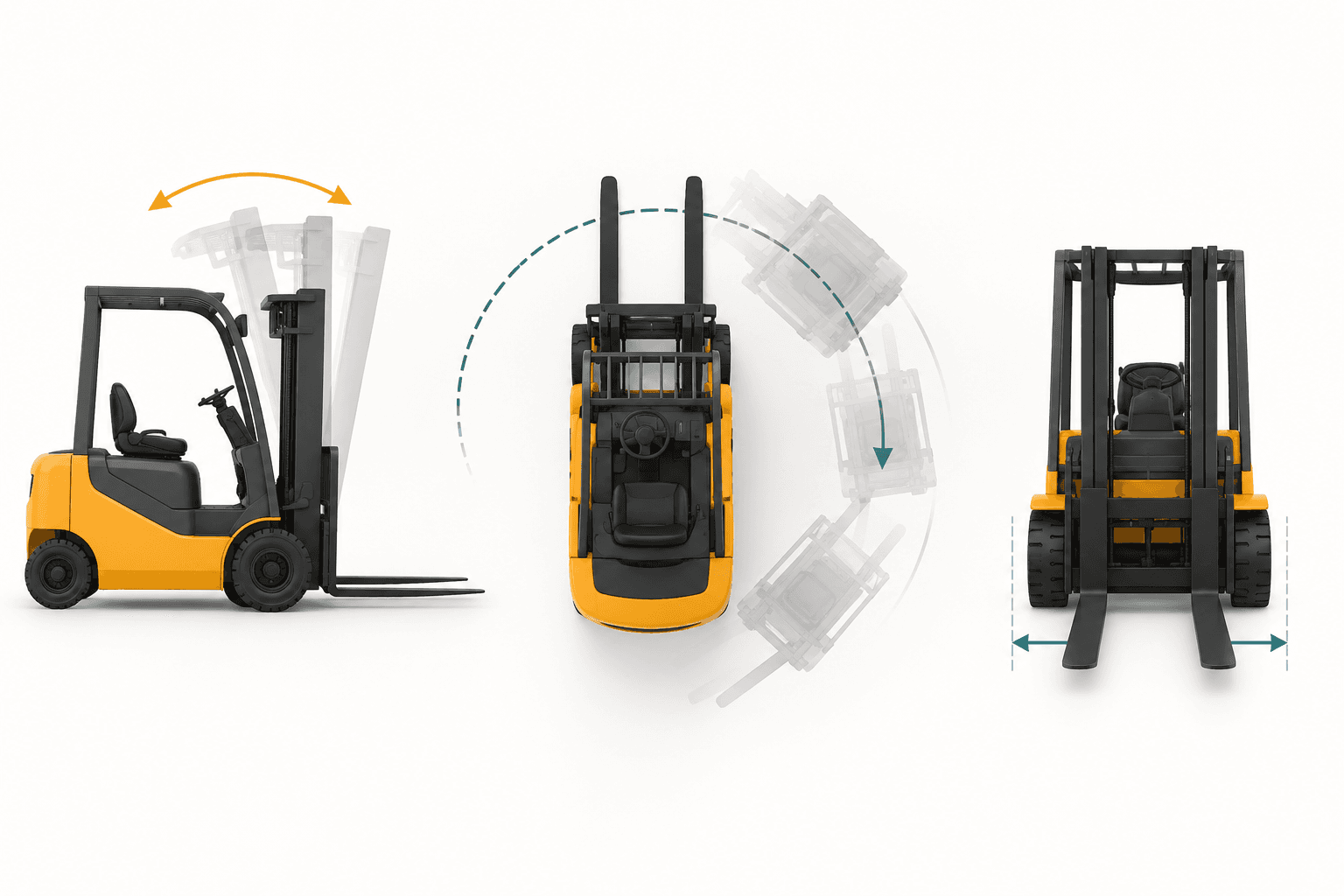
Different forklift designs solve different material handling problems.
A large diesel forklift may offer the power required for outdoor industrial applications but usually would not be selected simply because a warehouse has very tight aisles.
SKEGA describes its Hyundai Diesel Forklifts as equipment intended for rugged, demanding applications such as construction sites, shipping yards and industrial use. Hyundai Diesel Forklifts.
Indoor warehouses may instead consider compact electric equipment where lower noise, zero local exhaust emissions and easier maneuverability are valuable. SKEGA's Hyundai Electric Forklifts are positioned for warehouses, logistics centres and indoor applications and the company highlights their compact design for maneuverability. Hyundai Electric Forklifts
This is why the smallest forklift is not automatically the right forklift and the highest-capacity forklift is not automatically the best forklift. The right choice depends on load, lift height, aisle dimensions and working environment.
Forklift Types and Their Typical Turning Requirements
Different equipment categories have different maneuverability characteristics.
| Forklift Type | General Maneuverability | Common Application |
| Counterbalance forklift | Moderate | Warehouses, factories and yards |
| 3-wheel electric forklift | High | Tighter indoor areas |
| 4-wheel electric forklift | Moderate | General warehouse handling |
| Reach truck | High | High racking and narrower aisles |
| Narrow aisle forklift | Very high | High-density warehouse storage |
| VNA equipment | Specialized | Very narrow aisle operations |
| Articulated forklift | High | Narrow aisle applications |
These descriptions should be used for comparison, not as exact turning-radius values.
A counterbalanced forklift turning radius, electric forklift turning radius or reach truck turning radius can vary significantly between manufacturers and individual models.
Always check the exact specification sheet.
What Is the Turning Radius of a 2-Ton, 3-Ton or 5-Ton Forklift?
Searching for a 2 ton forklift turning radius, 3 ton forklift turning radius, 5 ton forklift turning radius or even the turning radius of an 18-ton forklift may give you many different answers.
That is because load capacity alone does not determine turning radius.
Two forklifts rated at three tonnes can have different wheelbases, overall lengths, counterweights, steering geometry and chassis designs.
Therefore, there is no trustworthy universal figure for the turning radius of every 3-ton forklift.
The same applies to 2-ton, 2.5-ton, 5-ton and higher-capacity machines.
Use capacity to narrow down the forklift category, then compare the actual forklift dimensions, turning radius, lift height, load centre and right-angle stacking specifications for each model.
Narrow-Aisle Forklift Turning Radius
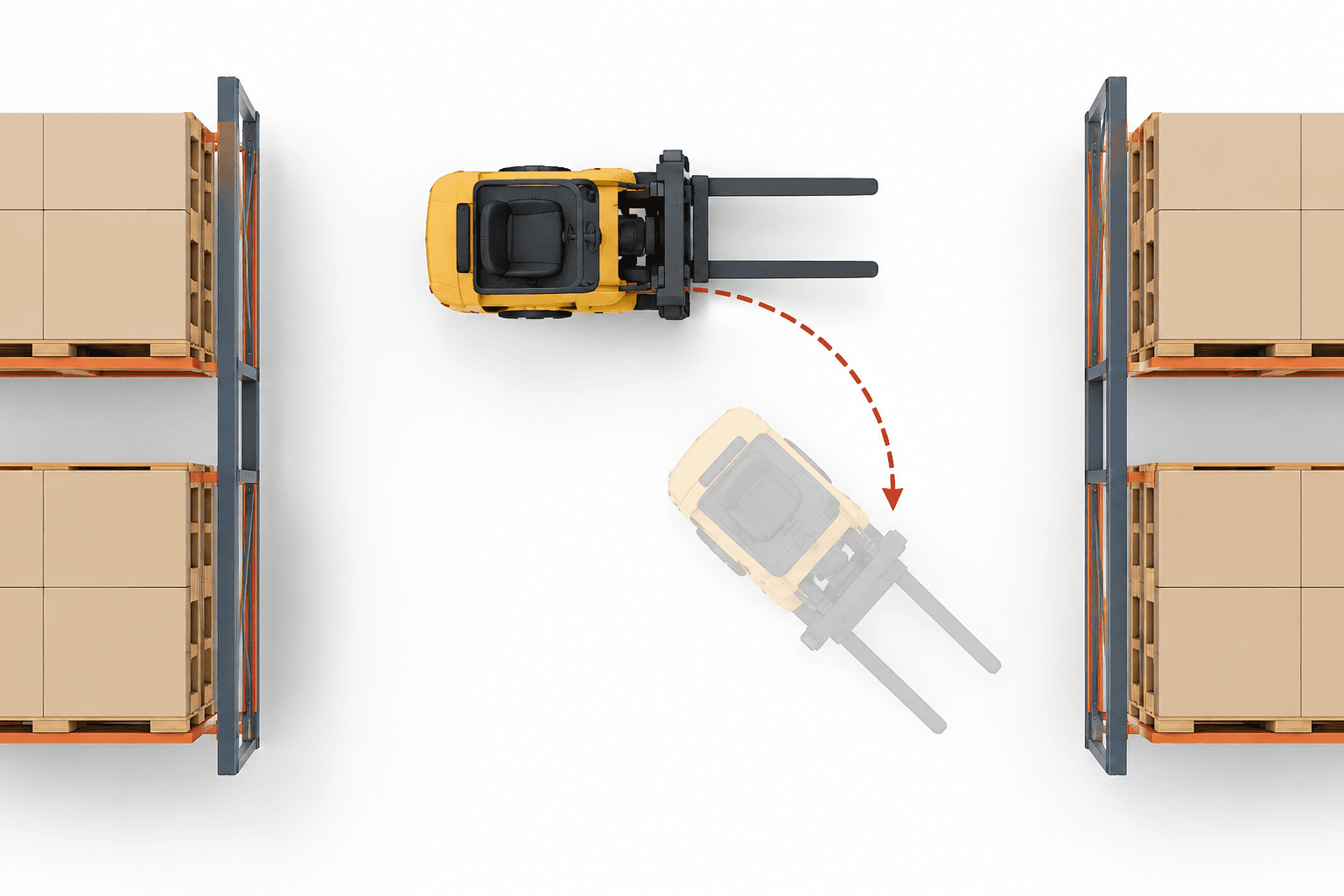
A warehouse with limited aisle space may need equipment designed specifically for compact operation.
Reach trucks, narrow-aisle forklifts, VNA equipment and stackers can all be considered depending on load, rack height and required movement.
SKEGA's Fully Electric Battery-Operated Stacker gives a useful example of why model-specific data matters. Its WONT-HFES1533 specification lists a 1,500 kg load capacity, 850 mm overall width and 1,760 mm turning radius. Fully Electric Battery-Operated Stacker
That does not mean every 1.5-ton stacker has a 1,760 mm radius. It means warehouse planners can use real equipment specifications to compare machines against their available floor space.
This is a much safer approach than planning around an assumed “standard” turning radius.
How Can You Optimize Warehouse Space for Forklifts?
Good warehouse optimization begins with the load rather than the forklift.
Know the pallet dimensions, load weight, load centre and required lift height first. Then determine what type of equipment can safely handle those loads.
The next step is to compare that equipment against available aisle width, rack spacing, cross-aisles, doors, columns and staging areas.
Do not forget row ends. A forklift may perform well inside a working aisle but still struggle when turning from a narrow cross-aisle into that row.
For shorter horizontal pallet movement where high-level stacking is not required, other material handling equipment may also be useful. SKEGA's pallet truck range is designed for moving palletised goods across warehouses and factories. Pallet Truck
Choosing equipment around the job rather than forcing one machine to perform every task can make warehouse movement simpler.
Forklift Size Guide: How to Choose the Right Forklift Size
Forklift size should never be selected from load capacity alone.
A useful Forklift Size Guide by Application should consider load capacity, load centre, lift height, mast height, forklift width, forklift length, fork dimensions, turning radius, right-angle stacking requirement, floor conditions, power source and operating hours.
Understanding forklift height is particularly important where doors, mezzanines, low ceilings or overhead structures are present.
You may have enough floor space for the truck but insufficient clearance for the mast.
Similarly, forklift width may determine whether the equipment can travel through a doorway while turning radius determines whether it can work comfortably after entering the warehouse.
SKEGA provides a wider range of material handling equipment, including forklifts, stackers, pallet trucks and other warehouse movement solutions, allowing equipment to be selected according to the application rather than capacity alone. Material Handling Equipment
Forklift Turning Radius Guide for Safe Operations
Turning space is not only a layout issue. It also influences everyday operating behaviour.
Operators need clear turning zones and enough space to account for rear-end swing. Loads should be handled according to equipment instructions and operators should avoid unnecessary sharp movements in congested areas.
Warehouse intersections also need particular attention because forklifts, pedestrians and other equipment may enter the same area from different directions.
A technically possible turn is not automatically a comfortable working turn.
Where warehouse dimensions are unusual, an equipment supplier should review the actual operating conditions. SKEGA's services include equipment customization, maintenance, repair and after-sales support for material handling applications. SKEGA Equipment Customization and Services
Warehouse Planning Checklist Before Selecting a Forklift
Before finalizing equipment or rack spacing:
- Measure the available rack-to-rack aisle width; record pallet length, width and maximum weight; confirm the required lift height and load centre; check forklift overall width and length; obtain the manufacturer's turning-radius and right-angle stacking specifications; consider attachments and load overhang; check door, ceiling and mast clearances; review cross-aisles and row-end turning space; allow suitable operating clearance; consider pedestrian movement; test the proposed layout where possible; and verify the final arrangement with the equipment supplier or relevant technical professional.
Taking these measurements before purchase is easier than changing the warehouse after equipment arrives.
Frequently Asked Questions About Forklift Turning Radius
Q:1 What is forklift turning radius?
A - Forklift turning radius is the amount of space a forklift needs to turn around a fixed centre point. It is commonly provided in the equipment manufacturer's specification and helps warehouse planners understand how easily the forklift can maneuver through the facility.
Q:2 How do you calculate a forklift's turning radius?
A - Although turning geometry can be calculated mathematically, warehouse planners should normally use the manufacturer-published turning radius for the exact forklift model. Different wheelbases, steering systems and dimensions mean there is no single universal formula suitable for every forklift.
Q:3 What is a good turning radius for a forklift?
A - There is no universal “good” forklift turning radius. A good turning radius is one that allows the selected forklift and its load to complete the required movement within the available warehouse space while maintaining suitable operating clearance.
Q:4 How much space does a forklift need to turn?
A - The required space depends on forklift turning radius, overall dimensions, load size and maneuver being performed. Right-angle stacking into racking usually needs more space than the turning-radius figure alone suggests.
Q:5 What is the standard forklift turning radius?
A - There is no single standard forklift turning radius. It varies according to forklift type, capacity, wheelbase, steering configuration and manufacturer.
Q:6 What is the turning radius of a 3-ton forklift?
A - A 3-ton capacity rating does not provide enough information to determine turning radius. Different 3-ton forklift models can have different turning radii. Check the specification sheet for the exact model being evaluated.
Q:7 How does forklift turning radius affect aisle width?
A - A larger turning envelope can increase the amount of space needed for maneuvering. However, aisle width should be planned using the forklift's right-angle stacking requirement, load dimensions and appropriate clearance rather than turning radius alone.
Q:8 What is right-angle stacking aisle width?
A - Right-angle stacking aisle width is the space a forklift needs to approach a rack, turn approximately 90 degrees and place or retrieve a load. Manufacturer guidance treats this as a separate and more application-specific measurement than turning radius alone.
Q:9 What is the 3-metre rule for forklifts?
A - The phrase “3-metre rule” is sometimes used in workplace procedures or discussions about forklift separation and safety, but it should not be treated as one universal forklift rule that applies everywhere. Requirements depend on the country's regulations, workplace traffic-management plan and operating conditions. Follow the rules applicable to your specific site.
Q:10 Is a reach truck better for narrow aisles?
A - Reach trucks are commonly designed for warehouse racking and tighter aisle environments, but suitability depends on load capacity, rack height, pallet dimensions and available aisle space. Compare the exact reach truck aisle width and turning specifications before making a decision.
Conclusion: Plan the Warehouse Around Real Forklift Specifications
Forklift turning radius may look like one small number on a specification sheet, but it can influence rack placement, warehouse aisle width, equipment selection and daily productivity.
The main lesson is simple: do not plan your warehouse around forklift width or load capacity alone.
Check the truck's overall dimensions, turning radius, right-angle stacking requirement, load dimensions and available maneuvering space together.
The same applies when choosing between a standard counterbalance forklift, electric forklift, reach truck, narrow aisle forklift or stacker.
A warehouse works best when the equipment and layout are planned as one system.
SKEGA provides material handling solutions for manufacturing, logistics, construction, warehousing and distribution applications, with equipment options and customization support designed around different operational requirements.