
How to Choose a Hydraulic Lift Table for Packaging Lines.
Picture a packing station where cartons arrive at knee height and the conveyor sits at waist height. Every pack means a bend, a lift and a twist. Do that a few hundred times a shift, and the line slows down while the strain builds up.
Introduction
Picture a packing station where cartons arrive at knee height and the conveyor sits at waist height. Every pack means a bend, a lift and a twist. Do that a few hundred times a shift, and the line slows down while the strain builds up.
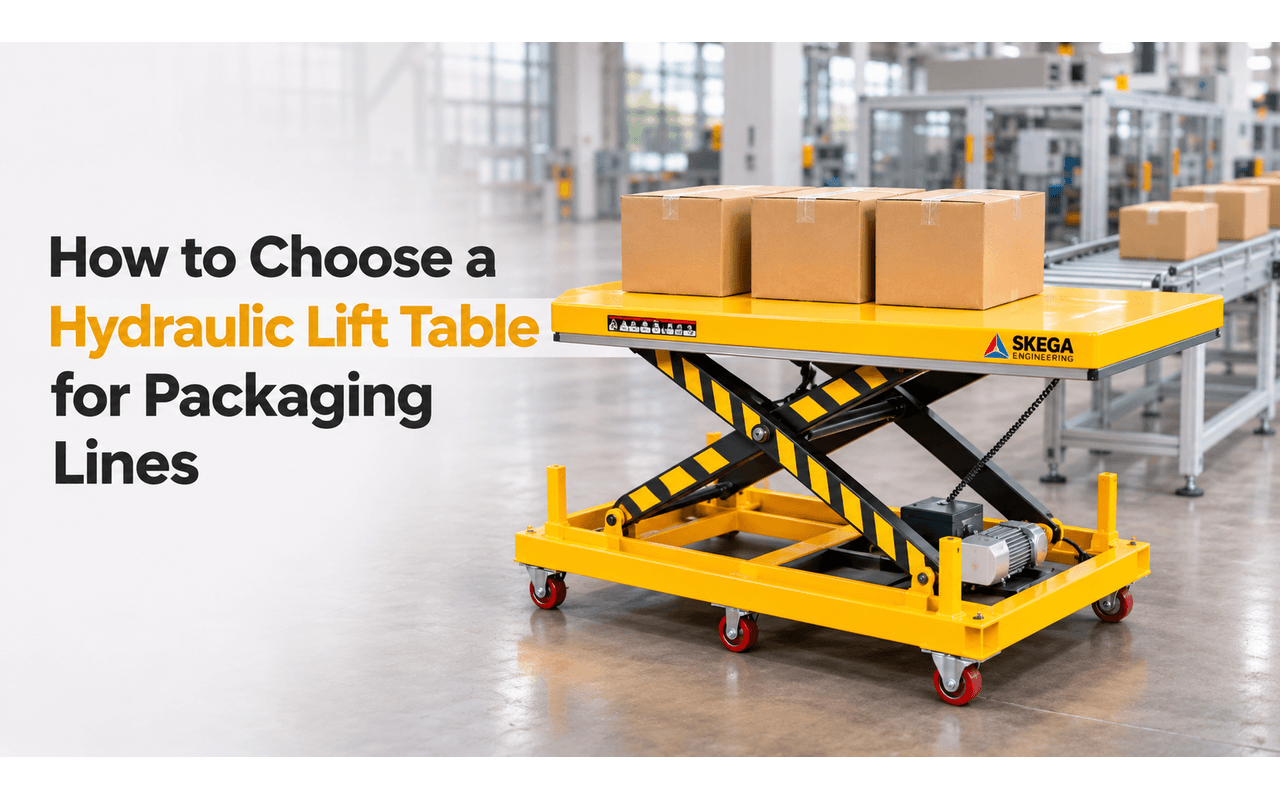
A hydraulic lift table for packaging lines fixes that height gap. Whether it is a hydraulic scissor lift table on wheels or one set into the floor, it raises and lowers the load to the level where the work happens. But capacity alone does not decide the right table. Platform size, lowered height, lifts per hour and the way it meets your conveyor matter just as much. This guide takes you through each check, step by step.
Quick answer: Choose a lift table by checking the total supported load, how the load sits on the platform, the platform size, the lowered and raised heights, how often it will lift, how the load is transferred and the safety features. Then confirm the final configuration with the manufacturer.
What Is a Hydraulic Lift Table and How Does It Work?
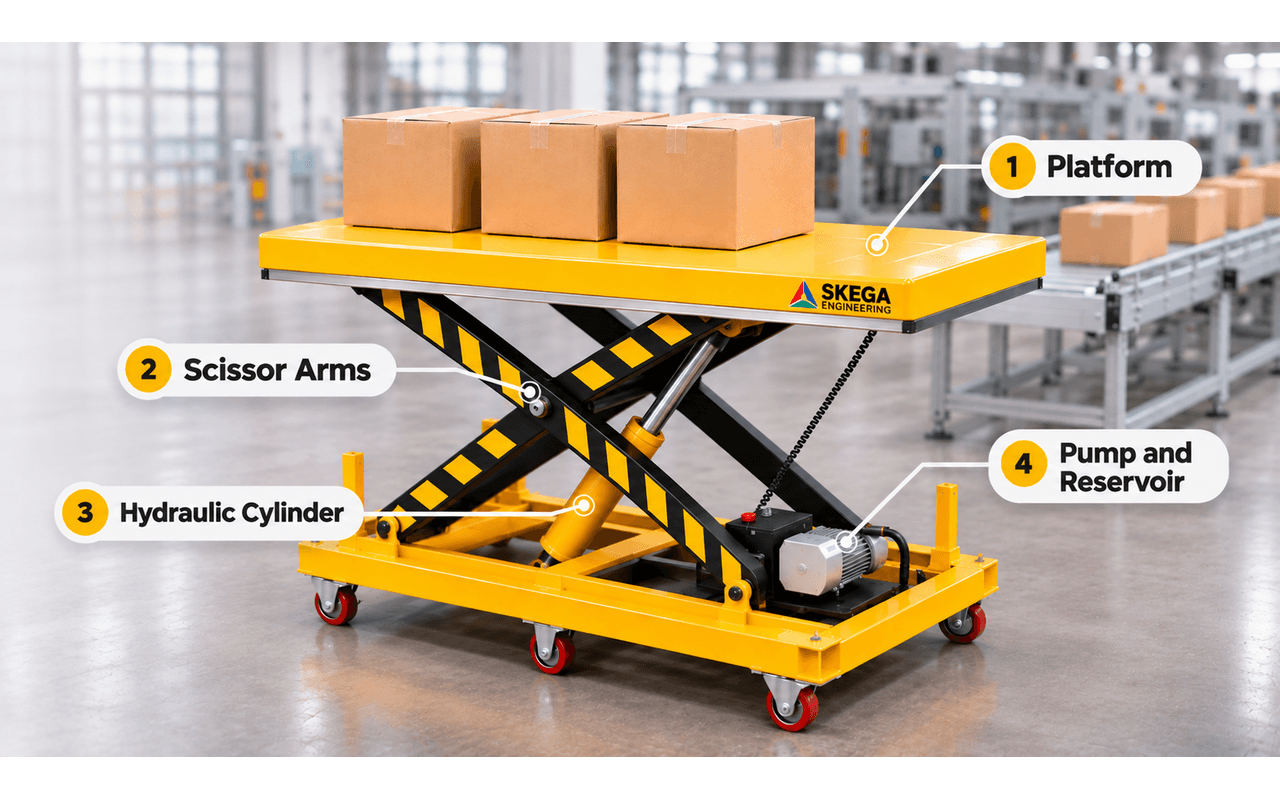
A hydraulic lift table is a flat platform raised and lowered by a hydraulic cylinder acting on a scissor mechanism. It brings the load to a steady working height, so people and conveyors do not have to adapt to the load.
What are the main components
- Platform: the top surface that carries the load.
- Scissor mechanism: the crossed arms that fold and open to change height.
- Hydraulic cylinder: pushes the scissor arms up.
- Pump: moves oil into the cylinder.
- Controls: a foot pedal or lever on manual tables, push buttons on powered ones.
How does a hydraulic lift table work, step by step?
- The operator starts the pump. On a manual table this is a foot pedal. On a powered table it is a motor.
- The pump pushes oil into the cylinder.
- The cylinder pushes the scissor arms, and the platform rises.
- A valve holds the oil in place, so the platform stays at the chosen height.
- To lower the table, the operator opens a release valve, and the oil flows back to the tank while the platform comes down in a controlled way.
How do manual and electric hydraulic systems differ?
These are not opposite categories. Both are hydraulic. The difference is how the pump is driven. In a manual system, the operator pumps with a foot pedal. In an electro-hydraulic system, an electric motor drives the pump. Skega's portable table, for example, is a manual foot-operated type, while its pit-mounted table is electro-hydraulic.
Where Are Hydraulic Lift Tables Used in Packaging Lines?
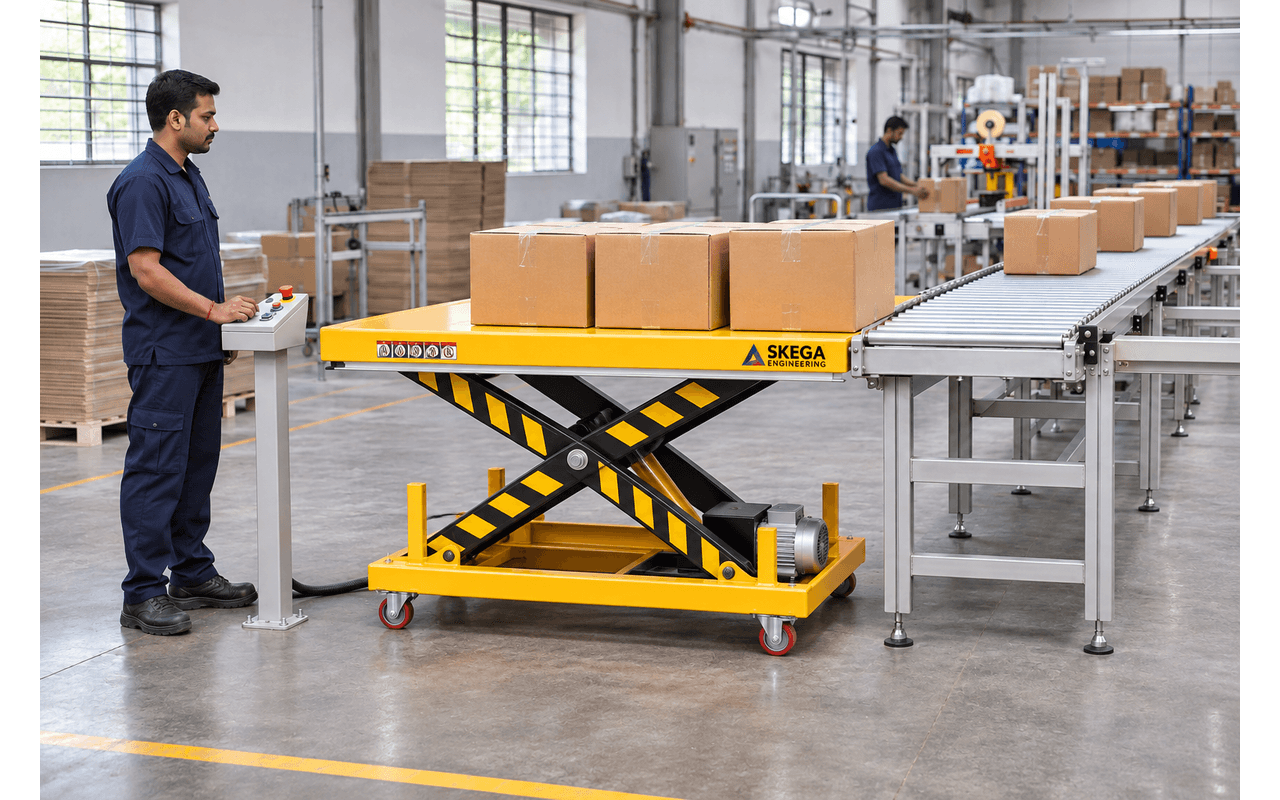
Feeding cartons and materials into packing stations: As cartons are used up, the stack gets lower. A lift table raises the stack so the operator keeps the same reach height.
Transferring products between heights: A table can match the height of two workstations or a compatible conveyor, so products slide across instead of being lifted.
Supporting pallet loading and unloading: A pallet placed on a lift table can be raised while it is being unloaded and lowered while it is being stacked. Many plants bring the pallet in with a pallet truck and place it on the table.
Handling finished packs before dispatch: A table can hold finished packs at a steady height for checking, labelling or wrapping, as long as the use is within the equipment's approved application.
Which Types of Lift Tables Suit Packaging Operations?
There is no single best type. The right one depends on how the table will be used.
| Lift table type | Application to evaluate | What to check |
| Manual mobile hydraulic table | Occasional lifting across work areas | Pumping effort, floor conditions, how often it lifts |
| Stationary electro-hydraulic table | Repeated lifting at a fixed station | Power supply, installation, duty rating |
| Pit-mounted table | Loading from floor level | Civil work, drainage, maintenance access |
| Low profile table | Loading where entry height must be low | The actual lowered height and loading method |
| Roller top table | Transfer to compatible conveyors | Load restraint, transfer gaps, control integration |
If your load arrives on a pallet truck and needs to be level with the floor, an electro-hydraulic pit-mounted scissor table is worth a look, as it sits flush with the floor and is built for frequent use.
How Do You Choose a Hydraulic Lift Table for Packaging Lines?
Work through these eight checks in order. Each one narrows the list.
1. Calculate the total supported load
Add up the product, the pallet or container and any attachments. Then look at how the load sits. A centred load puts the weight evenly on the platform. An uneven or off-centre load does not. Tell the supplier your real loading arrangement and ask them to confirm the table suits it. There is no single safety margin that fits every job, so let the manufacturer advise.
Capacity is rated in kg. A table rated 500 kg is a different choice from a 1,000 kg or a 2 ton (2,000 kg) table. For reference, Skega's portable table is listed in models from 500 kg to 2,500 kg.
2. Match the platform size to the load footprint
Note the length, width and support points of the load. Then check how much overhang is allowed with the manufacturer. Leave space around the table so people can reach and move safely. For reference, the Skega portable table has a platform of 1,200 mm by 600 mm.
3. Check the lowered height, raised height and lifting stroke
These are three different numbers, and people often mix them up.
- Lowered height: how high the platform is when fully down
- Raised height: how high it is when fully up
- Lifting stroke: the difference between the two
For example, the Skega portable table lists a minimum table height of 450 mm and a maximum lift height of 1,500 mm, which gives a lifting stroke of 1,050 mm. Match these to your pallet height, your conveyor height and the working height at the packing station.
4. Match lifting speed and duty cycle to production
Count the lifts per hour, the hours per shift and the peak demand. Think about loaded lifting time and lowering time too. Then confirm the duty rating from the manufacturer. Do not assume a table can run nonstop. A manual table suits occasional lifts. A table that lifts all day usually needs a powered system.
5. Choose stationary or mobile equipment
If the load needs to move between stations, a wheel-mounted table helps. If the work happens at one fixed point, a stationary table is steadier. For mobile tables, check the floor condition, clearances, wheel type and how the table is parked. Confirm where it may and may not be moved while loaded.
6. Check conveyor and roller top integration
Confirm the conveyor height, the transfer direction and how the product is supported. Look at roller spacing, load stops and the gaps at the transfer point. Also find out what control or interlock is needed. Adding rollers does not automatically make a table suitable for an automated line. Skega offers roller conveyors in gravity and powered versions, so you can plan the table and the conveyor together.
7. Assess the operating environment
Think about dust, moisture, cleaning routines and corrosion. These decide the material and the finish. Plants in food, beverage and agri-processing or in the pharmaceutical industry may have extra cleaning needs, so state them clearly in your enquiry.
8. Review installation and maintenance access
Check floor loading, anchoring, power supply and pit needs. Leave room for inspection and servicing. Ask for installation drawings before you approve the order. If the standard model does not fit your line, Skega lists equipment customisation under its services.
Which Safety Features Should Buyers Check?
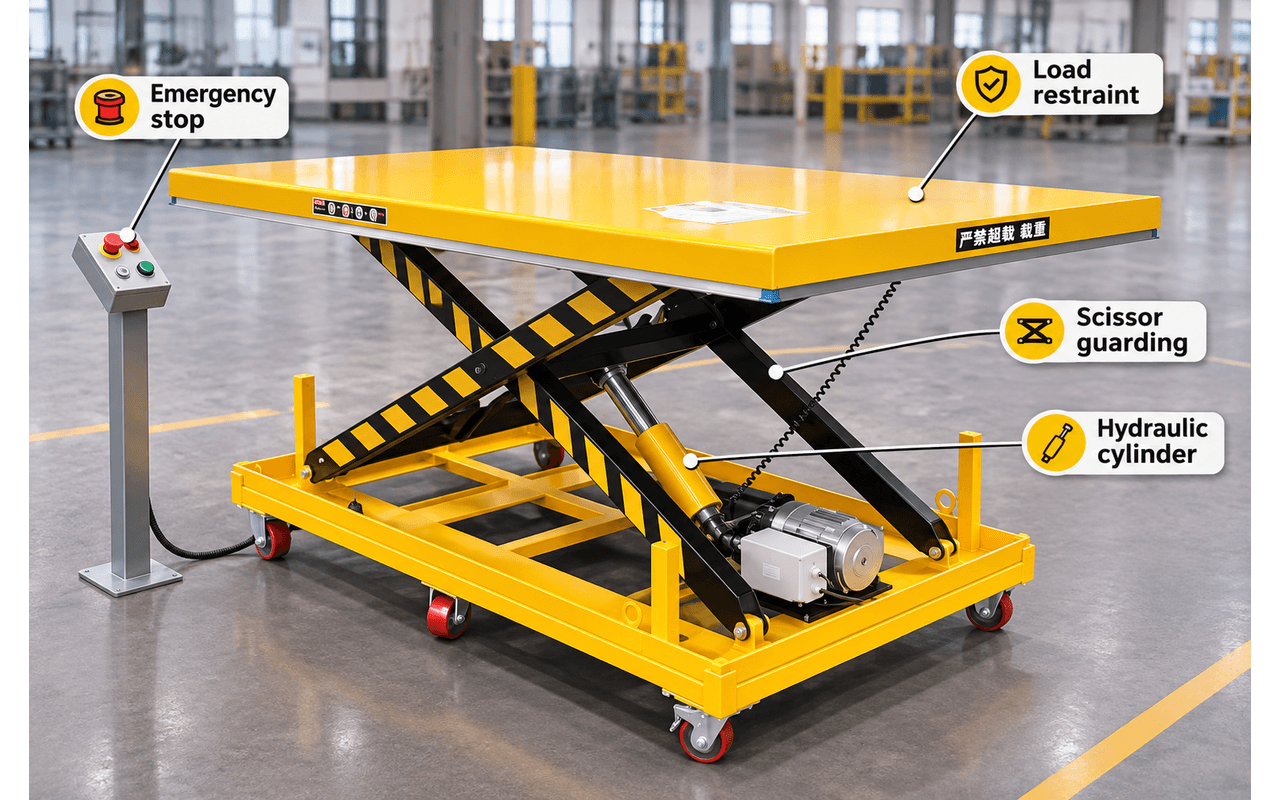
Safety claims should always be tied to the model you are buying. Ask the manufacturer for its documents, and have a qualified equipment specialist review them.
Load rating and operating limits: Look for a clear rating plate and model-specific instructions.
Controls and protective devices: Ask about emergency controls, protection for the hydraulic circuit and guarding around moving parts.
Servicing and isolation: Ask how the table is made safe for maintenance, and who is authorised to service it.
What Benefits Can Lift Tables Bring to Packaging Operations?
The benefits depend on the task and on choosing the right table. In suitable tasks, a lift table can mean:
- Less repeated bending
- More consistent positioning of cartons and materials
- Easier transfers between compatible work levels
- Better access during pallet loading and unloading
- Less need to adjust height by hand
These are practical gains. Productivity figures should only be quoted from measured results.
What Affects Hydraulic Lift Table Price in India?
Price depends on the specification, so compare quotations on the same basis.
| Cost factor | Why it matters |
| Capacity and platform size | Larger and stronger tables use more material |
| Lift range | A taller stroke needs a stronger scissor design |
| Manual or powered | Powered systems add a motor and controls |
| Roller tops, controls, custom work | Integration adds design and parts |
| Installation and support | Pit work, commissioning and service differ by supplier |
When you compare quotes, check that each one lists the same capacity, platform size, heights, controls and support terms
What Should You Ask a Hydraulic Lift Table Manufacturer?
Skega Engineering is an MSME manufacturer based in GIDC, Sachin, Surat, and you can read more on its about page. Whichever supplier you speak to, ask:
- Is the model suitable for our load distribution?
- What are its platform dimensions and height range?
- What operating frequency is it rated for?
- Can it work with our conveyor?
- What safety devices are included?
- What installation work is needed?
- Which documents, warranty terms and service support come with it?
What Maintenance Does a Hydraulic Lift Table Need?
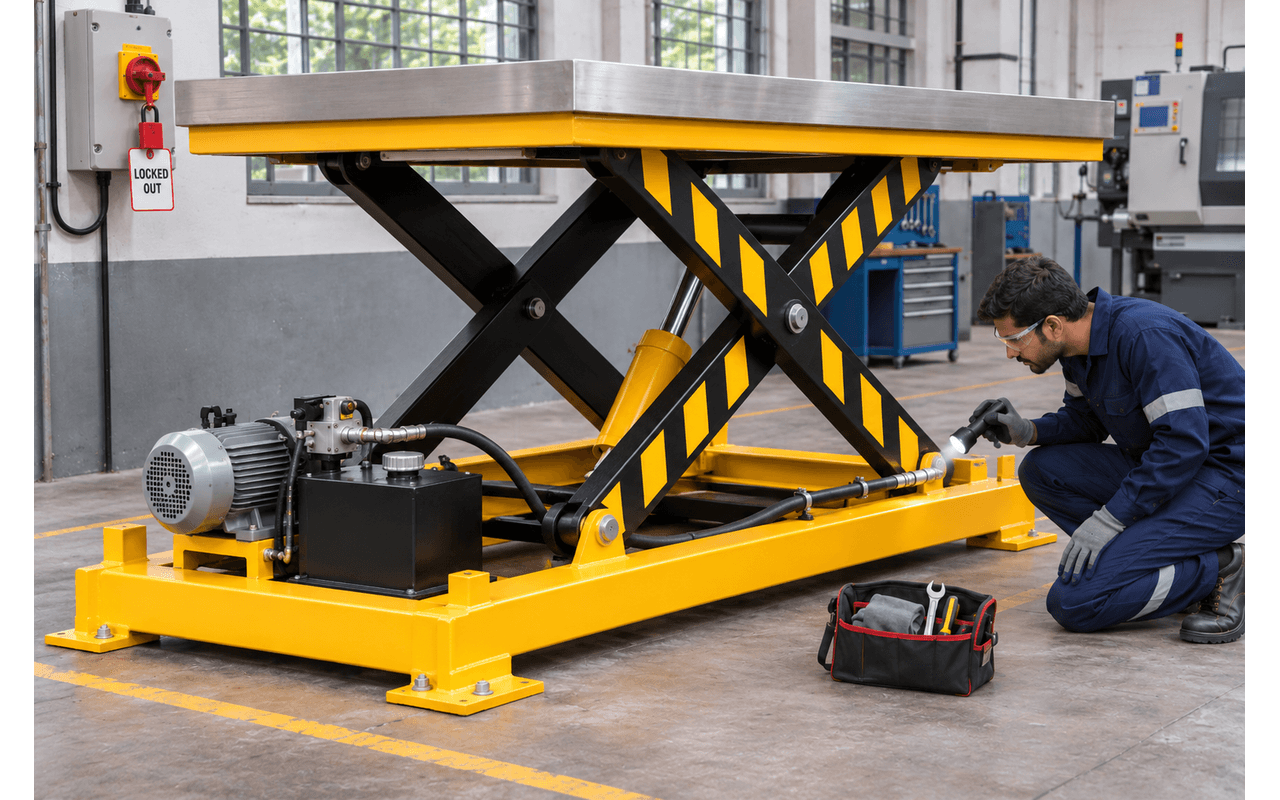
Check for hydraulic leaks, the controls, the platform condition, moving parts and, where fitted, the wheels. The inspection interval comes from the manufacturer's manual and your operating conditions. Warning signs, such as slow lifting, a sinking platform or unusual noise, need a check by qualified service staff. Do not attempt hydraulic repairs yourself.
Packaging-Line Lift Table Selection Checklist
| Requirement | Information to record |
| Maximum supported load | Product + pallet or container + attachments |
| Load distribution | Centred, uneven or changing |
| Load footprint | Length × width and support points |
| Required height range | Lowest and highest operating levels |
| Operating frequency | Lifts per hour and hours per shift |
| Transfer arrangement | Manual, pallet or conveyor transfer |
| Installation | Mobile, floor-mounted or pit-mounted |
| Environment | Dust, moisture, cleaning and temperature |
| Support | Documents, servicing and spare parts |
Frequently Asked Questions
Q1: What is a hydraulic lift table used for in packaging?
A - It holds cartons, pallets and materials at a steady working height. This helps with feeding packing stations, matching conveyor levels and loading or unloading pallets, so people bend and lift less.
Q:2 How do I choose the right hydraulic lift table capacity?
A - Add the product, pallet or container and attachments to get the total supported load. Note how the load sits on the platform. Then ask the manufacturer to confirm that the rated capacity suits your actual loading arrangement.
Q:3 Is a 500 kg hydraulic lift table suitable for my packaging line?
A - It depends on your total load, how it sits on the platform, the platform size you need and how often you lift. Check these against the manufacturer's specification, and do not choose by capacity alone.
Q:4 What is the difference between manual and electric hydraulic lift tables?
A - Both are hydraulic. A manual table is pumped by hand or foot. An electro-hydraulic table uses an electric motor to drive the pump. Manual suits occasional lifting, and powered suits repeated lifting at a fixed station.
Q:5 Can a hydraulic lift table connect to a roller conveyor?
A - Yes, with a roller top or a matching conveyor, but it needs planning. Check the heights, transfer gaps, load stops and any control or interlock needs. Do not assume rollers alone make a table suitable for an automated line.
Q:6 What dimensions should I send to a lift table manufacturer?
A - Send the load weight, the load length and width, the lowest and highest working heights, the conveyor or pallet height and the number of lifts per hour. Add the floor type and any space limits.
Share Your Requirements for an Application Review
The right lift table comes from matching the load, the platform, the heights and the duty to your line. Send your load weight, load dimensions, required height range and lifts per hour to Skega, and the team can review your application.
Ready to talk? Discuss your packaging-line requirements with Skega.