
Material Handling Equipment for FMCG Plants: A Practical Selection Guide.
Choosing material handling equipment for FMCG plants sounds simple, until you watch a normal day on the floor. Trucks arrive with raw materials and packaging. Pallets travel to the production and packing lines. Finished goods move to storage, and later out again for dispatch. Every one of these steps needs the right machine, and one wrong choice can slow the whole chain
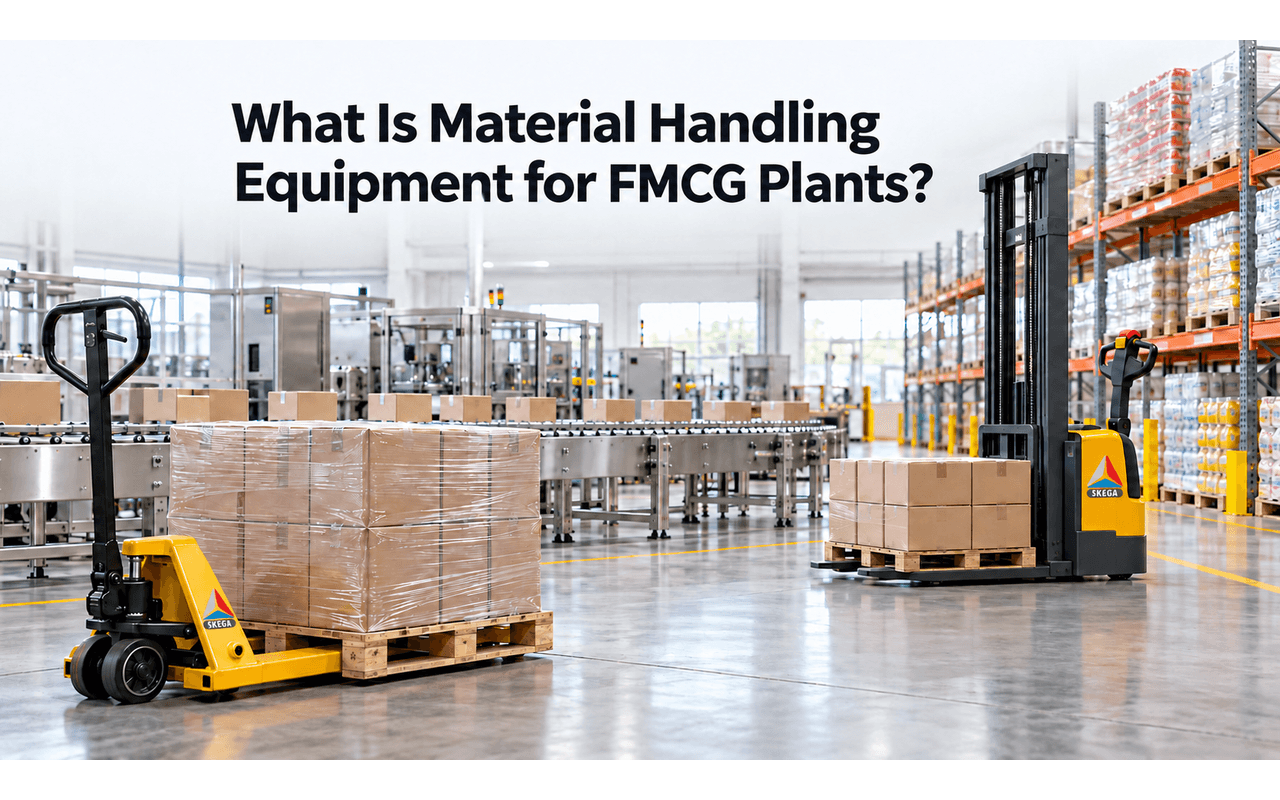
Choosing material handling equipment for FMCG plants sounds simple, until you watch a normal day on the floor. Trucks arrive with raw materials and packaging. Pallets travel to the production and packing lines. Finished goods move to storage, and later out again for dispatch. Every one of these steps needs the right machine, and one wrong choice can slow the whole chain.
That is why equipment should be chosen around your workflow, not around a product list. Load, route, storage layout and how often things move matter more than the name on the machine. The right material handling equipment suits your pallets, your aisles and your shifts. The wrong one creates slow trips, tired operators and waiting lines.
This guide is written for plant heads, production managers, operations heads and procurement teams. It explains what to check, which equipment fits which task and how to compare real operating cost. If you work in food, beverage or packaged goods, you may also like our page on material handling for food, beverage and agri-processing. Use this guide to build a shortlist for your own material handling solutions for FMCG and FMCG warehouse operations.
A packing line can be ready to run and still wait for materials. Finished cartons can be ready to leave and still sit near dispatch. Sometimes the delay comes down to how goods move between two points. Choosing material handling equipment for FMCG plants starts with understanding those movements: what travels, how far it goes and how often the journey repeats.
This guide explains what plant heads, production managers and procurement teams should check before investing in equipment for everyday FMCG operations.
What Is Material Handling Equipment for FMCG Plants?
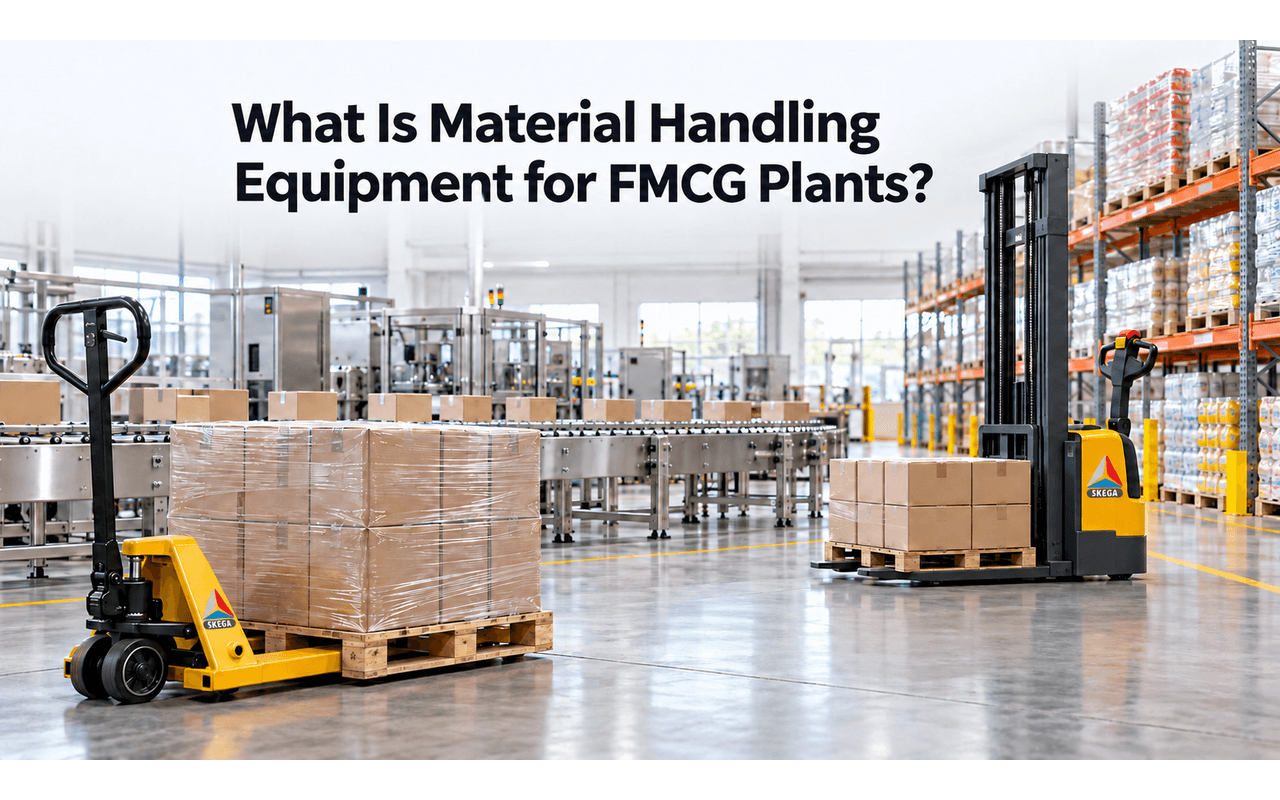
Material handling equipment includes machines and devices used to move, lift, stack and position materials. Within FMCG plants, it supports the movement of ingredients, packaging supplies and finished products between receiving, production, storage and dispatch.
Where Is Handling Equipment Used?
Typical applications include unloading incoming pallets, bringing packaging to production lines, transferring finished goods and retrieving stock for dispatch. Some tasks involve horizontal movement. Others need controlled lifting or stacking.
Start by separating these tasks. Material handling equipment for packaged goods must also suit the packaging: stable cartons, shrink-wrapped bottles and flexible bags do not behave identically during movement. Check how the complete load is supported and secured.
What Should You Check Before Selecting Equipment?
The best starting point is a short application sheet. Record the load, route, storage height, operating hours and environment before requesting quotations for FMCG warehouse equipment.
Load Weight, Dimensions and Pallet Compatibility
Record the heaviest complete load, including the pallet. Also measure its length, width and height. Note any overhang or uneven weight distribution.
Check pallet entry openings, fork length, fork spacing and clearance beneath the pallet. Some stacker designs have support legs that must also fit the pallet and storage arrangement. A suitable lifting capacity does not automatically mean a suitable physical fit.
Travel Distance and Movement Frequency
Count trips during a normal shift and a busy period. Measure the route rather than estimating it from the floor plan.
An occasional movement near a packing station presents a different requirement from repeated transfers between production and dispatch. Include waiting, turning and load positioning when assessing the work. A short route with frequent stops may still keep equipment occupied for much of the shift.
Lift Height, Racking and Aisle Space
Record the actual height at which the pallet must be placed. Check mast clearance beneath doors, beams and other obstructions.
Ask for the model’s capacity information at your required lift height and load centre. Load centre describes the position of the load’s centre of gravity relative to the fork face. Actual lifting capacity depends on the equipment configuration and load conditions; the headline capacity alone is insufficient. HSE training guidance specifically includes checking load weight and load centre against actual truck capacity.
Floors, Ramps and Loading Areas
Walk the entire route. Note broken surfaces, drainage channels, joints, thresholds, gradients and tight corners.
When selecting loading and unloading equipment for FMCG operations, explain how vehicles arrive and where unloading happens. Confirm dock equipment compatibility, surface loading and gradient suitability with the supplier. Do not assume equipment intended for a level indoor floor will suit a yard or ramp.
Hygiene, Temperature and Product Conditions
Tell the supplier about cold rooms, moisture, dust, cleaning chemicals and washdown exposure. Ask which parts of the proposed machine are suitable for those conditions.
Stainless steel construction alone does not establish complete washdown suitability. Wheels, bearings, controls and electrical components also need consideration. Keep handling equipment selection aligned with the plant’s hygiene procedures and movement restrictions between areas.
Battery Charging, Parking and Service Access
For powered equipment, discuss operating hours, charging time, charger requirements and battery care. Confirm whether the proposed arrangement can support every shift.
Plan where equipment will park and receive maintenance without blocking production or emergency access. Charging arrangements should follow the battery and charger manufacturer’s instructions.
Which Types of Material Handling Equipment Suit FMCG Operations?
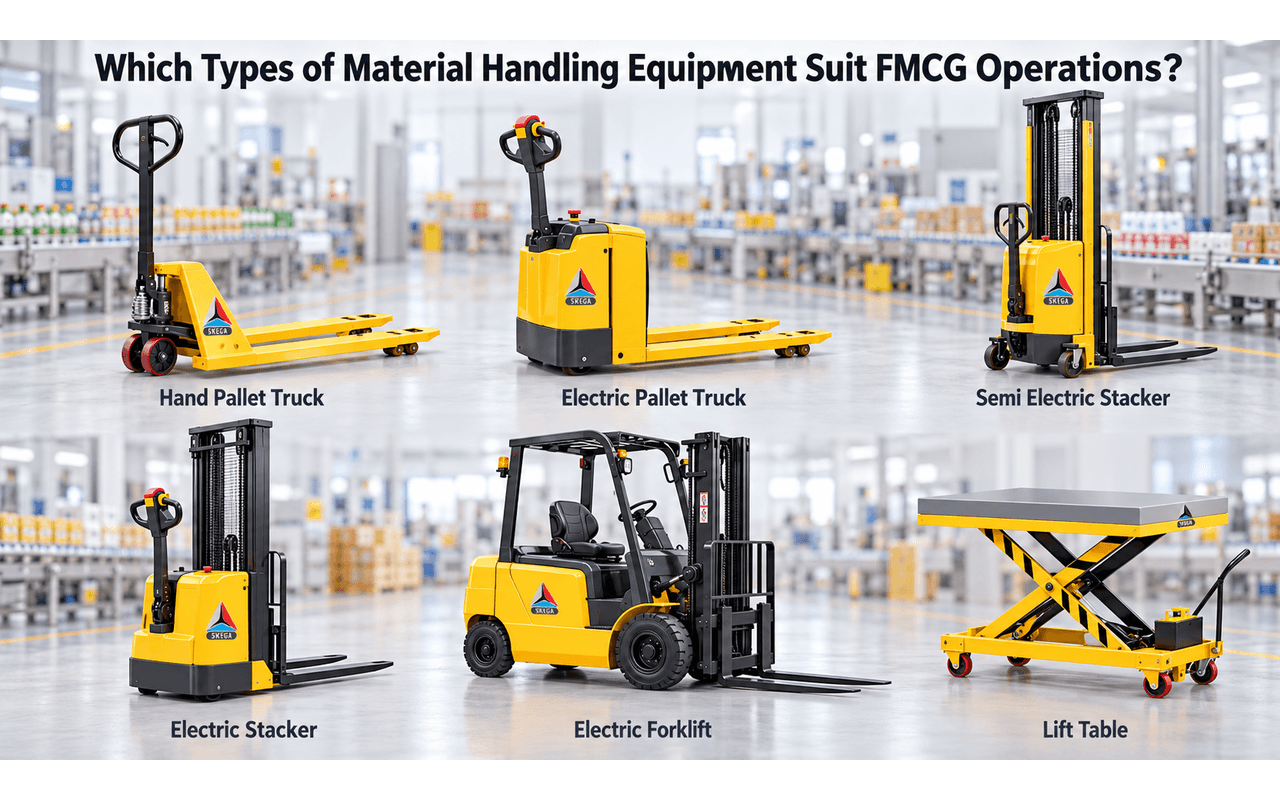
Different machines solve different handling problems. Use this comparison to prepare a shortlist, then verify the exact model against your application.
| Equipment | Main task | Conditions to assess | Limitations to check |
| Hand pallet truck | Horizontal pallet movement | Short routes and manageable manual effort | Pallet fit, floor condition and frequency |
| Electric pallet truck | Repeated horizontal movement | Route, trip frequency and operating hours | Battery duty, access and gradient suitability |
| Semi electric stacker | Stacking with partly powered operation | Lift frequency and travel requirements | Which functions are powered and pallet compatibility |
| Electric stacker | Powered pallet movement and stacking | Racking, aisle dimensions and duty cycle | Capacity at height and support-leg clearance |
| Electric forklift | Lifting, stacking and transport | Load configuration and working space | Capacity chart, turning space and environment |
| Lift table | Positioning loads at working height | Workstation layout and load footprint | Platform size, load distribution and guarding |
Hand Pallet Trucks and Hydraulic Pallet Trucks
Hand pallet trucks raise pallets sufficiently for horizontal transport. They are worth assessing for occasional transfers where the route and required manual effort are suitable.
During selection, compare fork dimensions, wheel material and pallet entry clearance. SKEGA’s hydraulic hand pallet truck page provides dimensions and construction information that can support this initial comparison. Check the selected model against your pallet rather than relying on its name.
Electric Pallet Trucks
Repeated horizontal movement is a reason to assess electric pallet trucks for FMCG warehouses. Powered travel changes the operator’s task, but the machine still needs to suit pedestrian traffic, stopping points and turning areas.
When comparing SKEGA’s electric pallet trucks with your requirements, request model-specific details about load capacity, battery duty and operating limits. Establish whether a pedestrian-operated or rider arrangement suits the route.
Semi Electric Pallet Stackers
“Semi electric” does not provide enough information to approve a purchase. Ask which functions are powered: lifting, travel or both in a particular configuration.
SKEGA lists hydraulic semi electric stackers, but procurement should confirm the selected model’s drive and lifting arrangement in writing. Also assess the manual effort involved in any unpowered function under actual site conditions.
Electric Pallet Stackers
Electric stackers for FMCG warehouses are candidates where pallets need regular lifting and placement into storage positions.
Before shortlisting an electric battery-operated stacker, compare its capacity at the required height, mast dimensions and pallet compatibility. Allow space for the operator and full manoeuvre. A machine fitting between racks does not establish that it can safely turn and place a loaded pallet there.
Electric Forklifts
Forklifts for FMCG warehouses should be assessed when the load, stacking arrangement or transport task calls for their capabilities.
The decision between a stacker and forklift depends on their specific designs. Review SKEGA’s electric forklift range alongside the available aisle space, load details and operator requirements. Confirm environmental suitability and any attachment requirements before ordering.
Lift Tables and Goods Lifts
A lift table positions materials at a working height. A goods lift transfers goods between designated levels. They serve different purposes and should have separate specifications.
At packing or inspection stations, a portable hydraulic scissor table may be worth assessing for load positioning. Check platform size, loading method and the manufacturer’s permitted use. Goods lifts additionally require an installation assessment covering landings, access protection and controls.
How Do You Match Equipment to Each FMCG Handling Task?
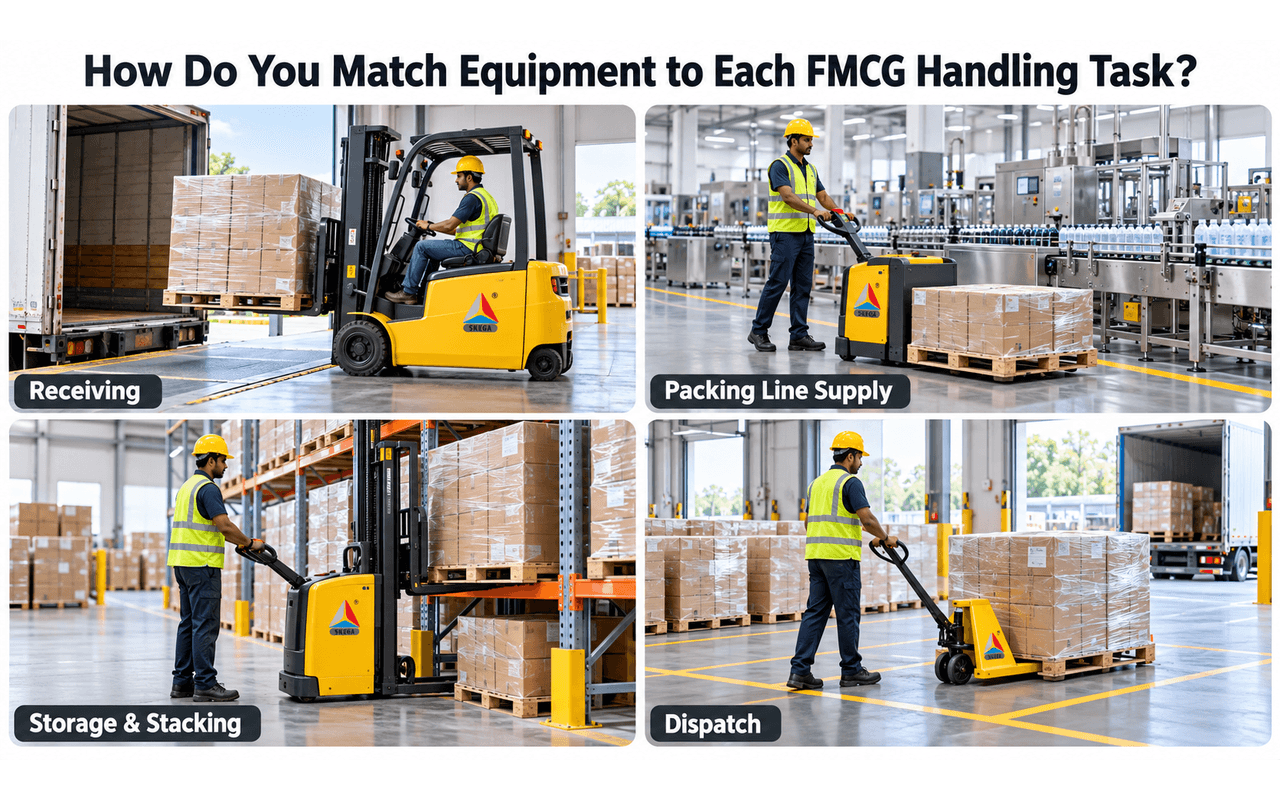
Build your shortlist around the task at each stage. This is useful both within plants and when choosing material handling equipment for FMCG distribution centres.
| Handling task | Equipment to assess | Main selection checks |
| Receiving palletised goods | Pallet truck or forklift | Vehicle access, unloading method and load |
| Supplying packing lines | Hand or electric pallet truck | Trip frequency, route and positioning space |
| Stacking finished goods | Electric stacker or forklift | Capacity at height, pallet and rack compatibility |
| Positioning workstation loads | Lift table | Platform dimensions and working height |
| Moving goods between floors | Goods lift | Installation, access protection and load dimensions |
| Preparing dispatches | Pallet truck, stacker or forklift | Dispatch peaks, staging space and loading method |
For example, imagine a plant where pallets move frequently from packing to dispatch but are never stacked along that route. An electric pallet truck would be a candidate to assess. If the same pallets must enter elevated rack positions, the lifting requirement changes the shortlist. This is an illustrative selection example, not a customer case study.
When Should an FMCG Plant Consider Automated Material Handling?
Consider automation when a clearly defined, repetitive movement is creating a measurable handling problem and the process is stable enough to support an engineered solution.
Which Tasks Could Be Automated
Possible applications include moving cartons between fixed stations, transferring pallets on repeat routes and connecting storage with production. Conveyor systems, automated vehicles and automated storage systems address different tasks.
For fixed transfer routes, SKEGA’s roller conveyors provide a relevant starting point for discussion. Confirm whether the proposed conveyor is powered or gravity-operated and what controls are included. A conveyor is not automatically a fully automated system.
What Must Be Ready First
Document load sizes, route availability, transfer points and expected throughput. Identify how the system will respond to damaged cartons, blocked routes or unavailable downstream equipment.
FMCG warehouse automation solutions also need a maintenance plan, operating responsibilities and a recovery procedure. Ask how any proposed system will interact with existing production equipment and software.
What Are the Benefits and Limitations?
An automated material handling system may reduce repeated manual transfers and support more consistent movement. Its value depends on the application.
Balance those potential benefits against installation costs, integration work, layout changes and maintenance needs. Measure the existing problem before estimating savings. Automating an unnecessary movement preserves the unnecessary movement.
How Do You Compare Purchase Price With Total Operating Cost?
Compare equipment over the same ownership period and expected workload. Include purchase, installation, energy, maintenance, wear parts, batteries and training.
Also consider what happens when the machine is unavailable. Can another unit cover its task? How quickly can parts and service reach the plant?
Ask about maintenance and after-sales support during quotation discussions so the operating plan includes more than the purchase price. SKEGA’s service page lists maintenance, repairs and support; confirm the scope applicable to your location and selected equipment.
Should You Buy New or Used Equipment?
Used material handling equipment for FMCG applications deserves the same application checks as new equipment, plus a condition assessment.
Have a competent person inspect the structure, forks, mast, hydraulics, wheels, brakes and controls as applicable. Review battery condition, service history, capacity markings and spare-parts availability. Confirm that manuals are available. A lower purchase price can become less attractive if repairs or downtime are substantial.
What Safety Checks Should Be Part of Equipment Selection?
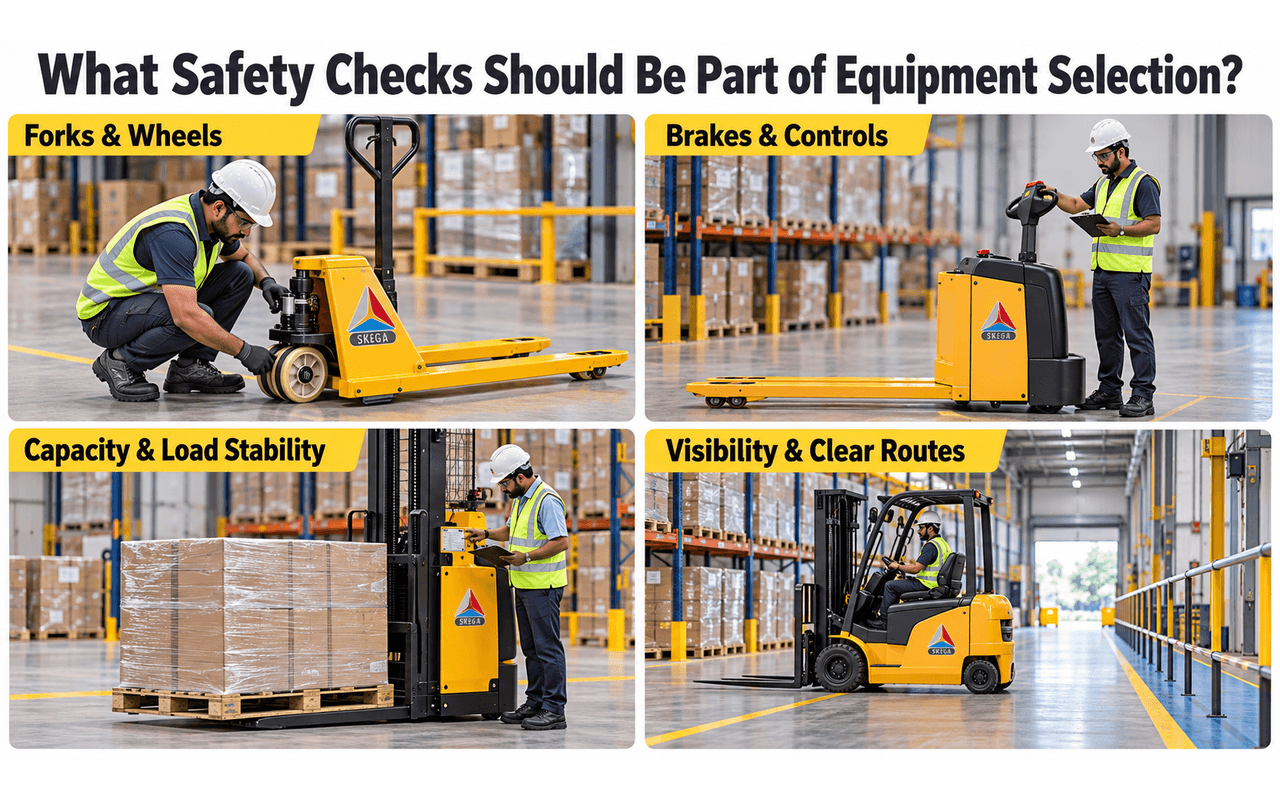
Safe material handling in FMCG warehouses depends on suitable equipment, trained operators and a controlled workplace. Review pedestrian routes, crossing points, visibility and parking alongside the machine specification.
Agree on pre-use checks covering relevant items such as forks, wheels, brakes, controls, leaks and safety devices. Establish how defects will be reported and equipment removed from service. HSE guidance includes operator inspection tasks and training on stability, loading and parking.
Check load security and overhead clearance before lifting. OSHA’s load-handling guidance also highlights adequate overhead space and caution near capacity limits.These are technical references, not a statement of Indian legal requirements. Follow applicable local requirements, the equipment manual and the plant’s safety procedures.
How Do You Choose a Material Handling Equipment Supplier in India?
Choose a supplier who can explain why a particular model fits your task. Share the application sheet and request a written proposal identifying assumptions and operating limits.
Ask for capacity information, pallet compatibility, service coverage, warranty terms and parts availability. Where practical, arrange a demonstration using representative loads and routes under controlled conditions.
When comparing material handling equipment suppliers in India, separate confirmed services from general sales claims. Ask who handles installation, operator instruction and breakdown support. Record the agreed responsibilities before placing the order.
Final Equipment Selection Checklist for FMCG Plants
Before approval, confirm:
- Complete load weight, dimensions and stability.
- Pallet openings, fork fit and support-leg clearance.
- Travel distance, trip frequency and peak workload.
- Required lift height and capacity at that height.
- Aisle, doorway and overhead clearances.
- Floor condition, gradients and loading arrangements.
- Hygiene, temperature and cleaning conditions.
- Charging, parking and maintenance arrangements.
- Operator training, inspections and service support.
- Written specifications and an application trial where practical.
Selecting material handling equipment for FMCG plants becomes clearer when production, operations, maintenance and procurement review the same requirements. Share your pallet weight, required lift height, movement frequency and layout when you contact SKEGA to discuss suitable equipment. A detailed brief gives the supplier a stronger basis for recommending a model.
Frequently Asked Questions
Q:1 What material handling equipment is used in FMCG plants?
A - Common options include hand pallet trucks, electric pallet trucks, stackers, forklifts, lift tables and conveyors. The appropriate combination depends on whether materials need horizontal movement, stacking, workstation positioning or transfer between fixed points.
Q:2 How do I choose between a hand pallet truck and an electric pallet truck?
A - Compare travel distance, trip frequency, load, floors and operator effort. Assess manual equipment for manageable occasional transfers and powered equipment for repeated movement, subject to an application review.
Q:3 What is the difference between an electric stacker and a forklift?
A - Both can lift and stack loads, but their designs, pallet compatibility, operating space and handling capabilities differ. Compare specific models against your load and storage arrangement rather than assuming one category is always better.
Q:4 What should I check before buying used handling equipment?
A - Check application suitability, maintenance records, structural condition, controls, battery health where applicable and capacity documentation. Include a competent inspection and an estimate of immediate repairs before comparing the final cost.
Q:5 When should an FMCG warehouse consider automation?
A - Consider it when repeated handling tasks have measurable constraints and stable loads, routes and transfer points. Confirm integration, maintenance and recovery arrangements before committing to an automated solution.
Q:6 What information should I provide for an equipment quotation?
A - Provide load weight and dimensions, pallet details, required lift height, aisle measurements, route conditions and operating hours. Include photographs or a layout and describe temperature, cleaning and charging requirements.