Why Multi-Scissor Lift Tables Are Essential for Heavy Equipment Manufacturing Units.
Picture this: a 400-kilogram transformer core needs to move through three stages of assembly. At one stage, it sits at knee height for base fitting. At the next, shoulder height for winding work. At the last, eye level for final inspection.
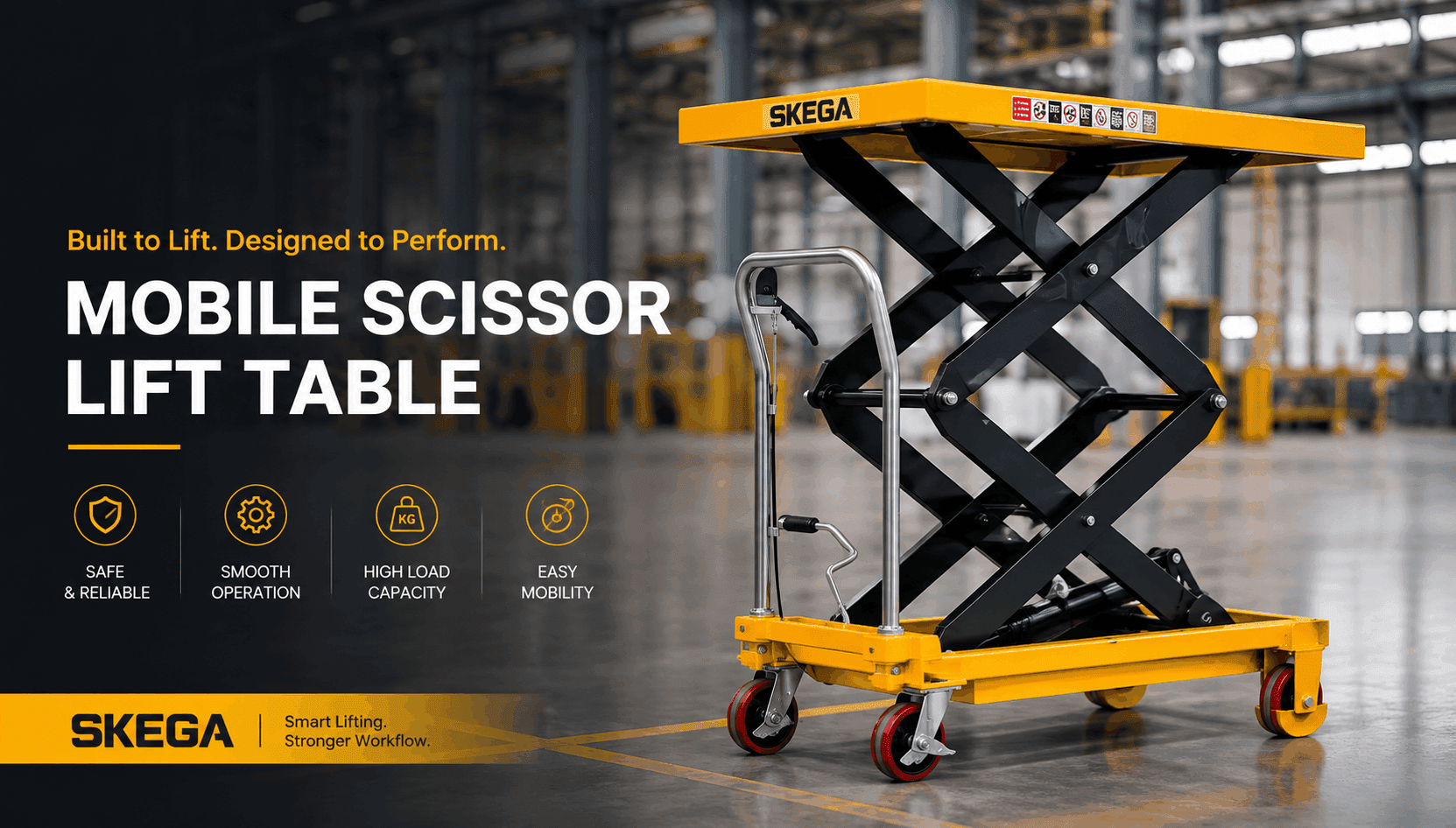
Picture this: a 400-kilogram transformer core needs to move through three stages of assembly. At one stage, it sits at knee height for base fitting. At the next, shoulder height for winding work. At the last, eye level for final inspection.
Now picture how that usually happens on a factory floor — a crane lifts it, sets it on a stand, someone bends over it, then it gets lifted again, repositioned, propped on blocks, checked, adjusted. Multiply that across every large component moving through your plant each day, and the real problem comes into focus.
Weight is rarely the hardest part of handling a heavy component. Height is. During assembly, inspection, or maintenance, that component may need to sit at several different working levels — and when workers repeatedly bend, reach, or wait on a crane just to make a small adjustment, a simple positioning task quietly turns into a production bottleneck.
This is exactly the gap that a multi-scissor lift table is built to close. For heavy equipment manufacturing units working with large, dense, and often awkward loads, industrial lifting equipment that can move a component precisely and safely to the height a process actually demands isn't a convenience — it's part of the production line itself. In this guide, we'll walk through what multi-scissor lift tables are, where they genuinely add value across industrial load positioning work, and how to think about choosing one for a heavy manufacturing environment.
Industrial Multi-Scissor Lift Table Applications
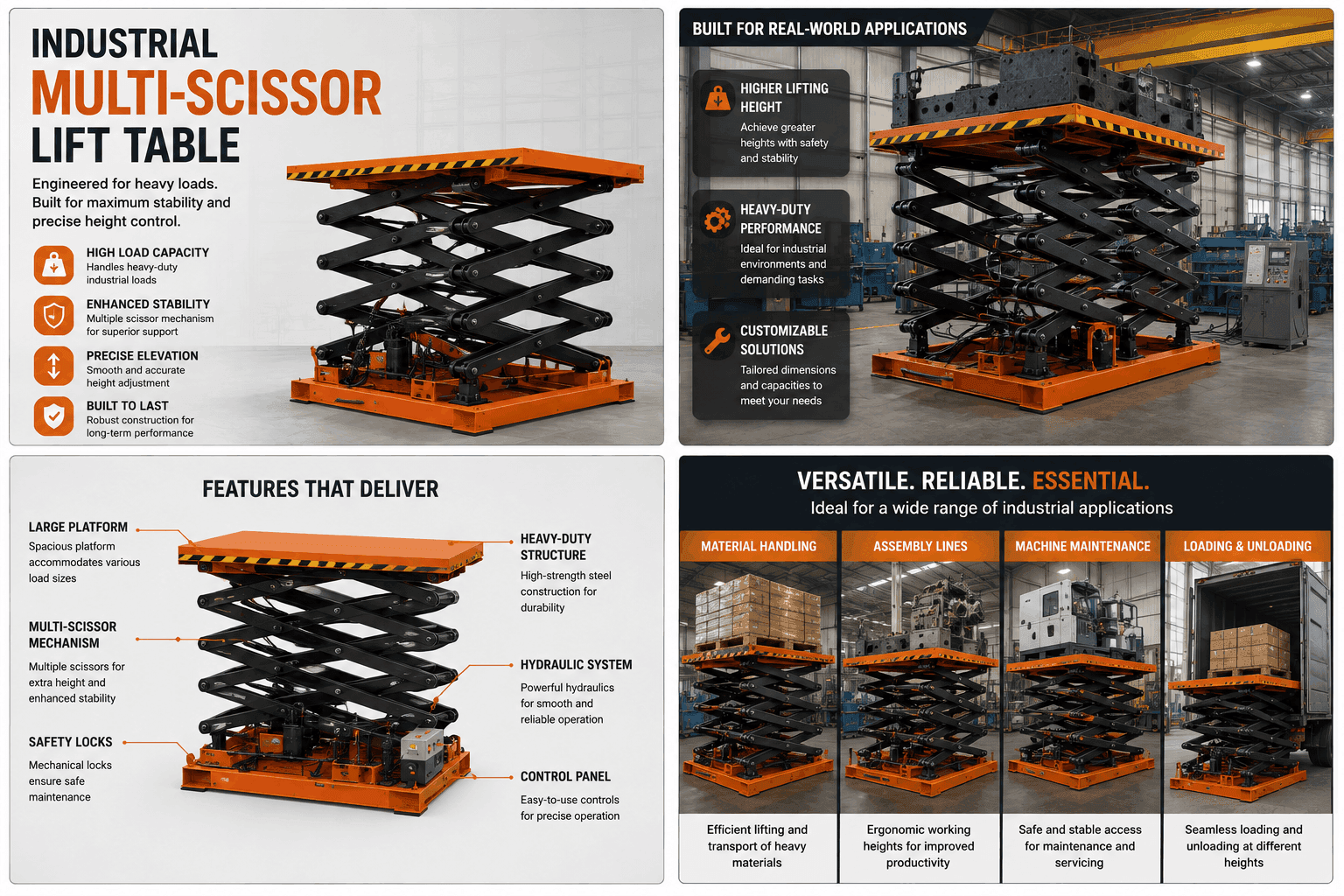
Multi-scissor lift tables use multiple vertically arranged scissor mechanisms to achieve greater lifting height than a conventional single-scissor configuration, while maintaining a relatively compact installation footprint. In heavy manufacturing, they're used to position machinery components, automotive assemblies, transformers, motors, dies, and other loads at the working heights required for assembly, inspection, and material handling.
Common applications include:
- Heavy component positioning
- Automotive assembly
- Transformer and motor manufacturing
- Die and mold handling
- Assembly-line integration
- Inspection and maintenance positioning
What Is a Multi-Scissor Lift Table and How Does It Work?
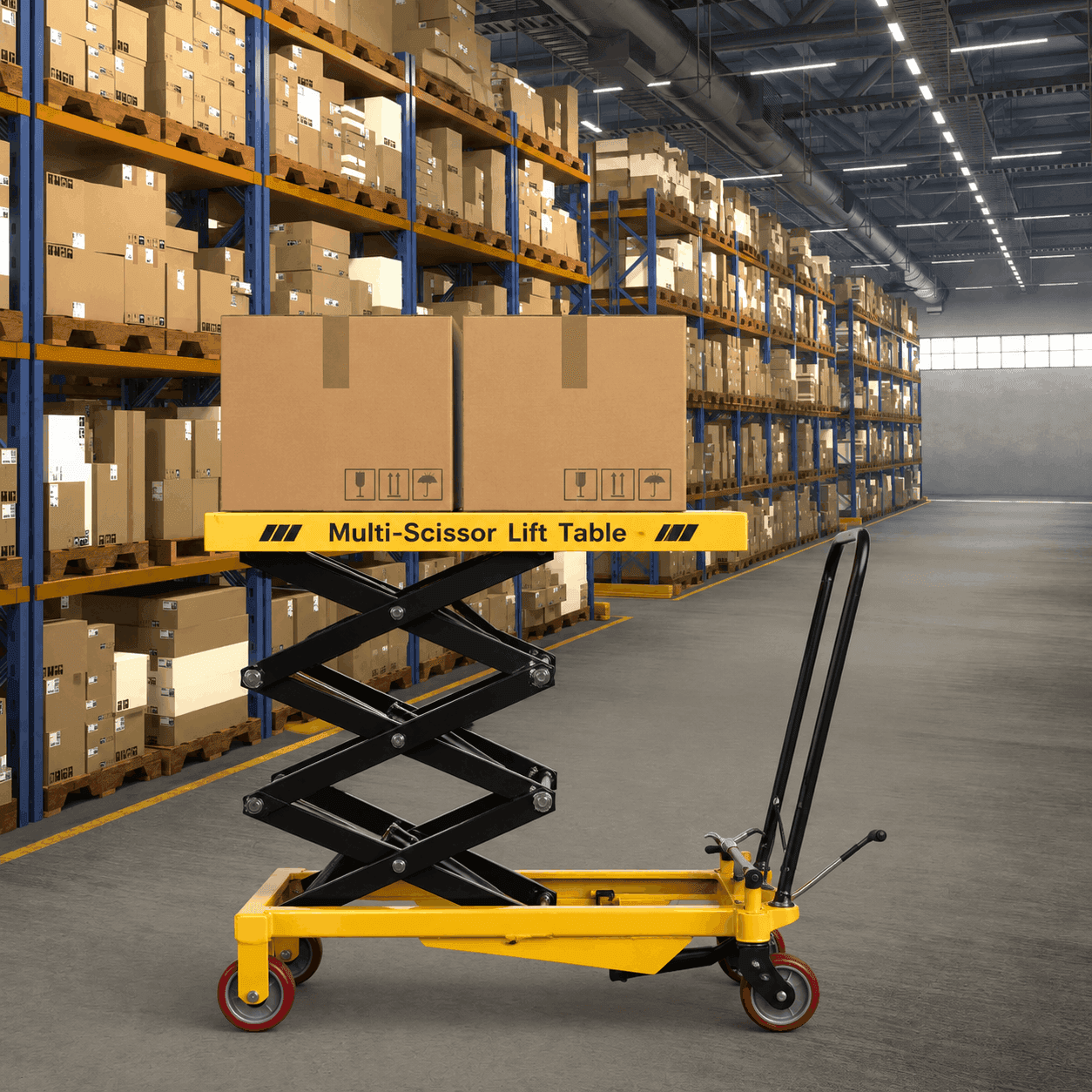
Multiple Scissor Stages for Greater Vertical Travel
A standard scissor lift table works on a simple pantograph principle: crossed support arms open and close as a hydraulic cylinder extends, raising and lowering the platform in a straight vertical line. A multi-scissor lift table stacks two or more of these scissor stages on top of one another.
Each additional stage adds to the total vertical travel the platform can achieve, without requiring the base of the machine to grow proportionally larger. The hydraulic system drives the stages together, so the platform still rises and lowers smoothly and stays level throughout its travel. The practical result is a machine that can reach considerably greater heights than a single-scissor unit, while still fitting into a comparatively compact footprint on the shop floor — which matters enormously in manufacturing cells where every square metre is already accounted for.
Single-Scissor vs Multi-Scissor Lift Tables
| Factor | Single-Scissor Lift Table | Multi-Scissor Lift Table |
| Scissor stages | Single | Multiple |
| Vertical travel | Standard | Greater |
| Installation footprint | Application-dependent | High vertical travel relative to footprint |
| Typical use | General load positioning | Higher-reach positioning |
| Manufacturing application | Standard work-height adjustment | Multi-level/high-reach operations |
It's worth being clear that a multi-scissor design isn't automatically the "better" choice — it's the right choice for a specific kind of problem. The appropriate configuration depends entirely on the load, the required lift height, the platform size, the duty cycle, and the nature of the application. A plant that only ever needs modest height adjustment may be perfectly served by a single-scissor table; a plant handling tall assemblies or multi-level access needs will lean toward a multi-scissor design.
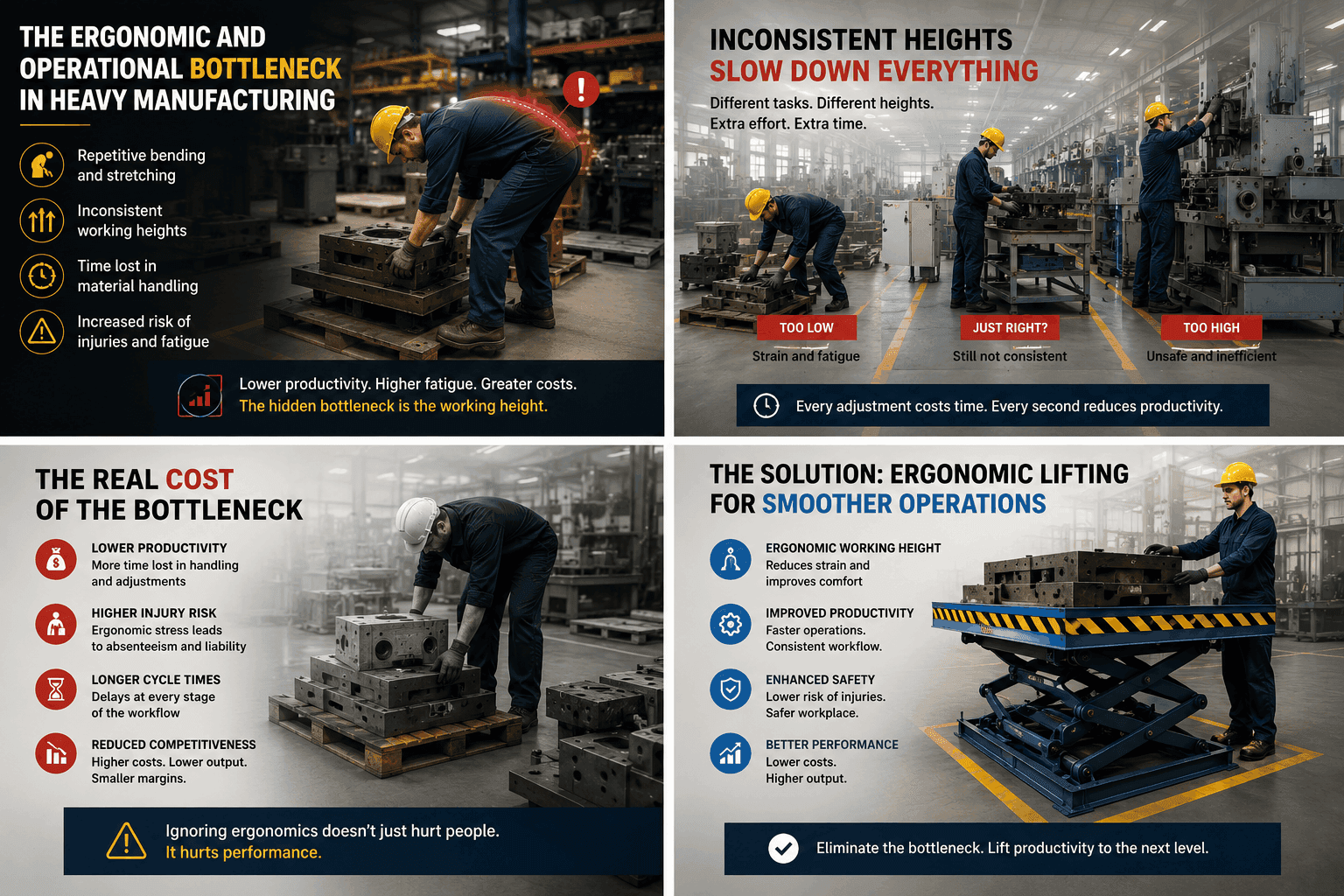
The Ergonomic and Operational Bottleneck in Heavy Manufacturing
Problems With Fixed Working Heights
Most manufacturing floors weren't designed around the idea that every component would arrive at exactly the right height. In practice, operators are left to adapt — bending to reach the underside of an assembly, stretching for a component sitting too high, or repositioning heavy parts by hand simply because the previous work surface didn't match the next task.
Over a full shift, these small adjustments add up. They're rarely dramatic on their own, but together they represent time, effort, and risk that a better-positioned workstation could largely avoid.
How Poor Load Positioning Affects Production
The connection here is straightforward: additional handling leads to additional movement, additional movement leads to additional time, and additional time works against production efficiency. When a component has to be lifted, set down, and lifted again multiple times to reach different working heights, that's time the process didn't need to spend. The actual scale of the impact naturally depends on the process, the component, and the plant layout — but the underlying pattern holds across most heavy manufacturing environments.
Challenges of Handling Large and Heavy Components
This challenge is especially visible with components like:
- Motors — large industrial motors often need access from multiple sides and heights during winding, assembly, and testing
- Transformers — core and coil assemblies typically move through several build stages at different working levels
- Dies and molds — heavy, awkwardly shaped, and often need to be raised precisely to align with press or tooling interfaces
- Automotive components — body panels, subframes, and drivetrain assemblies frequently require height changes as they move through a line
- Machine assemblies — large fabricated structures that need stable, adjustable support during build-up
For manufacturers working with loads like these, a lift table isn't just handling equipment — it's part of how the process itself gets executed.
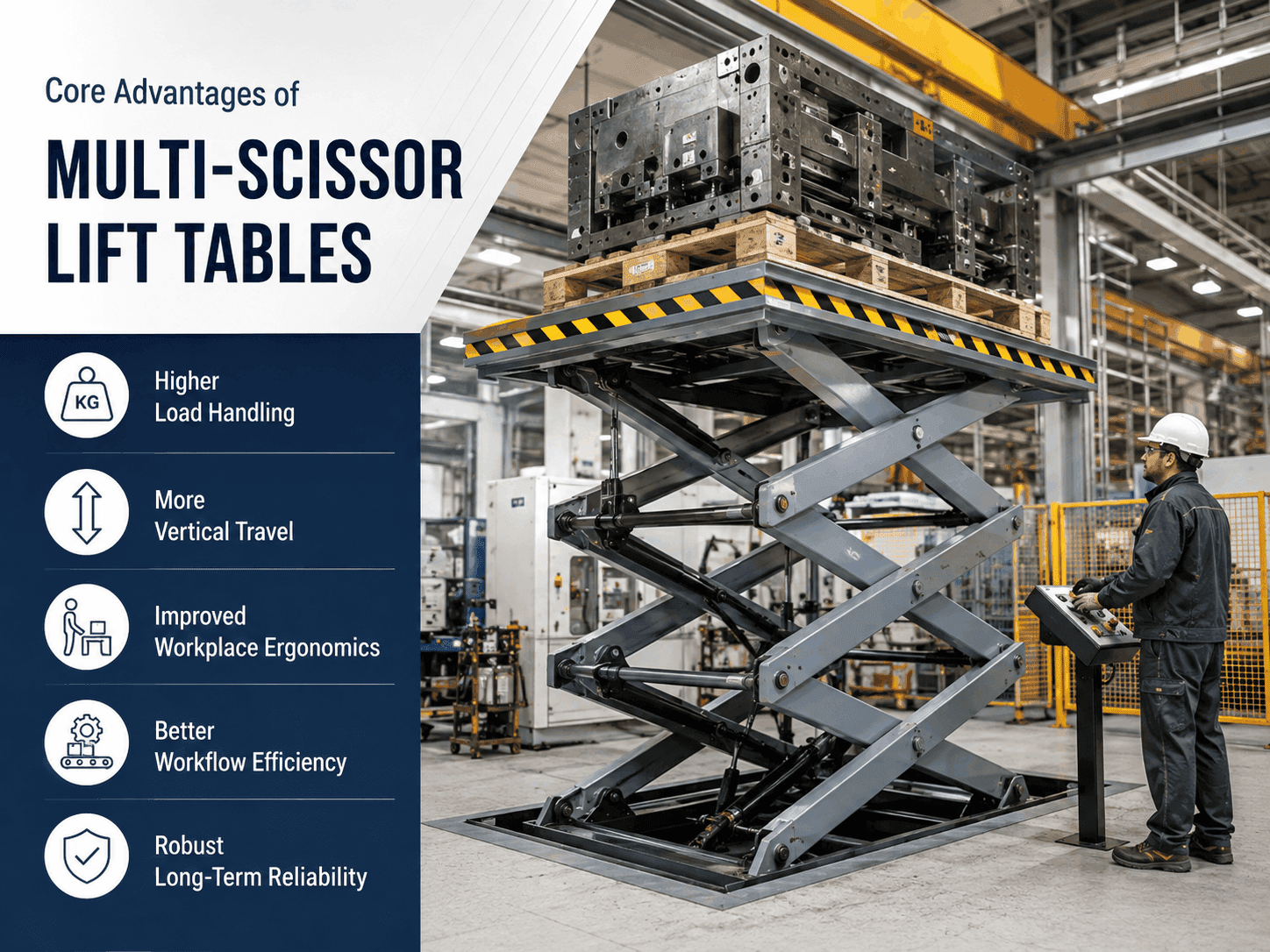
Core Advantages of Multi-Scissor Lift Tables
Greater Vertical Reach in Limited Floor Space
This is the defining advantage of the multi-scissor design. Because the extra lifting height comes from stacking scissor stages rather than widening the base, a multi-scissor mechanism can deliver high-lift applications in a footprint that a comparable single-stage industrial lift table simply couldn't match. In a manufacturing cell where floor space around machinery, conveyors, and walkways is already tightly planned, that difference matters.
Controlled Load Positioning During Assembly
A hydraulic scissor lift table allows a component to be moved through a controlled vertical path, bringing it to the height an assembly or inspection step actually requires — rather than forcing operators to work at whatever height the load happens to be sitting at. That controlled movement is what turns a lift table from a simple "up and down" device into a genuine part of the workstation.
Improved Working Height for Operators
There's a simple ergonomic principle behind all of this: instead of forcing the operator to adapt to the load, position the load closer to the height the operator actually needs. It's a small shift in thinking with a large practical effect — fewer awkward postures, fewer repeated adjustments, and a workstation that behaves more like it was designed for the task in front of it.
Reduced Dependence on Repeated Manual Repositioning
A well-specified lift table can meaningfully reduce how often a component needs to be manually lifted, shifted, or repositioned during a process. It's worth being precise here — a lift table doesn't eliminate manual handling altogether, and it isn't meant to. What it can do is remove a large share of the repetitive, avoidable repositioning that happens simply because a fixed work surface doesn't match the task.
Custom Platform Configurations for Manufacturing Processes
Depending on the manufacturer and the application, lift tables can be built with platform configurations tailored to a specific process — conveyor-integrated tops, turntables, tilting platforms, extended platforms, or fixtures designed around a particular component. These configurations turn a general-purpose lift table into a purpose-built station for a specific manufacturing step. If this is a requirement for your plant, it's worth discussing directly with the equipment manufacturer to understand what's genuinely achievable for your load and process.
Industrial Multi-Scissor Lift Table Applications by Industry
Automotive Body-in-White and Assembly Lines
In automotive manufacturing, structures and subassemblies frequently need to be presented at different heights during assembly, inspection, and component fitting. A multi-scissor lift table can support this by adjusting a component's position to match each stage, rather than requiring the line itself to be redesigned around a fixed height.
Transformer Manufacturing
Transformer builds typically progress through several distinct stages — core assembly, winding, tank fitting, and final inspection — each calling for a different working height. Positioning the transformer body correctly at each stage helps keep the process moving without unnecessary manual lifting.
Electric Motor Manufacturing
Large industrial motors often require operator access to different faces and components during build and test — the shaft end, the winding, the housing. A lift table that can bring the motor to a suitable working height, and adjust that height as work progresses, supports a more consistent build process.
Die Handling and Heavy Mold Positioning
Dies and molds are dense, heavy, and often need to be aligned precisely with press beds or tooling interfaces. A multi-scissor lift table can assist with positioning and transferring these loads between compatible working heights, and with safer access during maintenance. It typically works alongside a plant's existing die-handling systems rather than replacing them — the right equipment mix depends on the specific tooling and process involved.
Heavy Machinery Assembly
Beyond automotive and electrical manufacturing, multi-scissor lift tables are also used in assembling large mechanical structures, fabricated equipment, and general industrial machinery — anywhere a bulky component needs a working height that changes as the build progresses.
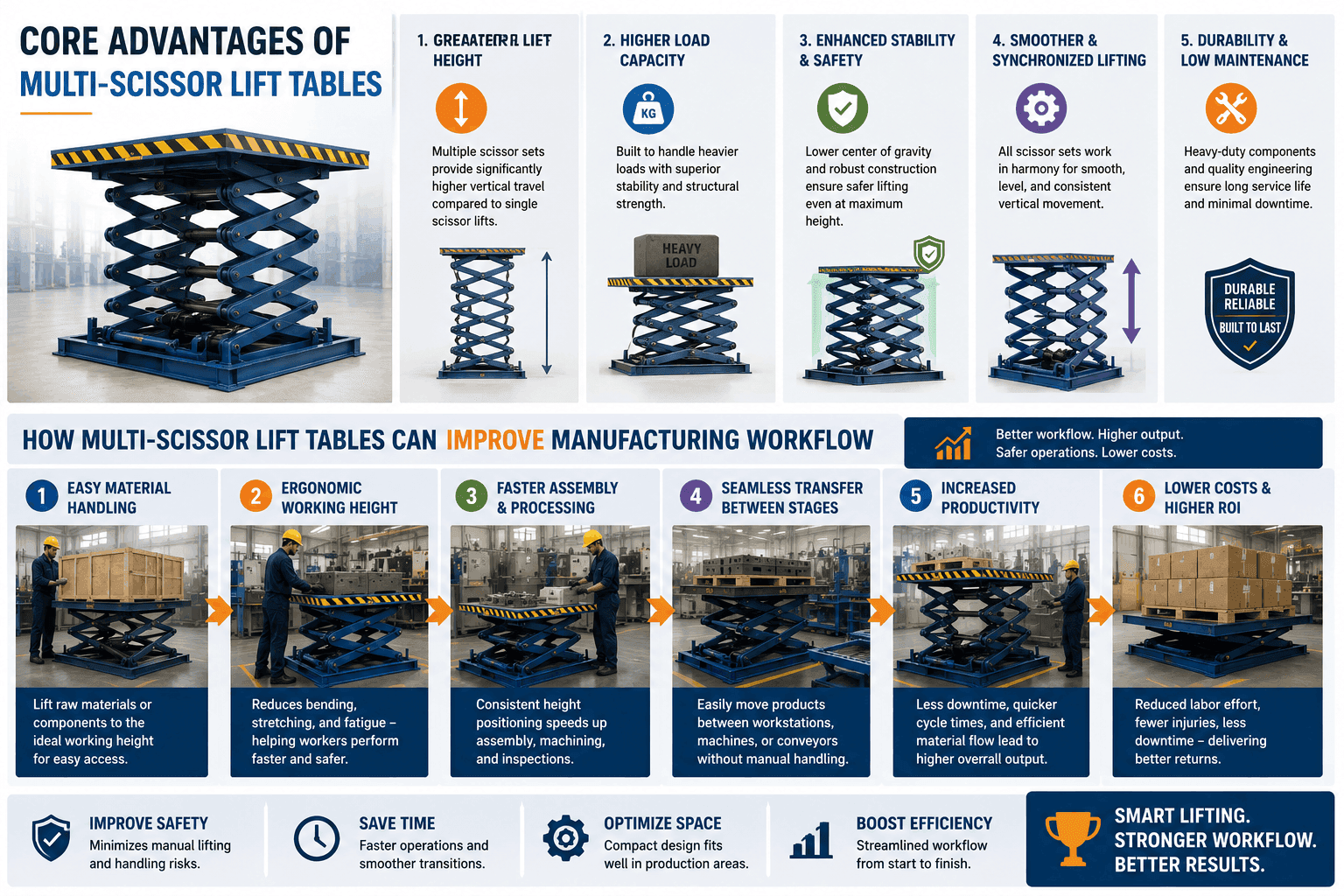
How Multi-Scissor Lift Tables Can Improve Manufacturing Workflow
Fewer Unnecessary Repositioning Steps
When a lift table can move a component directly to the height a process needs, it removes many of the intermediate repositioning steps that would otherwise happen by hand or with a crane.
Better Access During Assembly
With the load brought to an appropriate height, workers can access the areas they need without awkward stretching, bending, or working from a step or platform.
More Consistent Work Positioning
Repeatable positioning supports more standardized work, where the same component reaches the same height at the same stage every time — which can make quality and process control easier to maintain.
Potential Reduction in Material Handling Time
A well-matched lift table can reduce the time spent on repeated handling. That said, the actual productivity impact depends on the manufacturing process, load characteristics, equipment configuration, operator workflow, and plant layout — it's a factor worth evaluating for your specific operation rather than assuming a universal figure.
How to Choose a Multi-Scissor Lift Table for Heavy Manufacturing
Selecting the right equipment for a premium manufacturing environment means working through the requirements methodically, not just picking the highest-capacity or highest-reaching model available.
Required Load Capacity — Account for the full operating load: the component itself, plus any tooling, fixtures, or accessories on the platform. Work with a proper engineering assessment rather than choosing a capacity with no safety margin.
Required Lifting Height — Consider the maximum working level your process needs, including any future processes the equipment might have to support.
Platform Dimensions — The platform must suit the load's dimensions, how the load is distributed, and the access operators need during work.
Lowered Height and Raised Height — Both ends of the travel range matter. The lowered height affects integration with loading points and floor-level access; the raised height determines what working levels are achievable.
Available Floor Space — This is where the multi-scissor design shows its value most directly, weighing how much height you need against how much floor space you have.
Duty Cycle and Frequency of Operation — An occasional-use table and a high-frequency production-line table are built to very different demands.
Load Distribution and Centre of Gravity — Uneven or off-centre loads affect stability and platform design — worth discussing directly with the manufacturer's engineering team.
Integration With Existing Production Equipment — Consider how the lift table needs to work alongside conveyors, workstations, and loading areas already on your floor.
Controls and Safety Requirements — These should be evaluated based on the specific installation, application, manufacturer guidance, and applicable safety standards for your facility.
Build the Lift Table Around the Manufacturing Process
The right lift table isn't simply the one that reaches the highest position or carries the greatest load on paper. It's the one specified around your actual component, your working height requirements, your production process, your available floor space, and how often the equipment will really be in use.
For heavy equipment manufacturers, automotive assembly teams, and plant engineers working with large, demanding loads, that specificity is where a lift table stops being generic equipment and starts becoming a genuine part of the production line.
Consult with Skega Engineering to evaluate a multi-scissor lift table configuration tailored to your plant layout, load requirements, and manufacturing process.
When Does a Manufacturing Unit Need a Custom Multi-Scissor Lift Table?
Standard, off-the-shelf equipment doesn't always match a heavy manufacturing environment's exact requirements. A custom configuration is worth considering when your operation has specific needs around:
- Platform dimensions
- Load capacity
- Required vertical travel
- Installation space
- Load configuration
- Production-line integration
- Operating frequency
- Application-specific platform requirements
This is precisely the kind of engineering conversation Skega's team works through with manufacturing clients — matching a multi-scissor lift table configuration to the real conditions on the floor, rather than fitting the process around a generic machine.
Multi-Scissor Lift Table Selection Checklist
| Requirement | Question to Ask |
| Capacity | What is the maximum total operating load? |
| Lift height | What maximum working height is required? |
| Platform | What load dimensions must be supported? |
| Footprint | How much floor space is available? |
| Duty cycle | How frequently will the table operate? |
| Load | Is the load evenly distributed? |
| Integration | Will it connect with another workstation/process? |
| Environment | Where will the equipment operate? |
| Controls | What operating/control configuration is required? |
| Service | What maintenance/support will be required? |
Frequently Asked Questions About Industrial Multi-Scissor Lift Tables
Q1- What is a multi-scissor lift table?
A. A multi-scissor lift table is a hydraulic lift table built with two or more stacked scissor stages, allowing it to achieve greater vertical travel than a single-scissor design while keeping a relatively compact footprint. It's used to raise and lower heavy loads to precise working heights
Q2- What are multi-scissor lift tables used for?
A. They're used across heavy manufacturing for positioning components during assembly, inspection, and maintenance — including automotive assemblies, transformers, motors, dies, molds, and large machinery, wherever a load needs to reach several different working heights.
Q3- What is the difference between single-scissor and multi-scissor lift tables?
A. A single-scissor table has one lifting stage and a standard vertical travel range. A multi-scissor table stacks multiple stages, giving it greater height capability within a comparatively compact footprint — making it better suited to high-reach or multi-level positioning needs.
Q4- How much weight can a multi-scissor lift table carry?
A. Load capacity varies significantly by model and design. There's no single universal figure — the right capacity depends on your specific load, platform size, and application, and should be confirmed against the manufacturer's specifications for the model in question.
Q5- Can multi-scissor lift tables be customized?
A. Yes, in many cases. Manufacturers with in-house engineering capability, including Skega, can configure platform size, capacity, lift height, and control setup around a specific application. It's best to discuss your exact requirements directly with the engineering team to confirm what's achievable.
Q6- Are multi-scissor lift tables suitable for automotive manufacturing?
A. Yes — they're commonly used across automotive assembly for positioning body structures, subassemblies, and components at the working heights needed during assembly, inspection, and fitting stages.
Q7- How do I select the right industrial lift table?
A. Start with your required load capacity, lift height, and platform dimensions, then factor in available floor space, duty cycle, load distribution, and how the table needs to integrate with your existing production layout. These variables together determine whether a single-scissor or multi-scissor configuration — standard or custom — is the right fit.