
Essential Safety Checklist for Operating Self-Propelled Scissor Lifts.
A new scissor lift rolling off the delivery truck feels like a small win for any maintenance manager. The tyres are still spotless, the hydraulics respond like they should, and for a moment it seems like every awkward, ladder-balancing job on the shop floor is about to get a lot easier. Then reality sets in: a machine this capable is only as safe as the habits of the person operating it. That gap — between what a self-propelled scissor lift is engineered to do and what actually happens on a busy factory floor — is exactly where a proper pre-use checklist earns its place.
Reviewed by: Skega Technical / Safety Team Technical review: Qualified EHS professional
A new scissor lift rolling off the delivery truck feels like a small win for any maintenance manager. The tyres are still spotless, the hydraulics respond like they should, and for a moment it seems like every awkward, ladder-balancing job on the shop floor is about to get a lot easier. Then reality sets in: a machine this capable is only as safe as the habits of the person operating it. That gap — between what a self-propelled scissor lift is engineered to do and what actually happens on a busy factory floor — is exactly where a proper pre-use checklist earns its place.
This isn't paperwork for the sake of an auditor's signature. It's the few minutes that stand between an ordinary shift and an incident report nobody wanted to write — and it's also what protects the money your business put into a machine built to last for years, not months. Whether you're the EHS officer walking the floor each morning, the plant manager who owns the outcome, or the person who signed the purchase order, this guide breaks down exactly what to check, why each item matters, and how to keep a self-propelled scissor lift running safely, shift after shift.
Self-Propelled Scissor Lift Safety Checklist
Short on time? Here's the two-minute version of what needs checking before anyone steps onto the platform:
- Inspect the lift before each shift or use
- Check tyres, wheels, guardrails and platform condition
- Check the hydraulic system for visible leaks or damage
- Verify battery and power condition
- Test platform and ground controls
- Test emergency-stop and emergency-lowering functions
- Inspect the work area for holes, slopes and obstructions
- Check overhead clearance and electrical hazards
- Confirm the platform load is within the machine's rated capacity
- Keep gates and guardrails secured during operation
- Follow the manufacturer's operating limits and instructions
- Remove the machine from service if a safety-related fault is identified
The International Powered Access Federation (IPAF) recommends a pre-use inspection of Mobile Elevating Work Platforms (MEWPs) — the category scissor lifts fall under — before every single operation, always in line with the manufacturer's manual. IPAF doesn't treat this as an occasional formality; it's positioned as a daily, start-of-shift habit, as routine as clocking in.
In short: a self-propelled scissor lift should be checked for structural damage, tyre condition, hydraulic leaks, battery health, guardrail integrity, control response and emergency-system function before every use. Operators also need to read the environment — ground stability, overhead hazards, platform capacity, and anything in the work zone that could turn a routine lift into a near-miss.
Why Is a Safety Checklist Important Before Operating a Self-Propelled Scissor Lift?
At a glance, a scissor lift is a simple idea — a platform that goes up and comes back down. The risks around it are anything but simple. A short pre-use check is what stands between your crew and several genuinely serious hazards.
- Fall hazards from an open gate, a damaged guardrail, or an operator leaning past the platform edge
- Tip-over risks from uneven ground, overloading, or working a slope beyond the machine's rated limits
- Entrapment or crushing hazards near the scissor mechanism or between the platform and a fixed structure
- Electrical hazards from proximity to overhead power lines or live equipment
- Mechanical or hydraulic failure caused by wear, leaks, or maintenance that got pushed back one shift too many
- Collision risks with pedestrians, racking, or other equipment on a busy floor
- Downtime — every failure a two-minute inspection could have caught is lost production time instead
The U.S. Occupational Safety and Health Administration (OSHA) points to stability, correct positioning, fall protection and electrical hazard awareness as the core safety considerations when working with scissor lifts. These aren't theoretical concerns pulled from a textbook — they're the exact issues a proper pre-use inspection is designed to intercept before they become a report someone has to file.
For teams operating premium self-propelled scissor lifts, building this into daily culture does double duty: it protects people, and it protects the equipment investment. A machine that's inspected and operated correctly simply holds up longer and performs more consistently over its working life.
Pre-Operation Inspection Checklist for a Self-Propelled Scissor Lift
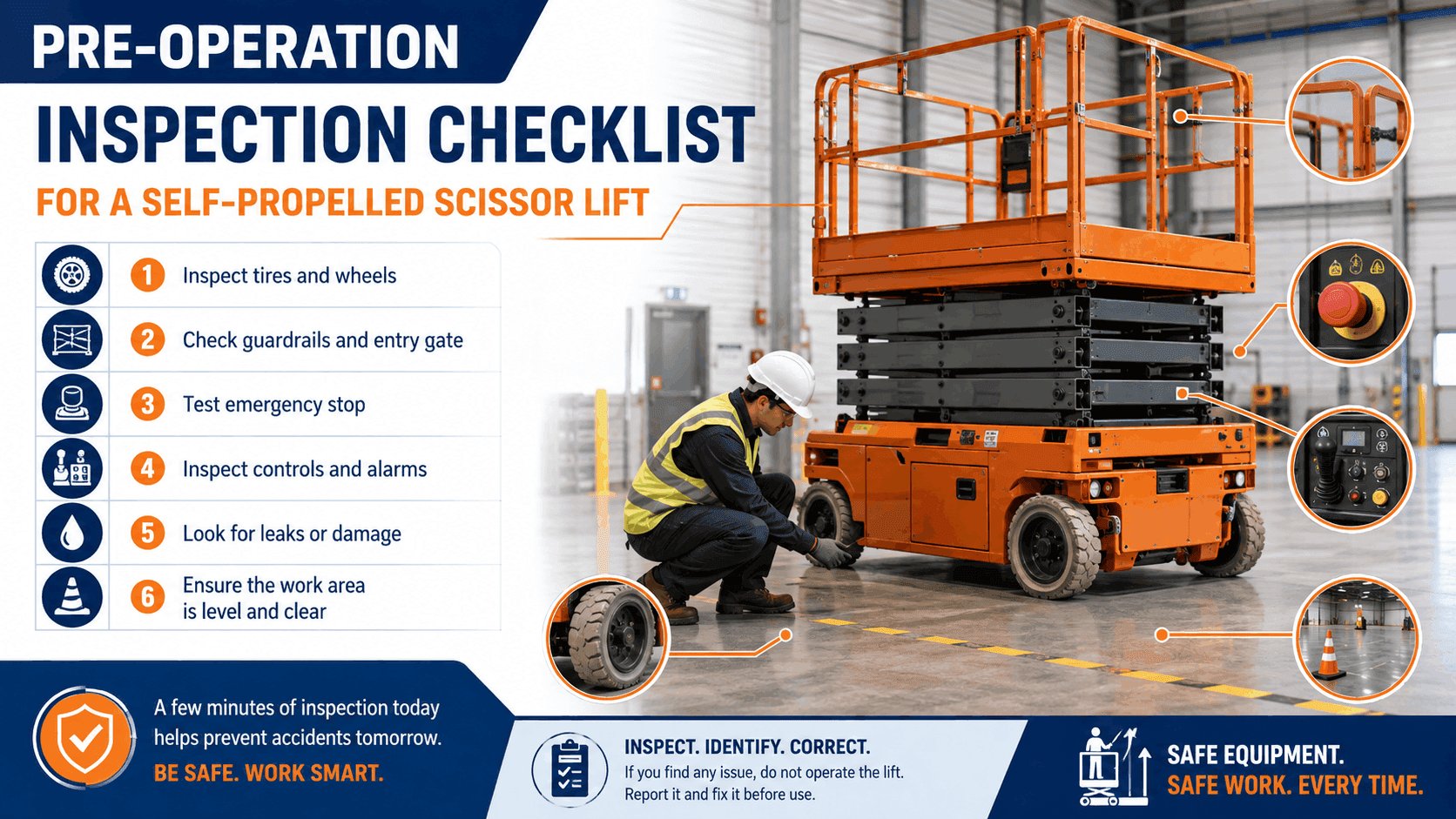
Check the Platform and Guardrail System
Start where the operator will actually stand. Walk the floor surface, the entry gate, the guardrails, and every fastener holding them together. Visible structural damage, a loose bolt, or a gate that won't latch cleanly are all reasons to stop — the machine shouldn't go into service until they're fixed.
Inspect the Scissor Mechanism and Structural Components
Circle the machine and look for:
- Bent components
- Cracks or deformation
- Loose pins
- Abnormal wear
- Damaged weld areas
One important note: never reach into or climb into the scissor mechanism as part of a routine check. That's territory for trained personnel only, following the machine's proper servicing and isolation procedures.
Inspect Hydraulic Components
Check hoses, connections, and cylinders for visible leaks or damage, and confirm the fluid level if the manufacturer's manual calls for it as a routine step.
Check Battery and Electrical Components
Confirm battery charge, inspect connections and cables for wear, and verify the unit is charging as expected. A neglected battery is one of the most common — and most preventable — reasons a lift goes down mid-shift.
Inspect Tyres and Wheels
Look for cuts, excessive wear, loose fittings, and anything lodged in the tread. IPAF's MEWP pre-use guidance calls out wheel security specifically, because a compromised wheel has a direct line to machine stability.
Test the Controls and Safety Devices Before Use
A visual once-over is only half the job. Before any lift starts work, the control systems need to be tested functionally, not just eyeballed:
- Test platform controls
- Test ground controls
- Verify the emergency stop
- Test the emergency lowering system
- Check warning alarms and safety indicators
- Check steering and braking functions
Every one of these should respond exactly as expected before the operator elevates or moves the machine.
Control layouts and test sequences differ between models, so operators should always work from the specific manufacturer's manual for their machine — a point IPAF's guidance also underlines as core to safe pre-use practice. You can browse the full specifications for Skega's scissor lift range to see how these details vary model to modeL.
Workplace Hazard Assessment Before Operating the Lift
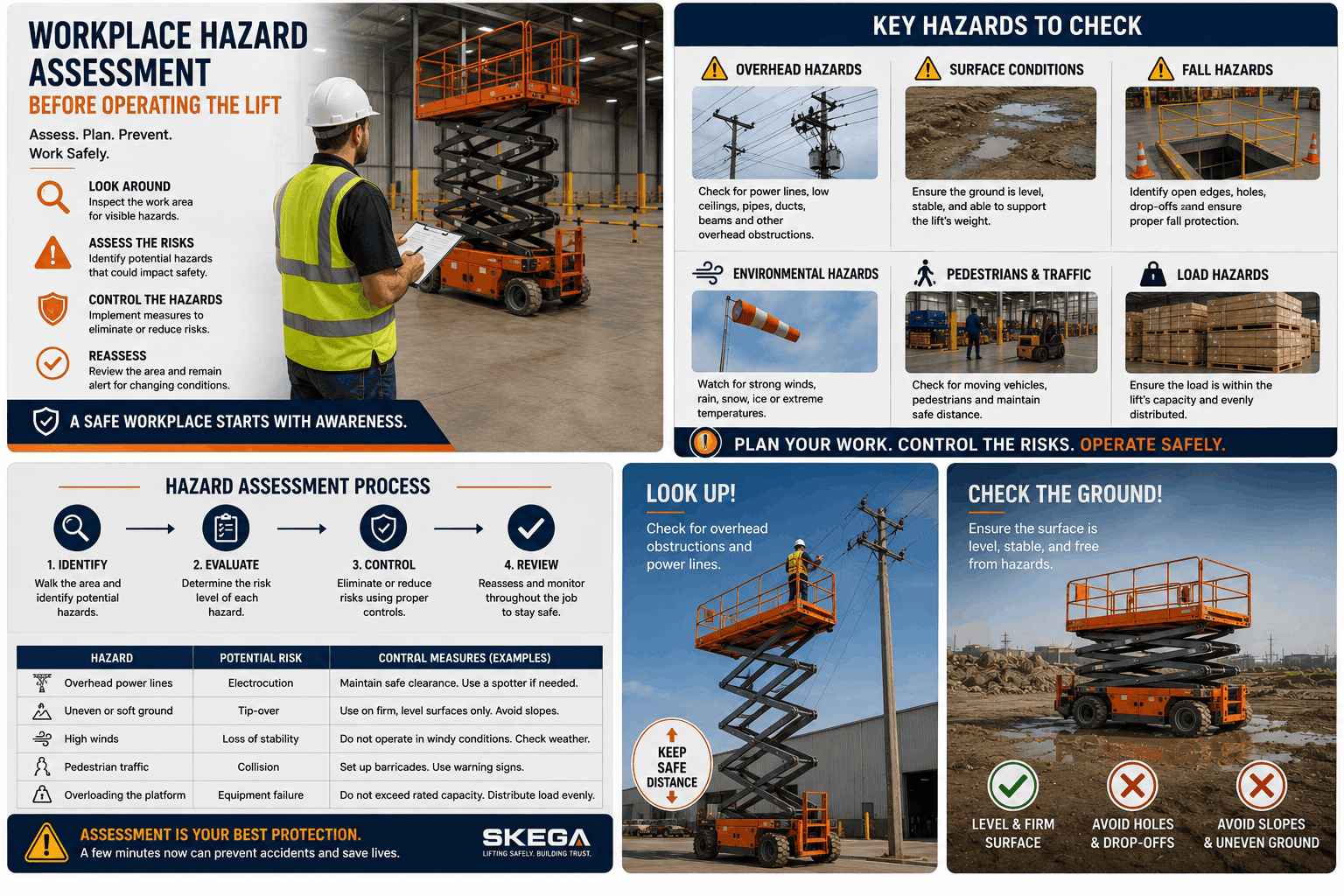
A scissor lift can be mechanically flawless and still be unsafe to use — simply because of where it's parked. That's why reading the environment matters just as much as inspecting the machine itself.
Check Floor and Ground Conditions
Look at levelness, potholes, floor openings, uneven ground, soft spots, debris, and slippery patches. A machine in perfect condition can still tip if it's set up on ground it was never designed to handle.
Verify Floor Load Capacity
This one matters especially indoors. The combined weight of the machine, the operator, and any materials on the platform needs to suit the supporting surface — including mezzanines, elevated floors, or loading decks that weren't built with heavy equipment in mind.
Check Slopes and Inclines
Every model has its own gradeability, cross-slope tolerance, and rules around elevated travel on a slope. There's no universal "safe" incline figure — always work from your specific machine's rated limits. If a slope exceeds those limits, use a purpose-built ramp instead of pushing the machine past what it's rated for.
Identify Overhead Obstructions
Before elevating, scan upward for beams, pipes, sprinkler heads, cable trays, door frames, machinery, and low ceilings. Overhead clearance gets missed more often than almost any other hazard, mostly because operators are trained to watch what's ahead of them, not above.
Identify Electrical Hazards and Power Lines
Arcing can happen without any direct contact at all, so proximity to overhead power lines needs to shape positioning decisions, not just physical contact avoidance. If your site works near power lines, follow your local electrical safety clearance rules rather than assuming one fixed international number applies everywhere.
Check Platform Capacity Before Elevating
Confirm Rated Platform Capacity
A scissor lift's rated capacity covers everything on the platform at once — operators, tools, equipment, and materials, combined. Going over it, even for a few minutes, eats into the stability margin the machine was designed with.
Distribute Loads Correctly
A load bunched in one corner can throw off balance even when the total weight is technically within limits. Spreading tools and materials evenly across the platform keeps things stable through elevation and movement.
Never Exceed Manufacturer Load Limits
This is where load capacity, platform limits, and overall stability all meet. The manufacturer's rated capacity isn't a rough guideline — it's calculated for that exact model's structure and hydraulics, and pushing past it removes the safety margin engineered in from the start.
PPE and Operator Safety Before Using a Scissor Lift
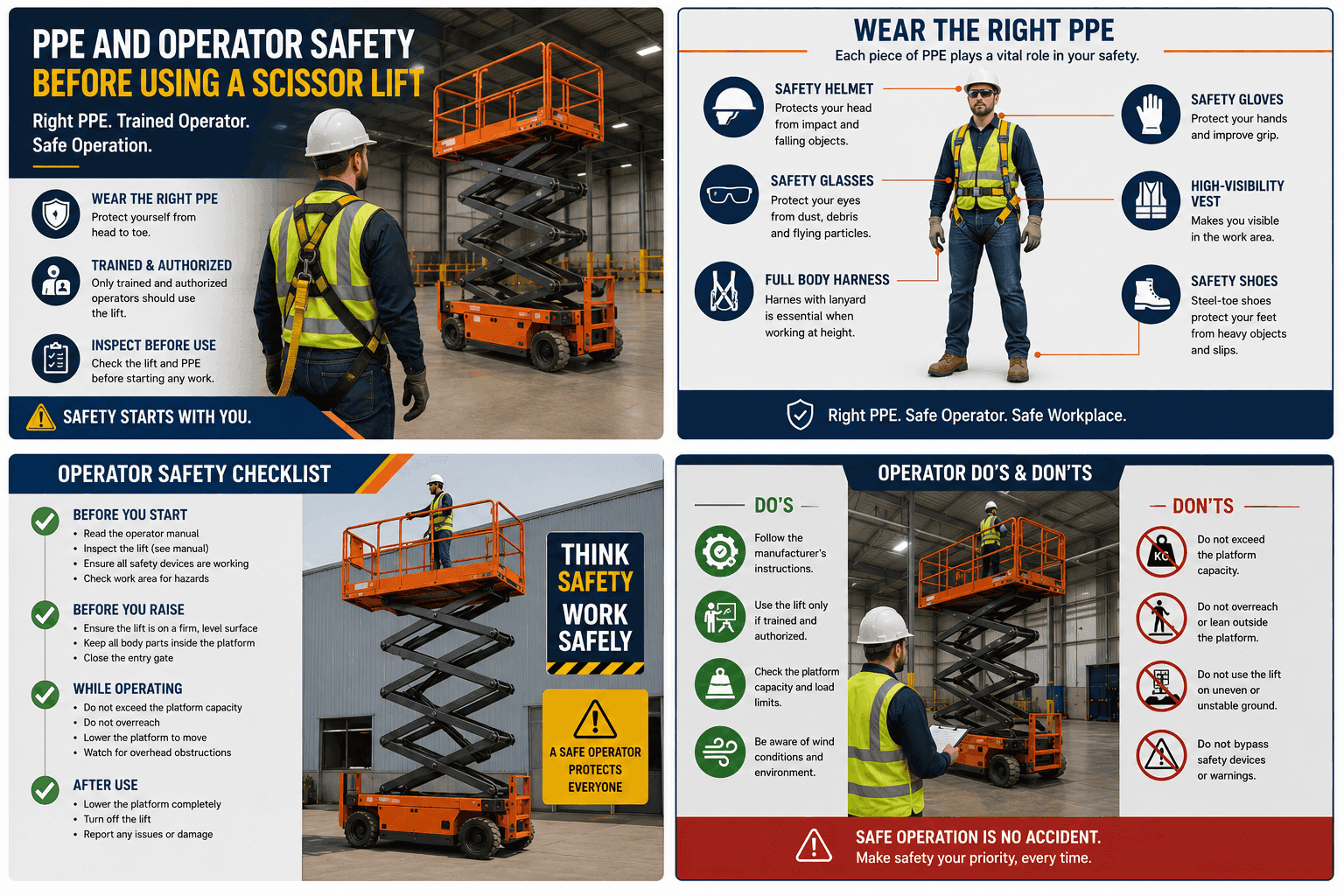
Before anyone steps onto the platform, they should be equipped with PPE suited to the site and task, which typically includes:
- Safety helmet
- Safety footwear
- High-visibility clothing
- Task-specific eye or hand protection
Is a Safety Harness Required on a Scissor Lift?
This is one of the questions that comes up constantly, and the honest answer is: it depends. On conventional scissor lifts, guardrails usually serve as the primary fall-protection system, since the operator works from within an enclosed platform. Whether additional fall-restraint or fall-arrest gear is needed comes down to the specific machine's configuration, the manufacturer's guidance, your site's risk assessment, and whatever rules apply in your jurisdiction.
The takeaway: don't treat a harness as automatically required or automatically unnecessary. Check the equipment manual and your workplace risk assessment before deciding either way.
Safe Operating Rules While the Scissor Lift Is Elevated
Keep both feet on the platform floor. Never use a ladder, box, guardrail, or improvised platform to gain extra height. OSHA is specific on this point — operators stand on the platform floor itself, never on the guardrails, and never lean or reach beyond the platform's edge.
Keep guardrails and entry gates secure. The gate should stay closed and latched for the entire operation. It sounds obvious, but it remains one of the most common oversights on a busy site.
Avoid overreaching outside the platform. If something's out of reach, reposition the machine instead of stretching for it.
Maintain safe clearance from obstacles. Keep a clear buffer from walls, racking, machinery, and other equipment, whether elevated or travelling.
Use controlled travel speeds. Move deliberately, particularly at height or in confined spaces.
Follow manufacturer restrictions for elevated travel. Some machines limit speed, height, or direction of travel once elevated — know the limits for your specific model.
Never override safety systems. Interlocks, alarms, and cut-outs exist for a reason. Bypassing any of them, even briefly, removes the margin the machine was designed around.
Can You Drive a Self-Propelled Scissor Lift While Elevated?
Some self-propelled scissor lifts are built for elevated travel, but the permitted height, speed, slope, and surface conditions vary a lot between models. There's no single yes-or-no answer here — it comes down entirely to what your machine is rated for. Before attempting elevated travel, check the manufacturer's rated limits for your unit, or review the detailed specifications across Skega's self-propelled scissor lift range to understand what each model allows.
Emergency Procedures Every Operator Should Know
Emergency stop procedure. Every operator should know exactly where the emergency stop is and how it works, both on the platform and at ground level.
Emergency platform lowering. If platform controls fail, ground-level personnel should know how to operate the manual or auxiliary lowering system to bring the platform down safely.
What to do if the lift loses power. Operators should understand the backup or manual descent options for their specific machine, and how to exit safely once the platform is lowered.
What to do if an operator is stranded at height. Every site needs a clear rescue plan — who's trained to run the emergency lowering system, and how fast help can actually reach the operator.
When Should a Scissor Lift Be Taken Out of Service?
A machine should come out of service immediately if there's.
- A safety control malfunction
- A hydraulic leak
- Structural damage
- A damaged guardrail
- Unusual movement or noise
- Any fault indication affecting safe operation
IPAF's inspection guidance goes beyond the checklist itself and also flags having a rescue plan in place as part of being genuinely ready to work with a MEWP — not just an inspection routine, but a plan for the moment something doesn't go as expected.
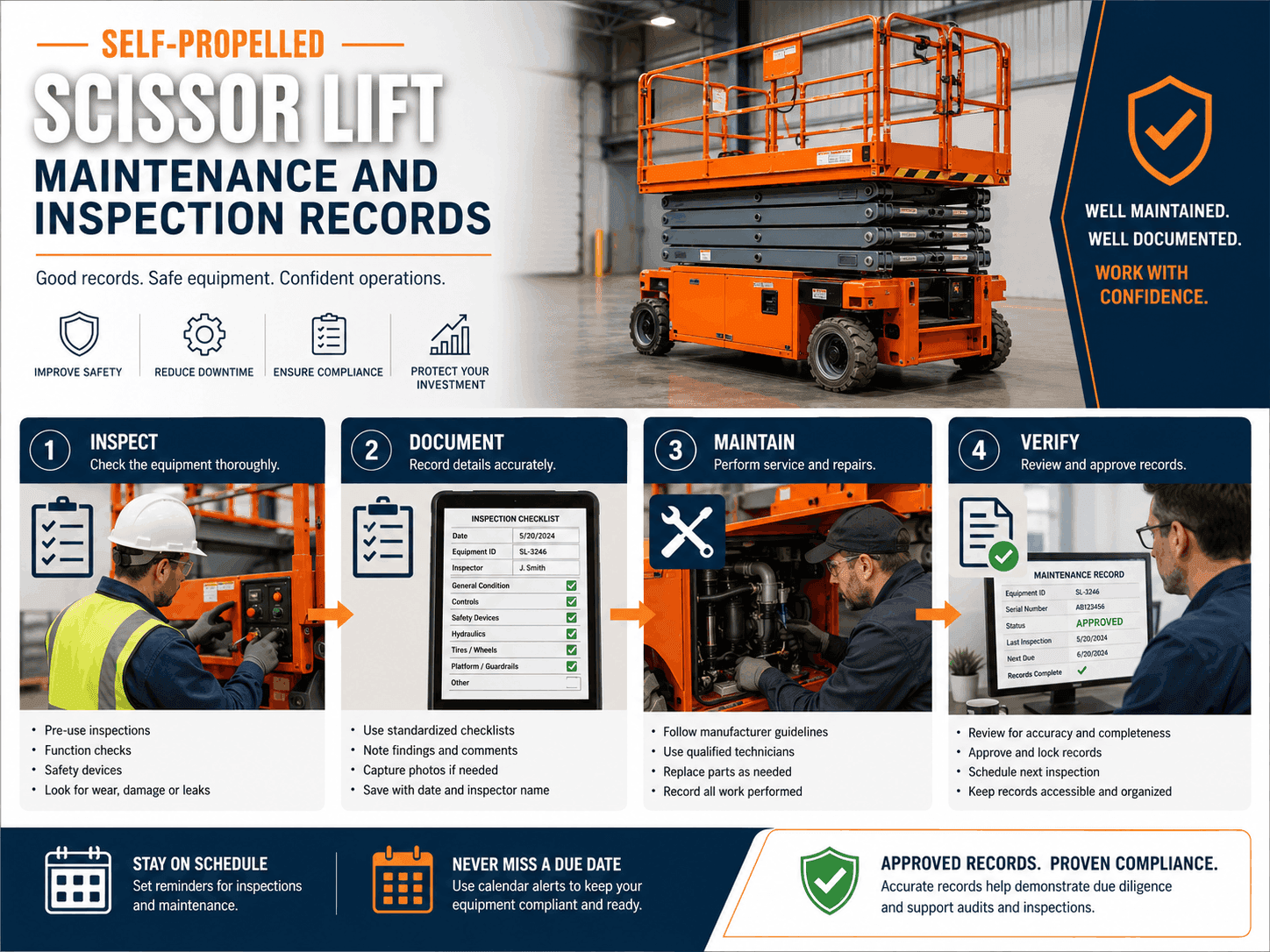
Self-Propelled Scissor Lift Maintenance and Inspection Record
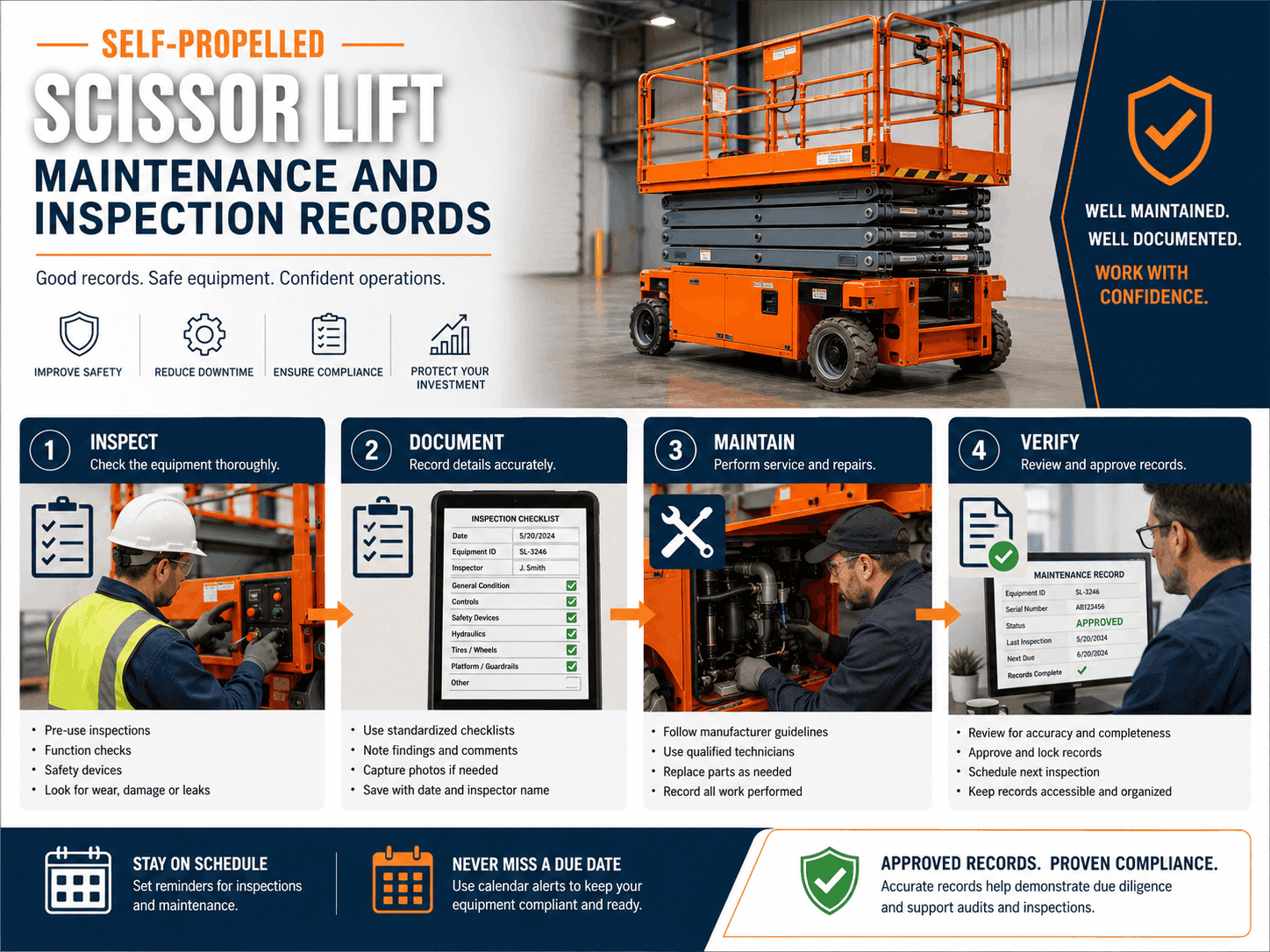
Maintain a daily pre-use inspection record. Every shift should start with a documented check, not just a mental one.
Record identified defects and corrective actions. Anything flagged during inspection should be logged, along with what was done to fix it.
Maintain service and periodic inspection records. Beyond the daily routine, periodic servicing and inspection records need to stay current and accessible.
Follow manufacturer-defined maintenance intervals. Every model has its own recommended service schedule — go by what's in your machine's manual, not a generic industry timeline.
Keep relevant inspection documentation available. Records should be easy for your EHS team, auditors, or anyone responsible for equipment sign-off to access, in line with whatever statutory or site-specific requirements apply.
Printable Self-Propelled Scissor Lift Safety Checklist
Here's a simple, printable version your team can use on the floor:
| Inspection Area | What to Check |
| Platform | Damage, cleanliness, stability |
| Guardrails | Secure and undamaged |
| Entry gate | Closes correctly |
| Scissor mechanism | Visible damage/wear |
| Hydraulic system | Leaks or damaged hoses |
| Battery | Charge and connections |
| Tyres/wheels | Damage and security |
| Controls | Correct operation |
| Emergency stop | Functional |
| Emergency lowering | Functional |
| Ground condition | Firm and suitable |
| Overhead area | Clear of hazards |
| Load | Within rated capacity |
| Work zone | People/obstacles controlled |
Frequently Asked Questions About Self-Propelled Scissor Lift Safety
What should be checked before operating a self-propelled scissor lift? Before use, check the platform, guardrails, hydraulic system, battery, tyres, and controls, along with the emergency stop and lowering systems. Also assess the work area for ground stability, overhead hazards, and load capacity before elevating.
How often should a scissor lift be inspected? A scissor lift should be inspected before use, at the start of every shift, as IPAF recommends — in addition to periodic servicing and inspection carried out per the manufacturer's instructions and any applicable local rules.
Can a self-propelled scissor lift be driven on an incline? It depends on the model. Every scissor lift has its own manufacturer-defined gradeability and cross-slope limits, so always check your specific machine's rated limits rather than assuming a general figure.
Can you move a scissor lift while it is elevated? Some self-propelled models are designed for elevated travel, but permitted height, speed, and surface conditions vary by machine. Always check the manufacturer's specifications for your particular model before travelling while elevated.
Is a safety harness compulsory when operating a scissor lift? Not universally. Guardrails are typically the primary fall-protection system on conventional scissor lifts, but harness requirements depend on the machine configuration, manufacturer guidance, and your site's risk assessment.
What causes a scissor lift to tip over? Common causes include operating on uneven or sloped ground beyond rated limits, overloading the platform, uneven load distribution, and using the machine outside its rated operating conditions.
What PPE should a scissor lift operator use? Typical PPE includes a safety helmet, safety footwear, high-visibility clothing, and task-specific eye or hand protection, depending on your site's requirements.
Who should operate a self-propelled scissor lift? Only trained and authorised personnel who understand that specific machine's controls, limitations, and safety systems should operate a self-propelled scissor lift.
Choosing a Self-Propelled Scissor Lift for Safer Industrial Work at Height
If you're evaluating equipment for your facility, safety doesn't start with the first inspection — it starts with picking the right machine for the job in the first place. Worth weighing:
- Working height required for your tasks
- Platform capacity needed for operators, tools, and materials
- Platform dimensions relative to your workspace
- Indoor or outdoor application
- Ground conditions at your site
- Turning space available in your facility
- Power source — electric, battery, or otherwise
- Required safety features for your specific risk profile
A machine specified correctly for your environment isn't just more productive — it's inherently safer, simply because it's matched to the conditions it will actually face day to day. Skega's range of self-propelled scissor lifts is worth comparing against this list before you commit to a model.
A Culture of Safety, Not Just a Checklist
The best safety records don't come from a laminated sheet pinned near the machine. They come from teams that treat every pre-use check as second nature — quick, thorough, and simply non-negotiable. For serious industrial operations, that discipline is what protects your people, your uptime, and the long-term value of your equipment.
Need a self-propelled scissor lift for factory maintenance or industrial work at height? Explore Skega's range of self-propelled scissor lifts and compare specifications to find the right fit for your applications.