- Material Handling Equipment
Material Handling Equipment for Automobile Plants: Uses and Selection.
A car is built from thousands of parts. Every one of them has to reach the right station, at the right height, at the right time. When one part is late, the line waits. And a waiting line is the most expensive thing in a plant.
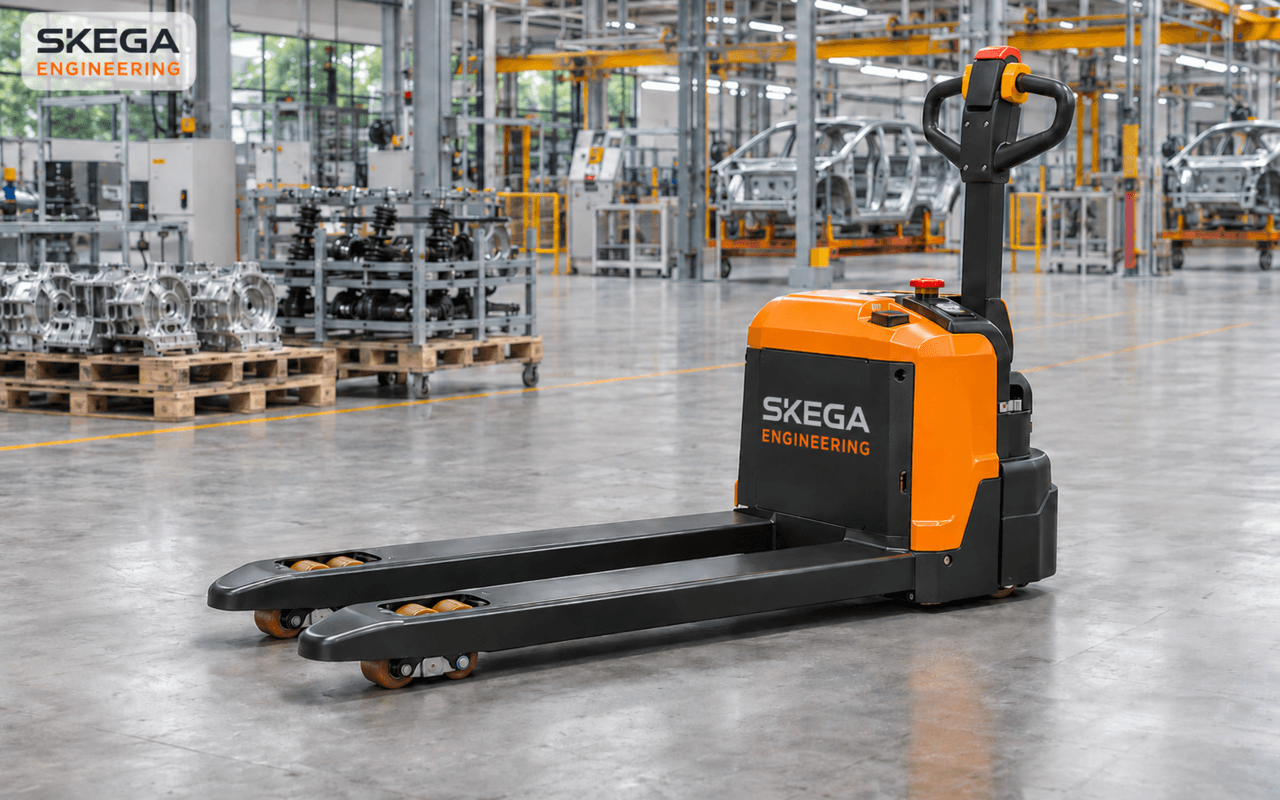
A car is built from thousands of parts. Every one of them has to reach the right station, at the right height, at the right time. When one part is late, the line waits. And a waiting line is the most expensive thing in a plant.
That is the job of material handling equipment for the automobile industry: the trucks, lifts, ramps, trolleys and automated systems that move parts and finished components through a plant safely and on schedule. The right mix keeps lines running. The wrong mix creates queues, strain injuries and damaged parts.
This guide shows where each type of equipment is used, how to choose it, and what to ask a supplier. At Skega, we build pallet trucks, trolleys, lift tables and goods lifts in Surat, and you can browse our warehouse and plant equipment range while you read.
Key Takeaways
- Material handling equipment moves, lifts, stores and protects parts from the dock to dispatch.
- Each plant zone needs different equipment, so choose by zone, not by brand.
- Lift tables bring parts to work height and cut bending on assembly lines.
- There is no single best machine. Match load, distance, space, floor and takt time.
- Automation pays off on repeatable, high-volume routes. Simple equipment still wins elsewhere.
- Ask suppliers for a site survey, load testing and service support.
What Is Material Handling Equipment?
Material handling equipment is any machine, vehicle or device that moves, lifts, stores or protects goods in a factory or warehouse. In an automobile plant it includes pallet trucks, trolleys, lift tables, goods lifts, cranes, racking, conveyors and automated vehicles.
There are three types of material handling, based on how much work a machine does on its own:
- Manual: a person pushes or pulls it, such as a hand pallet truck.
- Semi-automated: a person guides it, but power does the heavy work, such as an electric pallet truck.
- Automated: it follows a route or programme without a driver, such as an automated guided vehicle.
Equipment is also commonly grouped into four main categories: industrial trucks, storage equipment, engineered systems (such as conveyors and automated systems) and bulk handling equipment. Bulk handling, for loose material like grain or coal, is rare in car plants, so we will not cover it here.
Why Material Handling Matters in Automotive Manufacturing
Parts travel a long road before they become a vehicle: inbound receiving, press and weld, paint, assembly, the parts warehouse and dispatch. At every step, someone must lift, move or position something heavy.
Good handling cuts waiting time, protects parts from damage and keeps workers safe. Poor handling does the reverse. That is why handling decisions belong in the plant plan, not at the end of it.
Where Is Equipment Used? A Plant Zone Guide
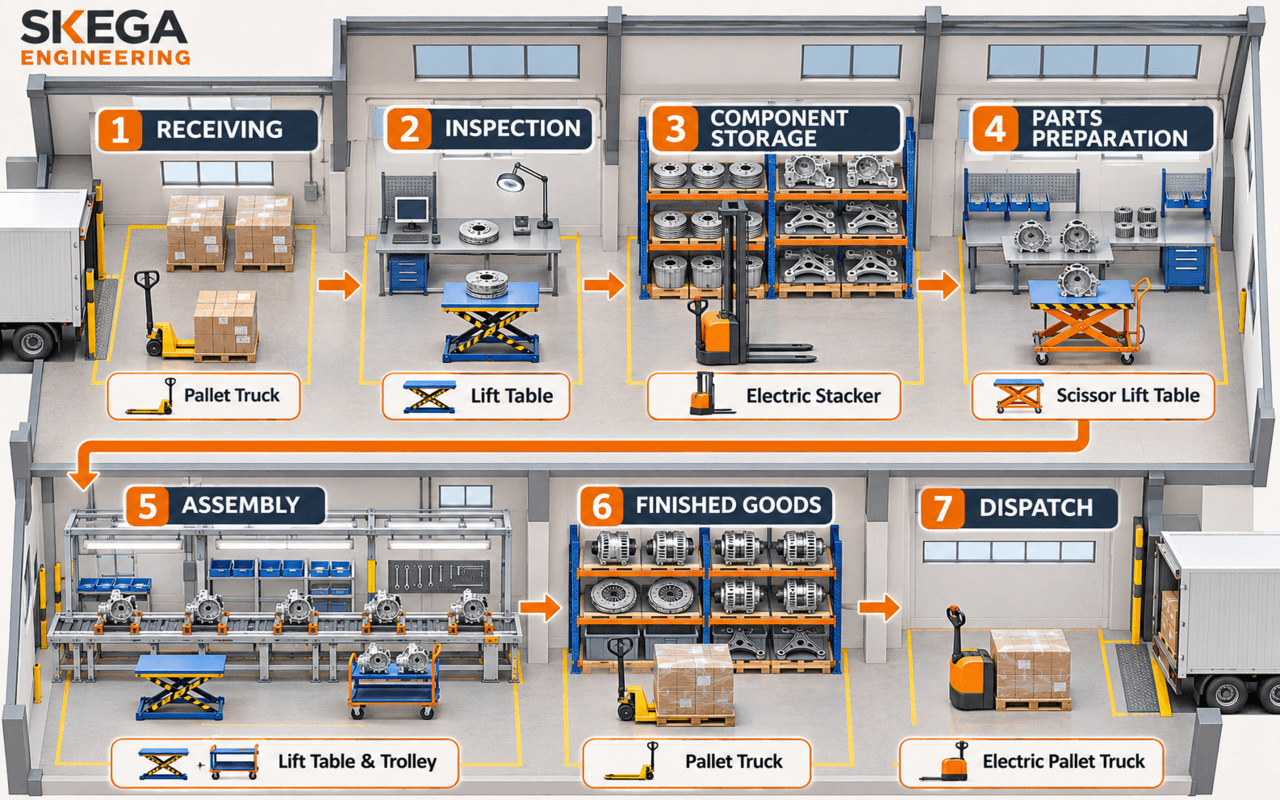
The best way to choose equipment is by plant zone. Here is a simple guide. Check it against your own plant, because layouts differ.
| Plant zone | Typical task | Equipment | Why it fits |
| Inbound and receiving | Unloading parts | Dock levelers, ramps, pallet trucks | Bridges dock gaps, quick unloading |
| Press and heavy components | Moving dies, panels, heavy parts | Cranes, heavy-duty lift tables, goods lifts | Heavy loads, controlled lifting |
| Body shop and welding | Positioning sub-assemblies | Lift tables, trolleys | Right height, steady loads |
| Paint shop | Moving painted parts | Specialised trolleys, conveyors | Avoids damage and contamination |
| Final assembly | Presenting parts at work height | Scissor lift tables, tugger trains, AGVs | Ergonomics, line-side supply |
| Parts and spares warehouse | Storage and retrieval | Pallet trucks, stackers, racking | Dense storage, quick picking |
| Dispatch | Loading outbound | Dock levelers, pallet trucks | Safe, quick loading |
At the receiving dock, a gap or height difference between truck and floor is a daily hazard. Dock levelers and a mobile dock ramp close that gap so pallets roll in and out safely.
Core Types of Automotive Material Handling Equipment
Transport equipment moves loads from one place to another. Hand and electric pallet trucks handle most pallet moves. Skega builds electric pallet trucks for frequent moves, an S.S. 304 hydraulic hand pallet truck for washdown or clean areas, and a hydraulic weighing scale pallet truck that weighs loads as it moves them. A four-wheeled platform trolley suits smaller parts and cartons. Forklifts and tugger trains cover longer distances and heavier loads.
Lifting and positioning equipment raises loads to a working height or another floor. This includes lift tables, goods lifts and overhead cranes. A goods lift, built to order, moves heavy parts between floors, which is common when a plant uses a mezzanine or multi-storey layout.
Storage equipment includes racking, stackers and mezzanines. It holds parts densely and keeps them easy to find.
Automated systems include conveyors, automated guided vehicles (AGVs) and autonomous mobile robots (AMRs). They move loads along set routes with little human input.
| Traditional equipment | Robotic and automated systems | |
| Flexibility | High. People adapt quickly. | Lower. Routes and layouts need planning. |
| Upfront cost | Lower | Higher |
| Best for | Varied tasks, changing layouts | Repeatable, high-volume routes |
| Safety | Depends on training and route design | Depends on sensors and system design |
AGV vs Forklift, and Manual vs Automated
The main difference between an AGV and a forklift is the driver. A forklift needs an operator and goes almost anywhere. An AGV follows a set route without a driver. Forklifts suit varied tasks. AGVs suit repeated trips between fixed points.
Here is a simple decision guide:
- If routes and loads change daily, choose forklifts or pallet trucks.
- If the same trip repeats all shift, consider an AGV or conveyor.
- If volume is low or the space is tight, manual or semi-electric equipment is usually enough.
- If lifting height matters more than distance, choose a lift table.
Automation and AI are changing material handling, but the gains are real only when the task is repeatable and the volume is high. In many plants, a well-chosen pallet truck or lift table still delivers the best return. Do not buy automation to solve a layout problem that planning could fix.
How Lift Tables Improve Assembly Line Efficiency
On an assembly line, parts should arrive at the height where the worker needs them. A lift table does exactly that. It raises or lowers a load, so the worker stops bending, reaching and twisting. That means less strain, steadier loads and faster changeovers between models.
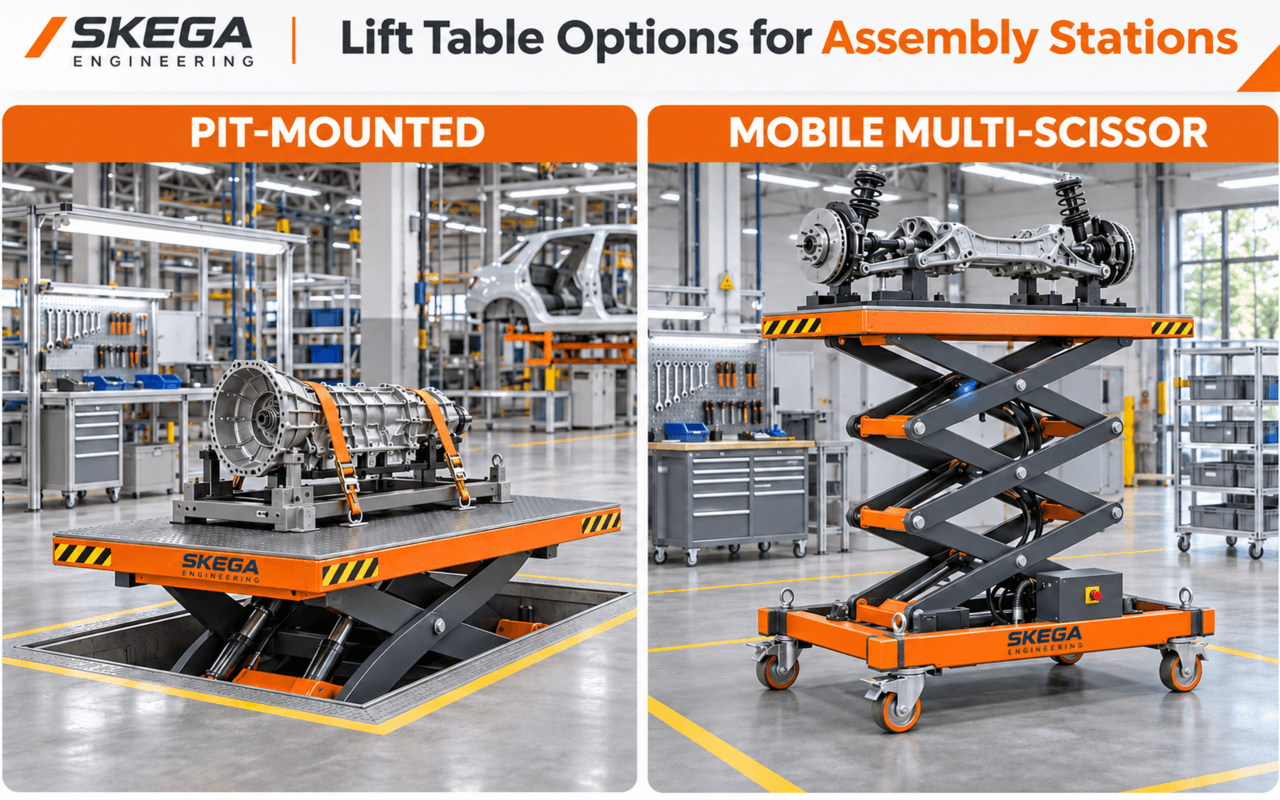
Three types suit most plants:
- Pit-mounted tables sit flush with the floor, so pallets roll straight on. See the electro-hydraulic pit-mounted scissor table.
- Portable tables move to where they are needed. See the portable hydraulic scissor table.
- Multi-scissor tables reach more than one working height. See the mobile multi-scissor lift table, and read why multi-scissor lift tables matter in heavy manufacturing.
Keep loads centred on the platform, never exceed the rated load, and inspect the table regularly.
Material Handling in EV Battery Manufacturing
EV battery modules and packs are heavy and sensitive. They need smooth, controlled lifting and careful positioning, with no jerks or knocks. Lift tables, trolleys and automated systems all play a part. The exact equipment depends on your process and safety rules, so confirm details with your battery line engineers and the equipment maker.
Biggest Challenges in Automotive Material Handling
| Problem | Common cause | Simple fix |
| Heavy component movement | Manual lifting or wrong equipment | Lift tables, goods lifts, cranes |
| Line downtime | Late or missing parts | Line-side supply plan, right-sized fleet |
| Part damage | Rough handling, poor trolleys | Right trolley and smooth routes |
| Tight space | Wide equipment, poor layout | Compact machines, one-way routes |
| Strain injuries | Bending and reaching at stations | Work-height lift tables |
| Many model variants | Fixed, rigid setups | Flexible, mobile equipment |
How to Choose Material Handling Equipment for an Automobile Plant
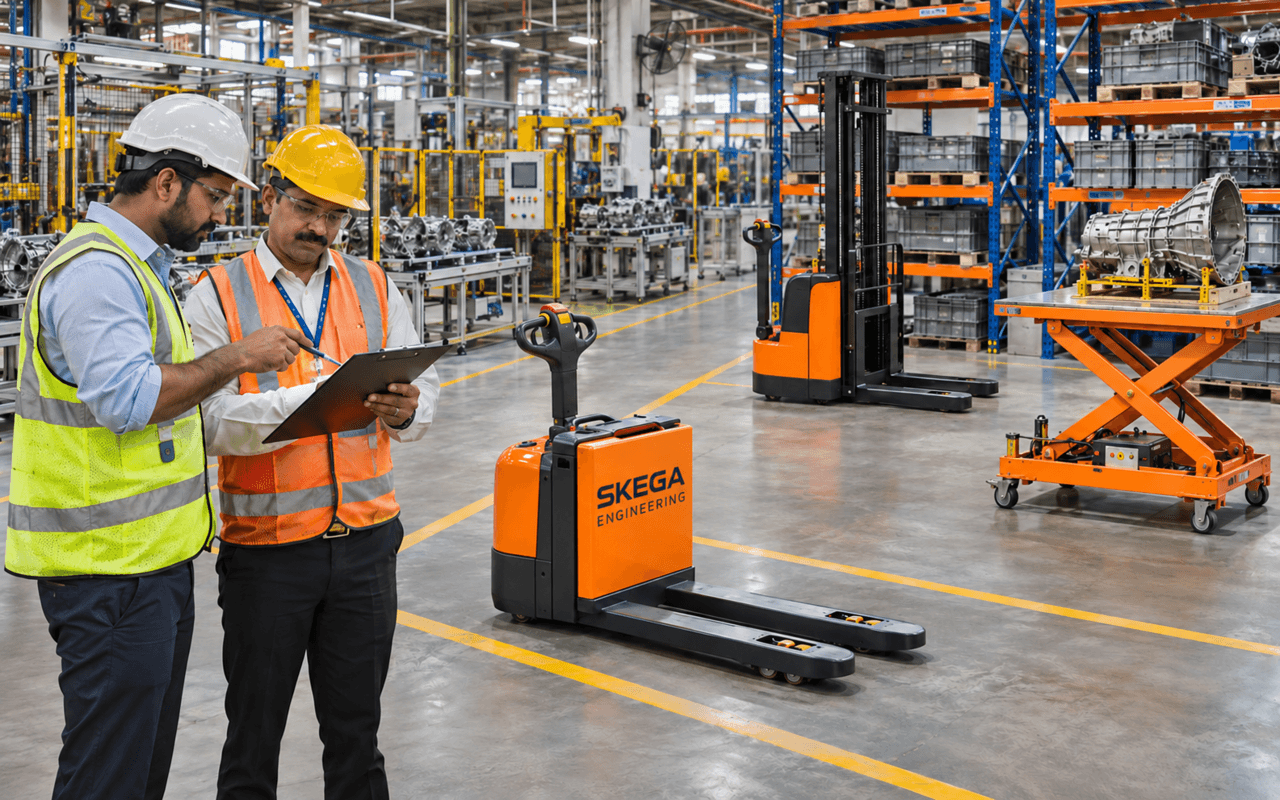
There is no single best material handling equipment in India or anywhere else. The best choice fits your load, distance, frequency, floor, space and time. Use this checklist:
- Load weight: include the fixture or pallet, and keep a safety margin.
- Part size and shape: long, awkward or fragile parts need special support.
- Distance: short trips suit manual trucks. Long trips suit powered ones.
- Frequency: count moves per hour, not per day.
- Floor: check slopes, joints, cracks and drains.
- Aisle and space: plan for the turning space too. Our guide to forklift turning radius helps with layouts.
- Safety: check guards, rated loads and the plan for separating people from vehicles.
- Total cost of ownership: think about spares, service and downtime, not only price.
If you need a lift for your assembly station, our guide to choosing the right scissor lift walks through load, height and platform size.
The 10 Principles of Material Handling
The widely cited principles of material handling, from the College-Industry Council on Material Handling Education, are: planning, standardisation, work, ergonomics, unit load, space utilisation, system, automation, environment and life-cycle cost. (Check the wording against the source before publishing.)
Three show up in every auto plant. Ergonomics means designing handling around the worker, which is why lift tables help. Unit load means moving parts in larger, standard units, which is why pallets and trolleys work. Life-cycle cost means counting service and spares along with the price.
Cost, Maintenance and Safety
To find the cost of each move, use this formula:
Cost per move = (yearly equipment cost + labour + power + maintenance) ÷ moves per year
Compare options with the same sum. For a deeper look at running costs, see our comparison of hydraulic vs. electric scissor lifts.
Keep a simple routine: inspect equipment before each shift, service it on the maker's schedule and keep a log. Stay within rated loads, separate people from vehicle routes and train every operator.
Choosing a Material Handling Partner
A good partner does more than sell a machine. Ask about in-house manufacturing, a site survey, load testing, genuine spares, service support, warranty and customisation. Custom builds help when your plant has unusual heights, loads, pits or layouts that standard equipment does not fit.
Skega has over 10 years of experience, has delivered 150+ projects across 12 industries, and builds every unit at GIDC Sachin, Surat, with 24/7 support. If your plant is in Gujarat, a nearby maker makes surveys and service faster. Learn more about Skega or see our services.
Frequently Asked Questions
Q:1 What is material handling equipment in the automobile industry?
A - It is the trucks, lifts, ramps, trolleys, cranes and automated systems used to move, lift and store parts in car plants.
Q:2 What are the four main categories of material handling equipment?
A - Industrial trucks, storage equipment, engineered systems and bulk handling equipment.
Q:3 What is the difference between an AGV and a forklift in automotive plants?
A - A forklift needs a driver and works almost anywhere. An AGV follows a set route without a driver.
Q:4 How do lift tables improve efficiency in assembly operations?
A - They raise parts to the worker's height, which reduces bending and speeds up repeat tasks.
Q:5 What are the benefits of custom material handling solutions?
A - They fit your exact loads, heights, pits and layouts, so there are fewer workarounds and less wasted space.
Q:6 What is the best material handling equipment in India?
A - There is no single best. The right choice depends on load, distance, frequency, floor and space.
Conclusion
The right material handling equipment for the automobile industry is the one that fits your zone, your load and your line. Map your plant by zone, pick equipment for each, and ask suppliers for surveys and testing before you buy. Small choices at the station level add up to a smoother line.
Need help matching equipment to your plant? Share your load, lift height and location. Talk to the Skega team