
Warehouse Material Handling Equipment Planning Guide: How to Move Goods from Production to Warehouse.
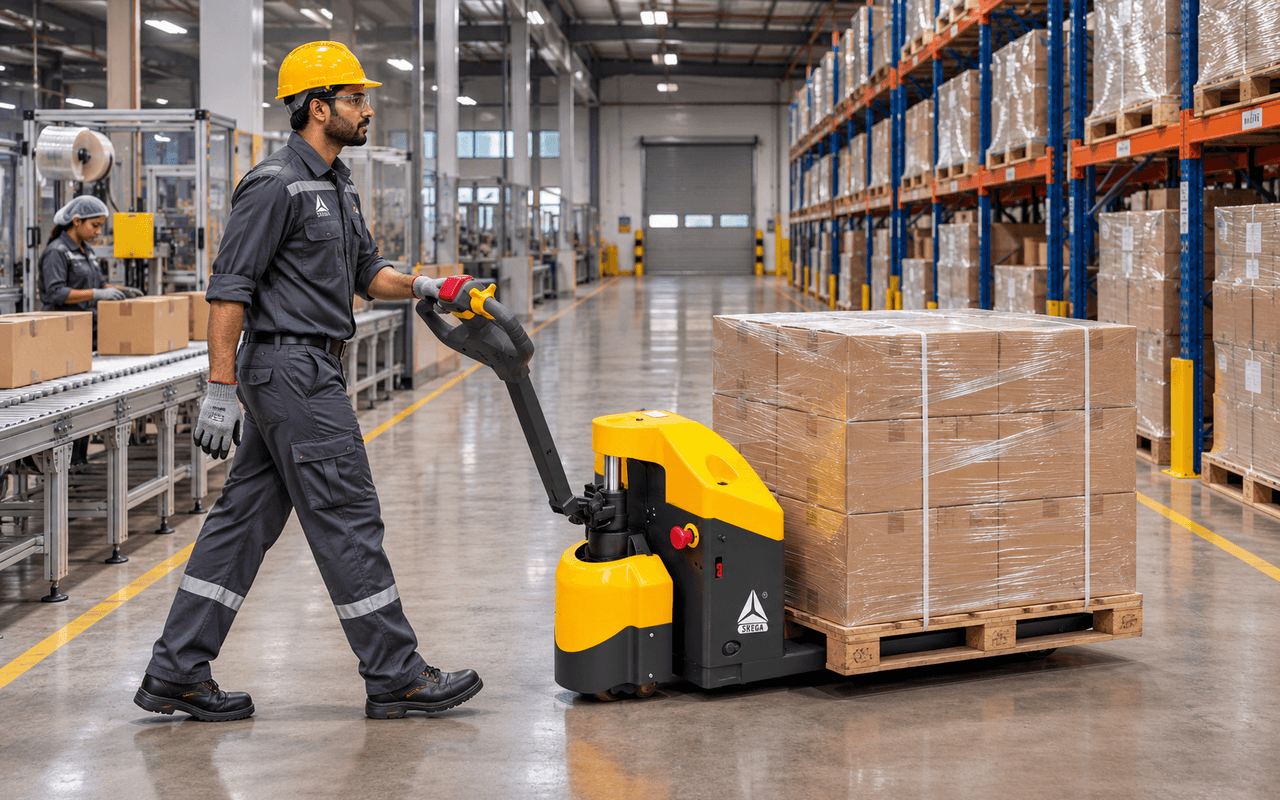
Walk through any factory at 4 pm and you will see it. Finished cartons pile up near the packing line. The pallet truck is missing because someone is using it at the other end of the plant. Two workers push a heavy load up a ramp and hope it does not tip. Nobody calls this a crisis, yet it quietly eats hours, damages stock and slows every dispatch.
Walk through any factory at 4 pm and you will see it. Finished cartons pile up near the packing line. The pallet truck is missing because someone is using it at the other end of the plant. Two workers push a heavy load up a ramp and hope it does not tip. Nobody calls this a crisis, yet it quietly eats hours, damages stock and slows every dispatch.
The fix is rarely "add more people." It is better planning of your material handling equipment warehouse setup: the pallet trucks, lifts, ramps and trolleys that carry goods from the last production step to the storage rack. At Skega, we build this kind of equipment in Surat, and on almost every site survey we see the same thing. The right machine in the wrong place costs more than no machine at all. If you are still shortlisting, keep our warehouse equipment range open in another tab while you read.
This guide is written for warehouse managers, logistics heads, operations heads and procurement teams. It uses simple steps, simple maths and real-floor thinking.
Key Takeaways
- Plan the flow of goods first. Buy equipment second.
- Match each machine to load weight, distance, trips per hour and floor condition.
- Cycle time is travel time plus loading and unloading time. Divide 60 by it to get moves per hour.
- Size your staging area from pallets per hour multiplied by waiting time.
- Plan aisles around your biggest machine, and keep people and trucks on separate routes.
- Track a few simple KPIs to spot bottlenecks early.
What Is Material Handling Equipment in a Warehouse?
Material handling equipment in a warehouse is any machine or tool that moves, lifts, supports or protects goods between production, storage and dispatch. Common examples are pallet trucks, trolleys, dock levelers, ramps, lift tables and goods lifts.
Think of it as the legs of your warehouse. Racks hold stock, but equipment moves it. If the legs are weak or mismatched, everything slows down. That is why smart teams plan movement first, then decide what stays manual and what needs power.
How to Map Material Flow from Production to Warehouse
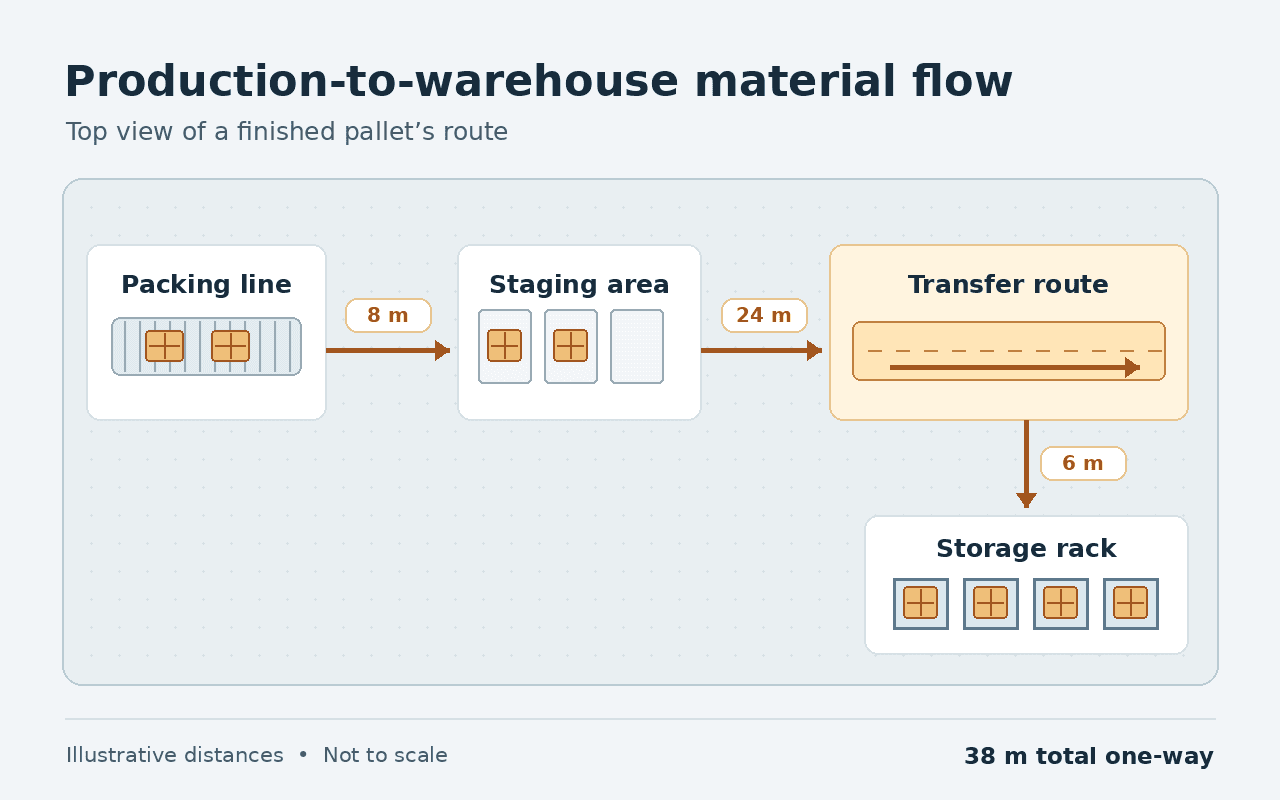
To map production to warehouse material flow, draw every step a finished pallet takes, from the packing line to staging, transfer, put-away and storage. Then note the distance, time, equipment and people involved at each step.
Here is a simple five-step method:
- Draw the floor plan. Sketch your plant on paper or in CAD. Mark packing lines, staging zones, ramps, lifts and storage.
- Trace one pallet. Follow a single pallet from the packing line to its rack. Use a stopwatch and note distance and waiting time.
- Count peak volume. Use pallets per hour at peak, not the monthly average. Equipment must survive your busiest hour.
- Mark crossing points. These are spots where trucks meet people or other routes. They are your safety risks.
- Circle the slow spots. Queues at lifts, long walks and steep ramps usually show up fast.
Once the map is ready, plan your pallet transfer routes. Keep them short, straight and, where possible, one-way. In many plants, waiting time is bigger than travel time, so fixing a queue often helps more than buying a faster machine.
Warehouse Material Handling Equipment Types and List
Here is a quick list of the main warehouse material handling equipment types and where each one fits best.
| Equipment | Best for | Watch out for |
| Manual pallet truck | Short, low-frequency pallet moves on flat floors | Operator fatigue on long routes |
| Electric pallet truck | Frequent moves and longer distances | Higher upfront cost, charging time |
| Pallet stacker | Lifting pallets onto racks | Aisle width and mast height |
| Platform trolley | Cartons, loose items, odd-shaped goods | Not for heavy pallets |
| Dock leveler or ramp | Bridging dock and truck bed | Needs correct capacity |
| Scissor lift table | Raising goods to working or loading height | Platform size and load rating |
| Goods lift | Moving goods between floors | Needs planning for landing space |
| Conveyor | Steady, repeated flow of the same product | Fixed layout, less flexible |
| AGV or AMR | High-volume, repeatable routes | Higher cost, needs good floors |
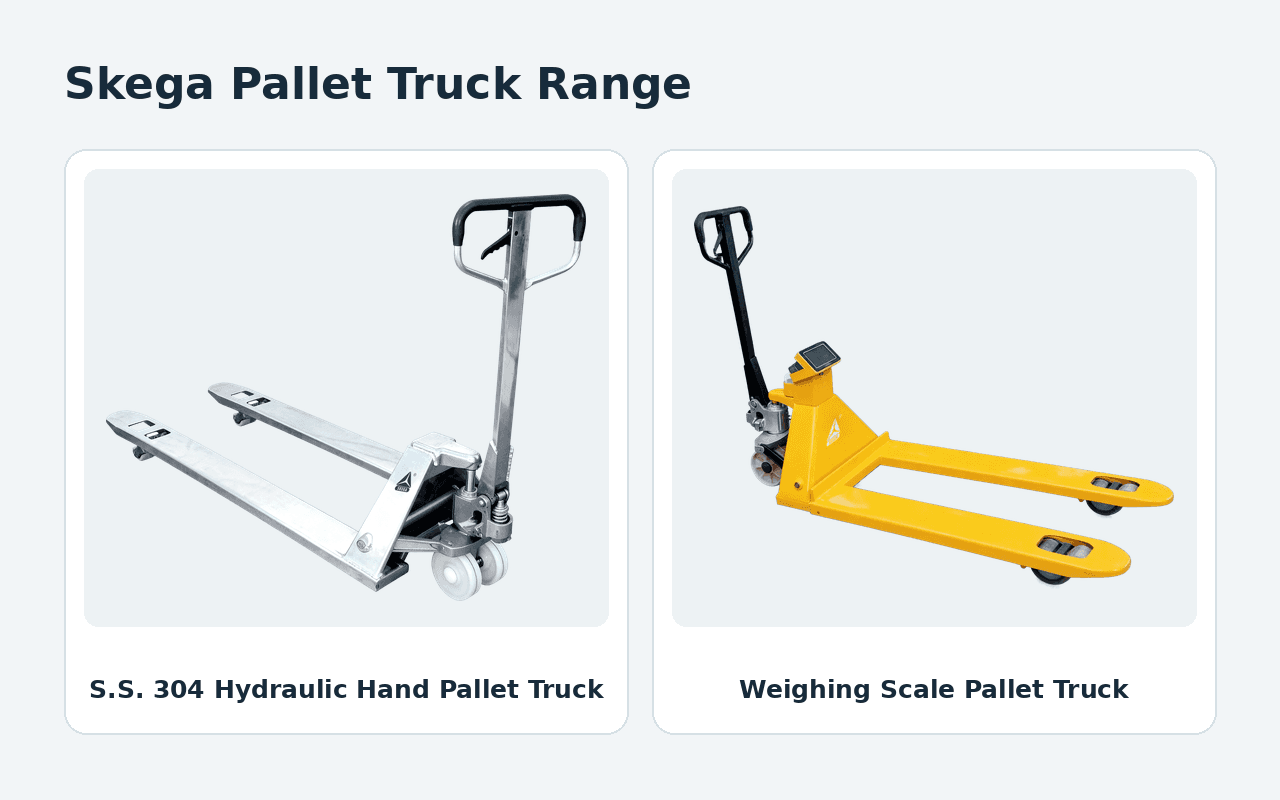
For short, frequent trips on a flat floor, a pallet truck is hard to beat. Skega builds electric pallet trucks for plants where operators move pallets all shift, and an S.S. 304 hydraulic hand pallet truck for clean or damp areas such as food and pharma. If you want weights while you move, the hydraulic weighing scale pallet truck saves a separate trip to the floor scale. For cartons and loose goods, a four-wheeled platform trolley works well. At the truck dock, dock levelers and a mobile dock ramp close the gap between the dock and the vehicle, so loading is safer and faster.
How to Choose Warehouse Material Handling Equipment
To choose equipment for moving pallets, compare load weight, distance, trips per hour, floor condition and aisle width. Then check the running cost against the time saved. Use this seven-point checklist.
- Load weight: Add the pallet weight too. Keep a safety margin above your heaviest load.
- Pallet type: Check size, material and fork entry (two-way or four-way).
- Distance: Short trips suit manual trucks. Long trips suit electric ones.
- Frequency: Count moves per hour, not per day.
- Floor condition: Cracks, slopes and joints affect wheel choice and safety.
- Aisle width: Plan for the machine plus the turning space.
- Budget and payback: Compare purchase price with labour saved and damage avoided.
A simple "if this, choose that" guide helps:
| If your need is... | Consider... |
| Short distance, few moves | Manual pallet truck |
| Many moves, long distance | Electric pallet truck |
| Wet, clean or hygienic area | Stainless steel pallet truck |
| Moving goods between floors | Goods lift |
| Raising loads to a set height | Scissor lift table |
| Same product, steady flow | Conveyor |
| Fragile finished goods | Smooth-running trolleys and gentle lifting |
For small warehouses, compact machines usually beat big ones. A narrow aisle can turn a good machine into a bad purchase.
How to Calculate Pallet Movements per Hour
Good planning needs numbers. Here are three formulas you can use today.
Cycle time = loaded travel time + empty return time + loading time + unloading time
Pallet movements per hour = (60 ÷ cycle time in minutes) × efficiency factor
Use an efficiency factor of 0.75 to 0.85, because real shifts include breaks, waiting and traffic.
Worked example (illustrative numbers): A packing line is 60 metres from storage. A manual pallet truck moves at about 1 metre per second, so each way takes 60 seconds. Loading and unloading take 30 seconds each.
- Cycle time = 60 + 60 + 30 + 30 = 180 seconds = 3 minutes
- Moves per hour = 60 ÷ 3 = 20, and at 0.8 efficiency that is 16 pallets per hour
Now suppose you need 40 pallets per hour. That means 40 ÷ 16 = 2.5, so you need 3 manual trucks
An electric truck at about 1.5 metres per second cuts each way to 40 seconds. Cycle time becomes 140 seconds, giving about 20 pallets per hour at 0.8 efficiency. For the same target, 2 electric trucks are enough.
Two more quick checks:
- Conveyor throughput = belt or roller speed ÷ spacing between items. At 12 metres per minute with 0.6 metres between cartons, you move 20 cartons per minute.
- Goods lift or lift table capacity: Add the heaviest load, the pallet, any trolley and any person on board. Add a safety margin, then confirm the rated capacity with the manufacturer.
These figures are planning estimates. A site survey gives the final answer.
What Is a Finished Goods Staging Area, and How Big Should It Be?
A finished goods staging area is a marked holding zone between production and storage. Pallets wait here for counting, quality checks and labelling before they move to their final rack or to dispatch.
To size it, use this formula:
Area = pallets per hour × holding time (hours) × floor space per pallet × 1.4
The 1.4 covers lanes and walking gaps. For example, 40 pallets per hour × 2 hours = 80 pallets. A standard pallet needs about 1.2 square metres. So 80 × 1.2 × 1.4 gives roughly 134 square metres.
Keep the layout clean:
- Use FIFO lanes so older stock leaves first.
- Create a QC hold zone for pallets awaiting approval.
- Mark a separate rejected goods zone with clear signs.
- Label every lane and keep a clear path to storage.
Aisles, Safety and Separating People from Trucks
Aisle width is not just about the machine. It is the machine, the load and the space to turn. A forklift can fit inside an aisle and still not have room to work properly, which is why our guide on forklift turning radius and warehouse layout planning is worth reading before you fix your rack positions.
To separate forklift and pedestrian routes, use these simple methods:
- Painted walkways and clear floor markings
- Physical barriers at busy crossing points
- Convex mirrors at blind corners
- One-way traffic and posted speed limits
- Signs at every crossing
Also check ramps and floor joints. Uneven floors shake loads and strain wheels, so choose wheels and capacities to suit. Follow applicable factory safety rules and your insurer's requirements.
How to Move Finished Goods Between Floors
A goods lift moves pallets and trolleys between floors using a guided platform driven by hydraulics or a traction system. It is the safest way to move heavy loads between a ground floor and a mezzanine or upper level. Skega's goods lifts are built to order in Surat and sized to your floor, which matters because every building has different ceiling heights, door widths and load needs.
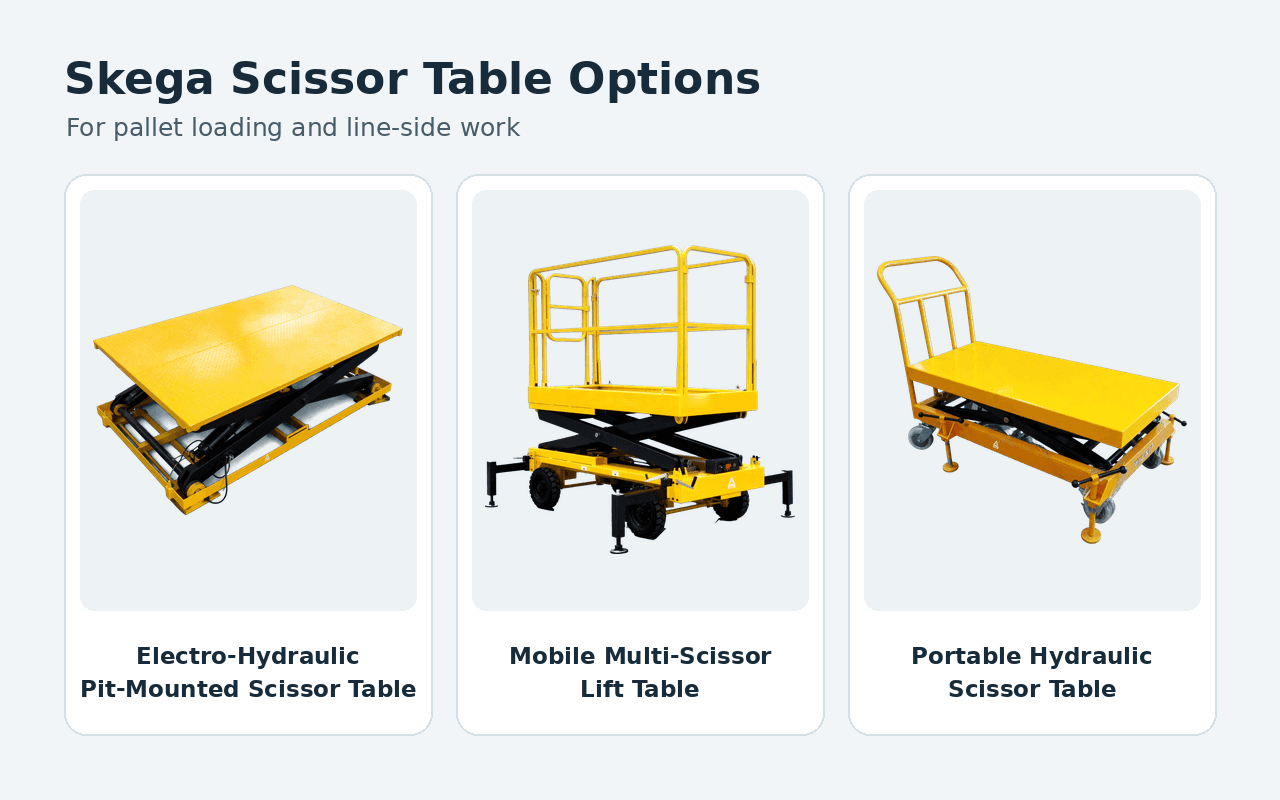
If you only need to change working height, not floor, a scissor table may be enough. A portable hydraulic scissor table moves to where it is needed. An electro-hydraulic pit-mounted scissor table sits flush with the floor, so pallets roll straight on. For multi-stage work, a mobile multi-scissor lift table gives flexible heights. You can read more in our blog on why multi-scissor lift tables matter in heavy manufacturing and our guide to choosing the right scissor lift for your warehouse.
For any lift, plan the landing area. Leave clear space at each stop, mark a safe standing zone and keep the path to the lift free of clutter.
How to Reduce Delays and Product Damage
Start by finding the bottleneck. Watch one shift and note where pallets wait. The usual suspects are a single lift, a narrow door, a busy crossing or a shortage of trucks at peak time.
A milk run is a fixed route and schedule where one operator collects finished pallets from several lines in a loop, like a bus with set stops. It replaces random, on-demand trips and keeps lines from waiting for a truck.
To cut damage during internal transfers:
- Never exceed the rated load of any truck, trolley or lift.
- Use the right trolley for the product, and pad or strap fragile items.
- Keep routes smooth, and fix floor cracks and ramp edges.
- Train operators on speed, turning and stacking limits.
KPIs and the Cost of Internal Material Movement
To measure material handling efficiency, track a few numbers every week:
- Pallets moved per hour
- Average cycle time
- Equipment utilisation (time in use versus idle)
- Damage rate (damaged pallets ÷ total pallets)
- Waiting time at lifts, docks and staging
To find your cost per pallet, use this formula:
Cost per pallet = (yearly equipment cost + labour + power + maintenance) ÷ pallets moved per year
Illustrative example: if the yearly total is ₹4,00,000 and you move 20,000 pallets, your cost is ₹20 per pallet. Run the same sum for manual and electric options and the better choice usually becomes clear. For a deeper look at running costs, see our comparison of hydraulic vs. electric scissor lifts for Indian industries.
How to Choose a Supplier
A good supplier should offer a site survey, load testing, genuine spares and fast service. Ask about warranty, delivery time and whether the machine can be customised. Skega has over 10 years of experience, has delivered 150+ projects across 12 industries, and builds each unit in-house at GIDC Sachin, Surat, with spares and 24/7 support after delivery. You can learn more about our team or review our services.
FAQs
Q:1 What is material handling equipment in a warehouse?
A - It is any equipment used to move, lift or store goods, such as pallet trucks, trolleys, ramps, lift tables and goods lifts.
Q:2 How do you calculate pallet movements per hour?
A - Divide 60 by the cycle time in minutes, then multiply by an efficiency factor of 0.75 to 0.85.
Q:3 When should you use an electric pallet truck instead of a manual one?
A - Choose electric when pallets move often, routes are long or operators tire quickly. Manual trucks suit short, occasional moves.
Q:4 What is a finished goods staging area?
A - It is a marked zone where finished pallets wait for checks, labelling and transfer to storage or dispatch.
Q:5 How do you move goods between floors safely?
A - Use a goods lift sized for your heaviest load, with a clear landing area and trained operators.
Conclusion
Good material handling is not about owning more machines. It is about the right machine, in the right place, at the right time. Map your flow, do the maths, size your staging area and track a few KPIs. Small fixes often unlock big gains.
Not sure where to begin? Tell us what you need to move and where it needs to work, and we will help size the right machine. Talk to the Skega team.