
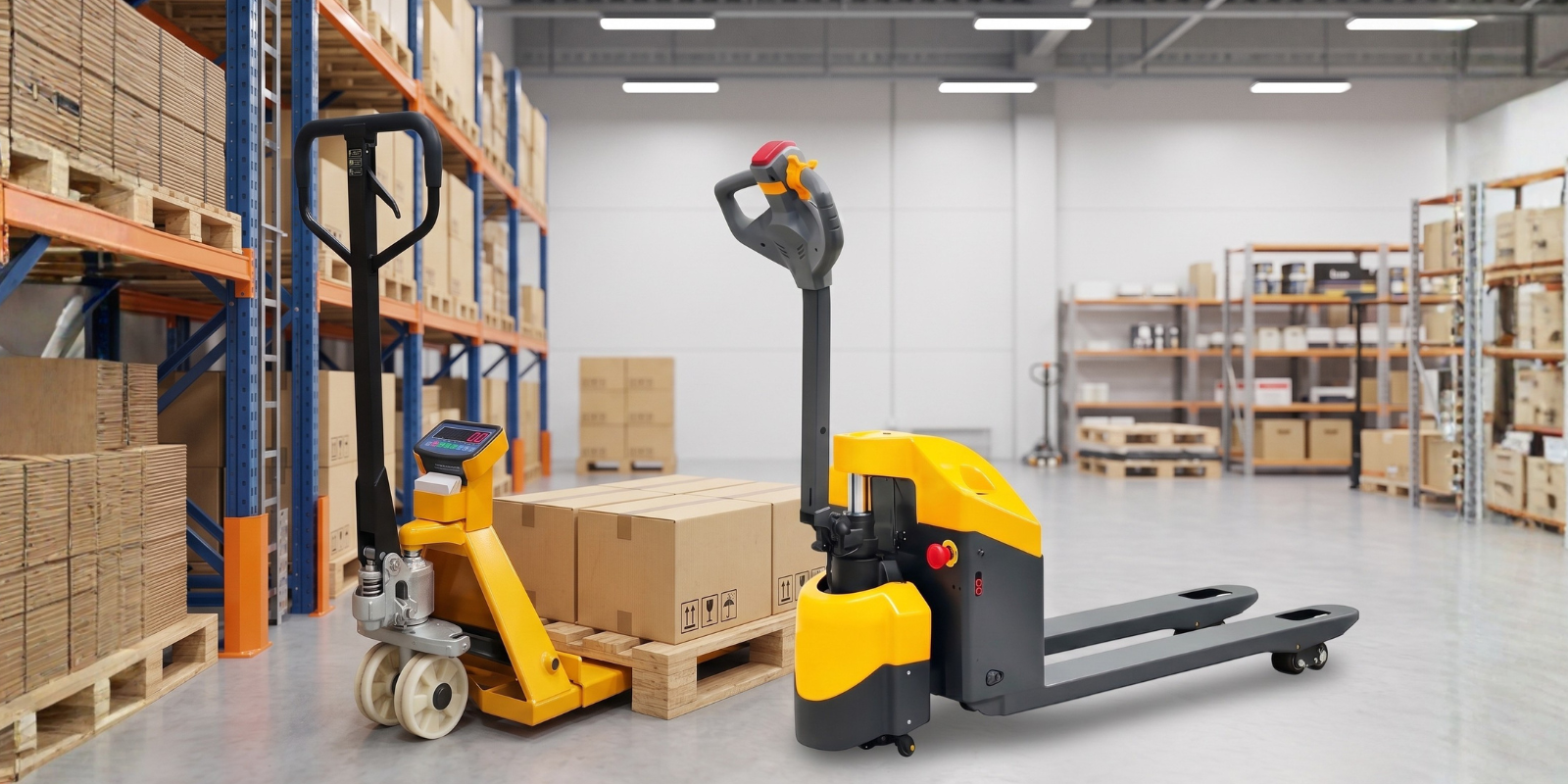

Every warehouse floor tells you what it needs. Watch how goods move through your facility for a single shift and the answer becomes obvious. Pallets stacking up at dock doors. Workers manually dragging loads across long aisles. A floor scale sitting idle in a corner while someone carries a clipboard alongside it, writing down weights the old way.
The right pallet truck fixes all of this. The wrong one creates a different set of problems.
Pallet trucks are the most widely used material handling equipment in Indian warehouses, distribution centres, and manufacturing plants. They are also one of the most underspecified. Buyers pick the cheapest option, or they pick based on what the previous plant had, without thinking through load weights, floor conditions, shift lengths, or whether a standard hydraulic pump truck will still feel manageable after six hours.
What follows is built from manufacturing experience, not a product catalogue. Each type, what it handles, who actually buys it, and where it fails if you pick wrong.
What Is a Pallet Truck?
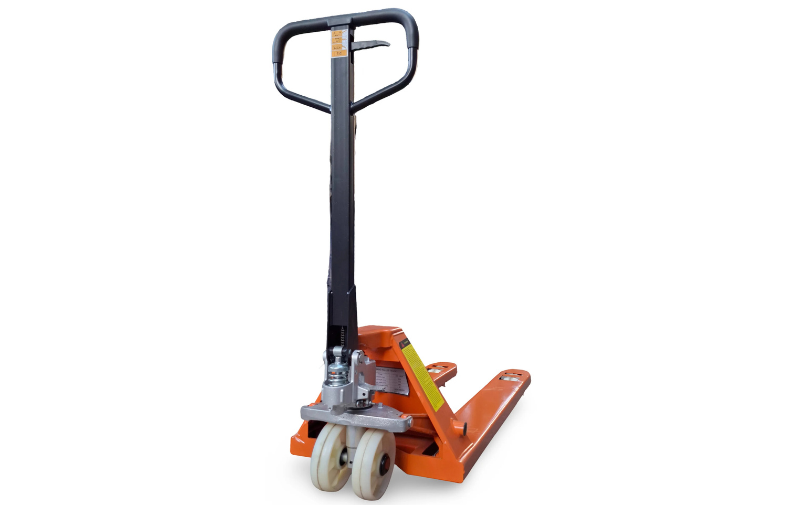
A pallet truck is a ground-level material handling device with two steel forks that slide under a standard pallet. A hydraulic mechanism raises the load clear of the floor for transport. The operator steers using a tiller handle and moves the truck manually or, in powered variants, via an electric drive system.
Pallet trucks handle horizontal movement. They are designed to carry palletised loads across flat surfaces inside a facility. They do not stack. They do not lift loads to height for racking. For that, you need a stacker or a forklift. But for moving goods from dock to storage, from one bay to another, or through production lines, a pallet truck is faster to deploy, cheaper to run, and far easier to manoeuvre in tight spaces than any alternative.
Capacity for most standard pallet trucks in India runs from 1,000 kg to 3,000 kg for manual variants. Electric versions typically handle 1,500 kg to 2,000 kg. Specialty variants go higher.
Types of Pallet Trucks: A Manufacturer’s Guide
Understanding the types of pallet trucks is the starting point for choosing correctly. Each type was built for a specific set of conditions. Picking the right variant reduces operator fatigue, lowers long-term maintenance costs, and keeps goods moving without stoppages.
1. Hydraulic Hand Pallet Truck
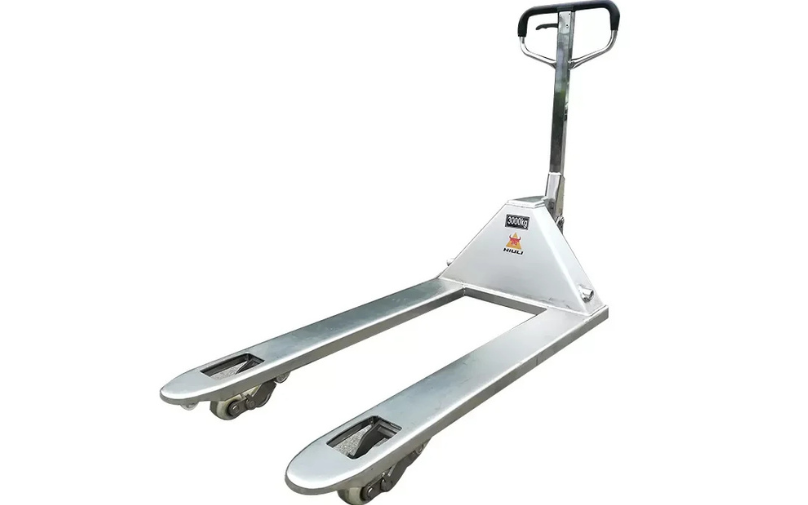
The hydraulic hand pallet truck is the standard across Indian industry. It is manual, pump-operated, and requires no power source. The operator pumps the tiller handle to pressurise the hydraulic cylinder, which raises the forks and the load. A lever on the handle releases the fluid, lowering the load smoothly.
Skega supplies hydraulic hand pallet trucks up to 2,500 kg capacity, with 1,200 mm fork width in mild steel construction. These are the workhorses found across every industrial segment in Gujarat and beyond.
Who uses it: Any facility handling palletised goods on flat, hard floors. Textile mills, ceramic plants, FMCG warehouses, cold storage facilities, engineering workshops, auto ancillary units, and retail distribution centres all use hydraulic hand pallet trucks at scale.
Why it works: Zero running cost beyond maintenance. No battery to charge. No motor to service. A well-built hydraulic hand pallet truck runs for years with nothing more than regular hydraulic oil checks and wheel inspections.
Limitations: It requires physical effort on every pump stroke. Over a long shift or with very heavy loads, operator fatigue becomes real. If your facility runs 10-hour shifts with heavy pallets moving frequently, the hydraulic hand pallet truck alone will slow you down.
Price in India: Standard manual hydraulic hand pallet trucks typically range from ₹12,000 to ₹25,000 per unit depending on capacity and build quality. Heavy-duty 3-tonne variants can go up to ₹35,000 or more.
2. Electric Pallet Trucks
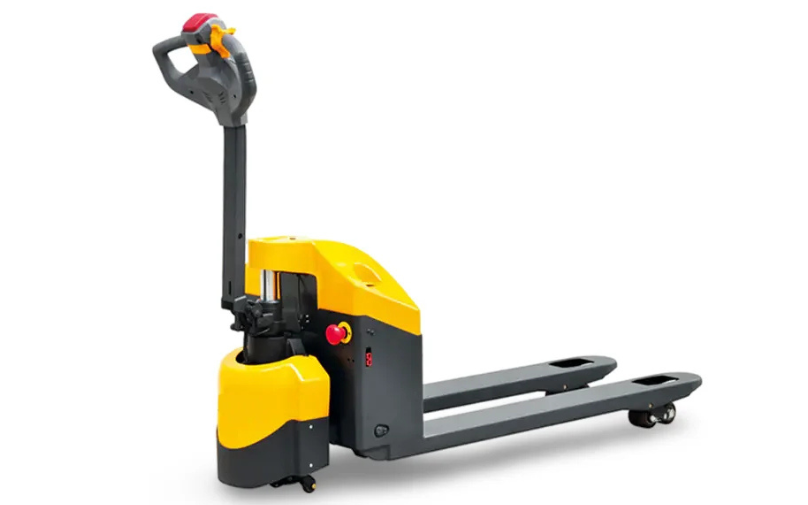
Electric pallet trucks replace the manual pumping mechanism with a battery-powered motor that handles both lifting and forward movement. The operator uses fingertip controls on the tiller handle to raise, lower, and propel the truck. There is no physical effort involved beyond steering.
Electric pallet trucks in India typically run on 24V DC systems with capacities around 1,500 kg to 2,000 kg. A full charge provides a standard 8-hour shift of use in most duty cycles. Lithium-ion variants charge faster and last longer per cycle than lead-acid models.
Who uses it: Facilities with high-frequency pallet movement across longer distances. Automotive plants, pharmaceutical warehouses, large distribution hubs, e-commerce fulfilment centres, and cold chain storage operations benefit most. Any operation where a worker covers 5 km or more on foot per shift should be looking at electric pallet trucks.
Why it works: Speed and operator endurance. An electric pallet truck moves at roughly 4–6 km/h under load, which sounds modest until you compare it against the pace of manual movement with a 2-tonne load. Throughput increases are substantial on shift-heavy operations.
Considerations: Higher upfront cost than manual variants, typically ₹90,000 to ₹2,50,000 depending on capacity, battery type, and brand. Battery maintenance matters. Lithium-ion units cost more but reduce long-term ownership costs.
Industries: Logistics and 3PL, pharma, FMCG, auto ancillary, retail chain distribution.
3. Semi-Electric Pallet Truck
The semi-electric pallet truck is a middle ground. Lifting is powered by a battery motor. Forward movement is still manual. The operator pumps nothing but still walks behind the truck. Semi-electric units are significantly cheaper than fully electric models while addressing the biggest source of fatigue in hydraulic hand pallet truck use: the effort of raising a heavy load.
Starting prices in India for semi-electric pallet trucks begin around ₹45,000 to ₹95,000 depending on capacity.
Who uses it: Operations that need powered lift but have shorter travel distances. Medium-scale warehouses, small manufacturing units, and facilities transitioning from fully manual to electric operations.
4. Hand Pallet Truck with Weighing Scale
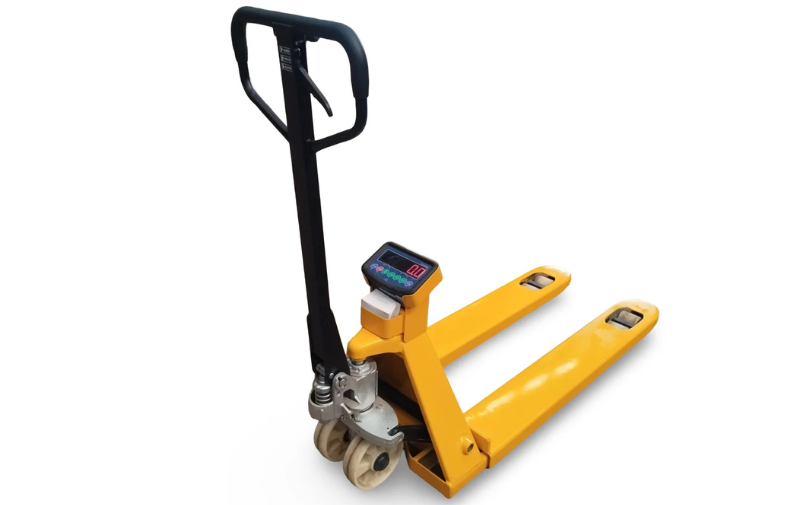
The hand pallet truck with weighing scale integrates a precision load cell system directly into the forks. The operator lifts the pallet, reads the weight on a digital display mounted on the handle, and proceeds without a separate weighing step.
Skega’s hydraulic weighing scale pallet truck combines a heavy-duty hydraulic system with built-in weighing technology. The digital display provides real-time weight readings as the forks lift. This eliminates the separate floor scale, the separate weighing trip, and the manual recording step.
Who uses it: Any operation where weight verification is part of the workflow. This covers more industries than most buyers realise.
Dispatch operations at manufacturing facilities need to verify outbound shipment weights for freight billing. FMCG and food processing plants weigh batches at multiple points in the production cycle. Pharmaceutical manufacturers verify load weights against batch records. Logistics hubs weigh inbound freight to reconcile against purchase orders. Chemical plants check drum weights before storage.
Why it matters operationally: Without an integrated scale, a worker moves the pallet to a floor scale, waits for the reading, records it manually, moves the pallet again to its destination. That is three handling steps for one weighing event. With a weighing scale pallet truck, lifting and weighing happen in one motion.
Key buying considerations: Accuracy rating of the load cells, digital display readability in your facility’s lighting conditions, tare function availability, and whether the unit is calibrated to any regulatory standard your industry requires.
5. High-Lift Pallet Truck (Scissor Lift Pallet Truck)
A high-lift pallet truck adds a scissor mechanism to the fork assembly, allowing the load to be raised to a working height of up to 800–1,000 mm rather than just the clearance height of 80–200 mm on a standard pallet truck. This brings the load to an ergonomic working height for packing, labelling, or inspection tasks.
Who uses it: Assembly lines, packaging stations, quality inspection bays, and any task where workers need to access pallet contents without bending to floor level.
Not a replacement for a stacker. A high-lift pallet truck raises the load for working access, not for rack placement. If you need to put goods into shelving, that requires a stacker or forklift.
6. Low-Profile Pallet Truck
Standard pallet trucks require a minimum fork entry clearance of around 80–90 mm. Where pallets or skids have a lower deck board gap, the standard fork cannot enter. Low-profile pallet trucks bring fork clearance down to 40–55 mm to handle non-standard pallets, solid-base platforms, and some types of metal skids.
Who uses it: Automotive manufacturers, press shops, steel processing units, and anywhere with heavy-gauge non-standard pallets or steel skids that cannot accommodate standard fork dimensions.
7. Rough Terrain Pallet Truck
The hydraulic hand pallet truck is built for flat, hard floors. Uneven yard surfaces, construction sites, outdoor storage areas, and unsealed industrial floors defeat a standard pallet truck quickly. The rough terrain variant uses large pneumatic or semi-pneumatic tyres and a reinforced frame to handle these conditions.
Who uses it: Construction material suppliers, outdoor storage yards, ceramic tile manufacturers with yard operations, and any facility that needs to move palletised goods across uneven surfaces.
Industries Where Pallet Trucks Are Non-Negotiable
The question that comes up when facilities are evaluating equipment is whether pallet trucks apply to their specific operation. After decades of supplying material handling equipment across Gujarat and beyond, the honest answer is that there is almost no warehouse or manufacturing environment where pallet trucks do not belong. The variance is which type and in what quantity.
Textile and Apparel: Surat is one of India’s largest textile hubs. Fabric rolls and finished goods ship on pallets. Hydraulic hand pallet trucks handle loading and unloading at dock bays. The weighing scale variant is used by dyers and processors who charge by weight.
Ceramics: Gujarat produces a significant share of India’s ceramic tiles. Heavy tile boxes on wooden pallets require trucks rated for 2,500 kg or more. Rough terrain variants handle outdoor yard movement between warehouses.
Chemical and Pharmaceutical: Drum handling often combines with pallet truck operations. Pharmaceutical companies need the weighing scale variant for batch weight verification. Cleanroom-compatible variants with appropriate wheel materials are available for regulated environments.
FMCG and Food Processing: High-frequency pallet movement in cold storage and ambient warehouses. Electric pallet trucks handle long-aisle, high-cycle operations. Stainless steel or food-grade variants are available where hygiene requirements apply.
Automotive and Auto Ancillary: Component kitting from stores to assembly lines is a pallet truck application. Low-profile variants handle steel skids. Semi-electric trucks serve medium-frequency lines.
E-Commerce and Logistics: Large fulfilment centres with multiple shifts need electric pallet trucks. Weighing scale variants at inward receiving desks verify freight weights against consignment notes.
Engineering and Metal Fabrication: Heavy material movement across shop floors. Trucks rated at 2,500–3,000 kg for raw material handling.
Retail and FMCG Distribution: Medium-scale distribution centres with daily inbound and outbound pallet movement. Standard hydraulic hand pallet trucks serve most needs with low operating cost.
Pallet Truck Price in India: What to Expect
Buyers looking at pallet truck price in India will find a wide range depending on type, capacity, and build quality. These are verified market benchmarks from current IndiaMART listings and industry data:
| Type | Capacity | Approximate Price Range |
| Manual Hydraulic Hand Pallet Truck | 2,000–2,500 kg | ₹12,000 – ₹25,000 |
| Heavy-Duty Manual (3 tonne) | 3,000 kg | ₹25,000 – ₹40,000 |
| Semi-Electric Pallet Truck | 1,500 kg | ₹45,000 – ₹95,000 |
| Electric Pallet Truck | 1,500–2,000 kg | ₹90,000 – ₹2,50,000 |
| Pallet Truck with Weighing Scale | 2,000–2,500 kg | ₹30,000 – ₹80,000 |
Price alone is a poor buying criterion for pallet trucks. A ₹10,000 hydraulic hand pallet truck with a weak cylinder seal will start leaking within six months under daily use. The seal replacement, the downtime, the oil spillage on the floor, and the repeated maintenance calls cost more over two years than a properly built unit would have at ₹18,000.
What actually drives total cost: hydraulic cylinder quality, wheel material (nylon versus polyurethane versus steel), fork steel grade, paint or coating quality, and the manufacturer’s ability to supply parts.
How to Choose the Right Pallet Truck for Your Operation
There is a practical sequence for making this decision. Most buyers skip steps and then discover the mismatch after the equipment is on the floor.
1. Load weight. What is the maximum pallet weight you will ever move? Add a 20% margin and buy to that rating. A 2,000 kg rated truck running at 2,000 kg every cycle will wear faster than a 2,500 kg rated truck at the same load.
2. Floor conditions. Flat epoxy-coated floors: standard nylon or polyurethane wheels. Concrete with joints: polyurethane absorbs vibration better. Outdoor or uneven: rough terrain variant only.
3. Distance and frequency. Short hauls of 5–20 metres a few times per hour: manual hydraulic is sufficient. Long hauls of 30–80 metres, multiple times per hour, multiple shifts: electric pallet truck.
4. Shift length and staffing. If your workers operate pallet trucks for more than four hours per shift on heavy loads, manual operation becomes a fatigue issue. Semi-electric or electric variants preserve operator capacity across the full shift.
5. Special requirements. Do you need to weigh loads in transit? Weighing scale variant. Do you need to raise loads to working height? High-lift variant. Do you handle non-standard pallets? Measure your deck board gap before ordering.
6. Spare parts and service access. A pallet truck from a manufacturer with no local service presence is a liability. Hydraulic seals, wheels, and tiller handles wear out. These parts should be available within a day’s lead time, not two weeks from a port.
Pallet Jack for Warehouse: Getting the Fleet Mix Right
Most facilities above a certain throughput level need a fleet mix rather than a single type. A medium-scale warehouse might run eight manual hydraulic hand pallet trucks for general movement, two weighing scale variants at inward and outward docks, and two electric pallet trucks for the long-aisle runs between bulk storage and picking zones.
The mistake is standardising on one type across the entire facility because it simplifies procurement. Operator experience and equipment utilisation both suffer when the tool does not match the task.
Buying from a pallet jack manufacturer who supplies multiple variants also simplifies maintenance and parts. A single supplier relationship means consistent hydraulic components, compatible wear parts, and a service team that knows your equipment.
About Skega Engineering Co. Pvt. Ltd.
Skega Engineering Co. Pvt. Ltd. is a material handling equipment manufacturer based at Sachin GIDC, Surat, Gujarat. Founded in 1997, Skega manufactures and supplies a full catalogue of industrial material handling equipment serving industries across India.
Our pallet truck range includes standard hydraulic hand pallet trucks, hydraulic weighing scale pallet trucks, and electric variants. Beyond pallet trucks, Skega manufactures scissor lifts, aerial work platforms, self-propelled scissor lifts, hydraulic stackers, electric stackers, dock equipment, conveyors, hoists and chain pulley blocks, scaffolding, ladders, drum handling equipment, and trolleys.
The range spans over 66 products across 17 categories. We manufacture against specific capacity and dimensional requirements for clients across textiles, ceramics, chemicals, pharmaceuticals, FMCG, automotive, logistics, and construction.
Skega operates from Gujarat and supplies to facilities across India. Every piece of equipment we supply is sold, manufactured to specification, and backed by our team in Surat. We have been doing this long enough to know that the right equipment recommendation matters more than a quick sale.
If you are evaluating pallet trucks for your facility, contact us at sales1@skega.in or call +91 98240 94354. Tell us your load weights, floor conditions, shift lengths, and any special requirements. We will tell you exactly which variant fits and at what price.
Skega Engineering Co. Pvt. Ltd. Plot No. 5402, Road No. 54, Sachin GIDC, Surat, Gujarat – 394230.
What to Look for When Buying a Pallet Truck in India
Indian warehousing is expanding fast. New distribution centres, third-party logistics hubs, and manufacturing facilities are coming up across Gujarat, Maharashtra, and beyond. The equipment decisions made during setup tend to persist for years because nobody revisits working equipment until it stops working.
Pallet trucks are bought in the first month of operations and forgotten until they need repair. The ones that were specified correctly are still running at year eight with regular servicing. The ones that were bought on price alone have been replaced twice.
Buy to your actual requirement. Verify that spare parts are available locally. Choose a manufacturer who has been doing this long enough to have seen both outcomes.
Skega Engineering Co. Pvt. Ltd. has been manufacturing material handling equipment from Sachin GIDC, Surat since 1997. Contact us at sales1@skega.in or +91 98240 94354 to discuss your requirement.
FAQs on Pallet Trucks
These are structured to match how people phrase questions in Google Search and voice search. Keep them in a dedicated FAQ section at the end of the post with clean H3 formatting. Schema markup (FAQ Page) on these will further improve eligibility for featured snippets and People Also Ask boxes.
Q: What is a pallet truck used for?
A pallet truck is used to lift and transport palletised loads horizontally across flat surfaces inside warehouses, factories, and distribution centres. The forks slide under a standard pallet, a hydraulic mechanism raises the load clear of the floor, and the operator moves it to its destination. Pallet trucks handle ground-level movement only — they do not stack goods into racking.
Q: What is the difference between a pallet truck and a forklift?
A pallet truck moves pallets at ground level across short to medium distances and requires a flat surface. A forklift lifts loads to height for rack placement, handles heavier capacities, and can navigate ramps and uneven terrain depending on the type. Pallet trucks are lower cost, easier to operate, and suited to horizontal movement within a facility. Forklifts are required where vertical lifting or higher capacities are needed.
Q: What is the difference between a hand pallet truck and an electric pallet truck?
A hand pallet truck uses a manual hydraulic pump operated by the tiller handle to lift loads. Movement is fully manual. An electric pallet truck uses a battery-powered motor to lift and propel the load, requiring only steering from the operator. Electric pallet trucks suit high-frequency, long-distance pallet movement and reduce operator fatigue significantly. Hand pallet trucks have lower purchase cost and zero power running costs.
Q: What is the capacity of a standard pallet truck in India?
Standard manual hydraulic hand pallet trucks in India are available in capacities of 1,000 kg, 1,500 kg, 2,000 kg, and 2,500 kg. Heavy-duty models go up to 3,000 kg and above. Electric pallet trucks typically range from 1,500 kg to 2,000 kg. Capacity selection should be based on your maximum pallet weight with a safety margin of at least 20% above actual working load.
Q: What is a pallet truck with weighing scale?
A pallet truck with weighing scale is a hydraulic hand pallet truck with precision load cells built into the forks and a digital display on the tiller handle. It weighs the load as it is lifted, eliminating a separate floor scale step. It is used in dispatch bays, inbound receiving, pharmaceutical batch processing, FMCG packaging lines, and any operation where load weight needs to be recorded at the point of movement.
Q: What is the price of a pallet truck in India?
Pallet truck prices in India vary by type and capacity. Standard manual hydraulic hand pallet trucks range from ₹12,000 to ₹25,000. Heavy-duty 3-tonne manual variants range from ₹25,000 to ₹40,000. Semi-electric pallet trucks start around ₹45,000. Fully electric pallet trucks range from ₹90,000 to ₹2,50,000 depending on battery type and capacity. Pallet trucks with integrated weighing scales range from ₹30,000 to ₹80,000. Prices vary by specification and manufacturer.
Q: Which type of pallet truck is best for a warehouse?
The best pallet truck for a warehouse depends on load weight, travel distance, shift length, and floor conditions. Manual hydraulic hand pallet trucks suit short-haul, lower-frequency operations with flat floors. Electric pallet trucks suit high-frequency, long-aisle operations across multiple shifts. A pallet truck with weighing scale suits any operation with a regular weighing requirement at the point of movement. Most medium-to-large warehouses use a mix of types.
Q: Can a pallet truck be used outdoors?
Standard hydraulic hand pallet trucks are designed for flat, hard indoor floors and perform poorly on uneven or outdoor surfaces. Rough terrain pallet trucks with pneumatic or semi-pneumatic tyres are built for outdoor use, construction sites, and unpaved yard surfaces. Using a standard pallet truck on rough ground risks tip-over, wheel damage, and hydraulic cylinder damage from uneven load distribution.