
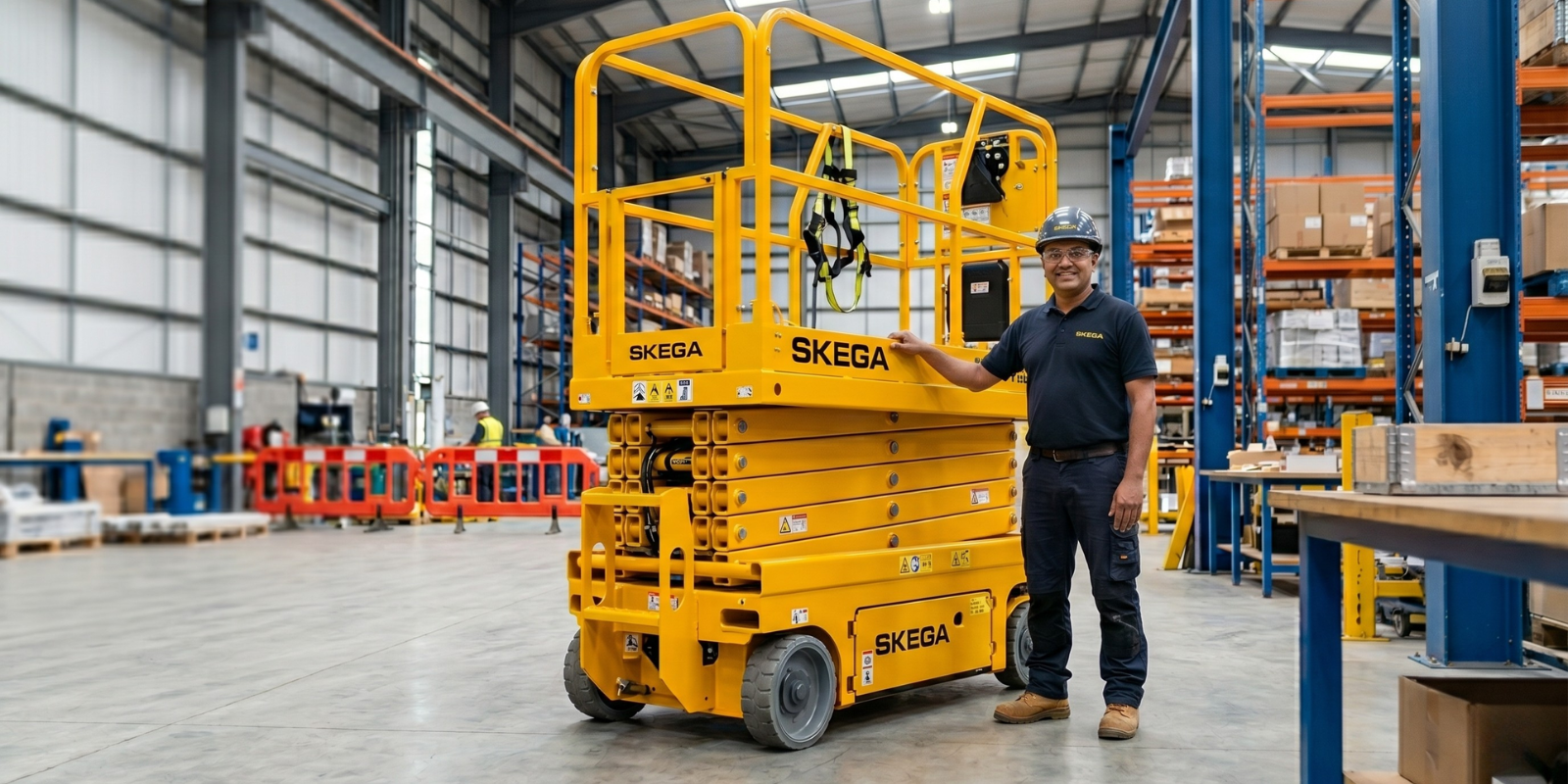

We have had this conversation more times than we can count.
A plant head calls in asking for a scissor lift. Somewhere in the first few minutes, it comes out that they have been renting one for the past two years. Sometimes three. They know the model number by heart. They know which rental guy to call. They know exactly how long delivery takes, and they have quietly built that delay into their maintenance window because there is no other option.
What they have stopped noticing is how much that arrangement is costing them… in money, in schedule dependency, in the friction of chasing a vendor every time a ceiling light goes out or a conveyor needs servicing at height.
The market for electric scissor lift for rent is well-organised precisely because it is profitable for the vendor. The daily and monthly rate is low enough to feel reasonable. The cumulative cost across years never appears on a single invoice, so it never triggers a review. By the time a facility runs the numbers, they have usually paid for the asset twice over.
We are writing this because we have heard the complaints enough times to know that the rental model works against the buyer in most industrial contexts. This is the case we would make in person, set down plainly.
What an Electric Scissor Lift Actually Does
Before getting into the ownership question, it is worth being precise about what this equipment is and what it is designed to do.
An electric scissor lift is a self-contained vertical access platform powered by a battery pack. The lifting mechanism uses a system of cross-linked arms arranged in a scissor pattern. When hydraulic pressure is applied, these arms extend upward in a straight vertical path, raising the platform. Because the entire drive and lift system runs on battery power, the equipment produces zero exhaust emissions during operation.
This matters for a practical reason. Work at height inside factories, warehouses, cold storage units, clean rooms, and pharmaceutical production floors requires equipment that preserves indoor air quality. A diesel or LPG-powered platform would be excluded from most of these environments by safety regulation and by common sense. The electric version is the standard choice for enclosed industrial spaces.
Platform heights across standard models range from approximately six metres to fourteen metres depending on the machine. Load capacities vary as well, with most commercial models rated between 250 kg and 700 kg. The platform itself provides a stable, flat working surface that operators can use for extended periods without the physical strain associated with ladders or scaffolding.
The Difference Between a Scissor Lift and a Mobile Elevating Work Platform
The term mobile elevating work platform (MEWP) is the broad category. Scissor lifts sit within this category alongside boom lifts, spider lifts, vertical mast lifts, and personnel hoists.
What separates scissor lifts from other MEWPs is the motion path. Scissor lifts move in a pure vertical line. The platform goes straight up and straight down. There is no horizontal reach beyond the footprint of the base. This makes them the right tool for tasks where the work is directly overhead and where the operator needs a large stable platform to stand on rather than a small cage.
Boom lifts, by contrast, extend horizontally. They reach over obstacles and position the operator away from the base of the machine. For tasks that require working around structure or reaching into awkward angles, a boom lift is appropriate. For systematic maintenance work at height along a production line, inside a warehouse rack system, or on a flat industrial ceiling, a scissor lift is the more productive choice.
Application of Scissor Lift Across Indian Industry
Understanding the application of scissor lift in real industrial settings clarifies who should own one rather than rent it on an ad-hoc basis.
Warehousing and logistics: This is the most straightforward application. Facilities with storage racks above four metres require access equipment for inventory management, lighting maintenance, fire system inspection, and racking repairs. A scissor lift for warehouse use moves between aisles, positions workers precisely at the required height, and allows them to carry tools and small materials on the platform. It is far more productive than fixed scaffolding and far safer than improvised ladder stacking.
Manufacturing plants: Assembly lines, overhead conveyors, crane rail maintenance, dust extraction system cleaning, and electrical panel work above ground level all require routine height access. In a production environment where downtime is costly, having the equipment available on-site means maintenance teams can respond immediately. Waiting for a rental unit to arrive from a vendor location introduces delays that production planning cannot absorb.
Construction and civil works: Electric models are used for interior fit-out work at height. False ceiling installation, MEP work in commercial buildings, curtain wall inspection from the inside, and interior painting on multi-storey floor plates are all standard applications. Rental is sometimes appropriate at this stage because construction projects end. But contractors who repeatedly rent across multiple projects are usually spending more than the capital cost of ownership within eighteen to twenty-four months.
Pharmaceuticals and food processing: These industries have strict hygiene and air quality standards. Battery operated scissor lifts are the preferred choice because they produce no combustion gases. Equipment that moves through these facilities also needs to be clean and well maintained. Rental equipment arriving from general commercial pools may meet basic safety standards but often fails the cleanliness expectations of regulated production environments.
Shipyards, ports, and heavy fabrication: Large-span overhead work in hull fabrication, structural steel assembly, and vessel fit-out requires MEWPs with adequate platform size and load capacity. Electric units work in covered dry docks and assembly halls where ventilation is limited.
Retail and commercial facilities: Mall maintenance teams, airport ground operations, hotel facility departments, and large-format retail stores use scissor lifts for signage, lighting, HVAC maintenance, and ceiling work. These operations are ongoing, year-round, and recurrent. Renting for recurrent requirements is a structural cost problem disguised as a procurement strategy.
Scissor Lift Types: Which Variant Fits Your Requirement
The term scissor lift covers several distinct variants, and the differences between them matter when you are buying rather than renting. A rental vendor will send whatever is available. When you own, you specify exactly what your facility needs.
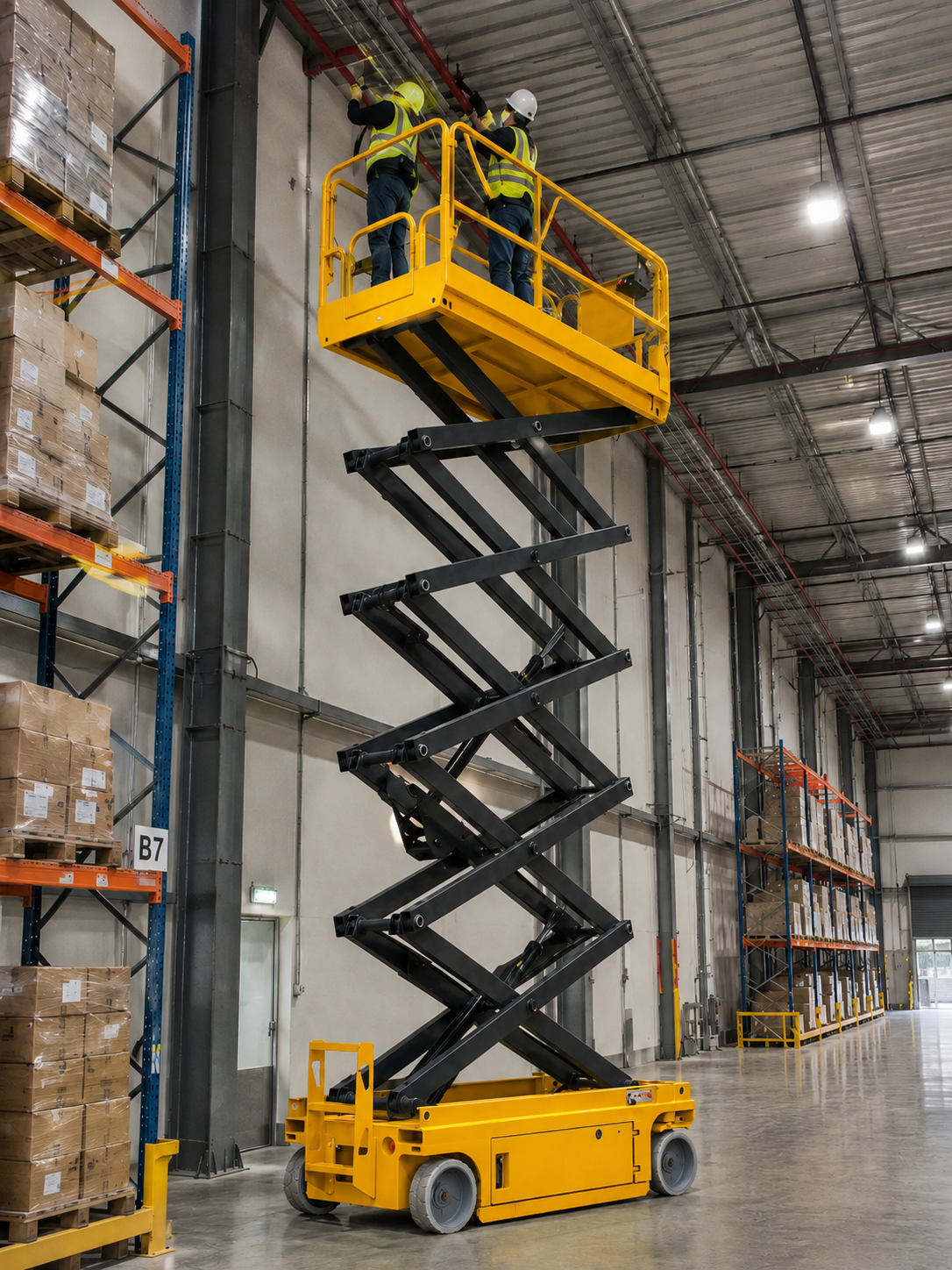
Self-propelled scissor lift: The operator drives the machine from the platform controls. No ground crew required for repositioning. This is the right specification for facilities where the same operator needs to move the machine between positions independently — warehouse aisles, production floors, or commercial maintenance where a single-person maintenance team is the norm. Skega’s Self-Propelled Scissor Lift is built for this type of deployment.
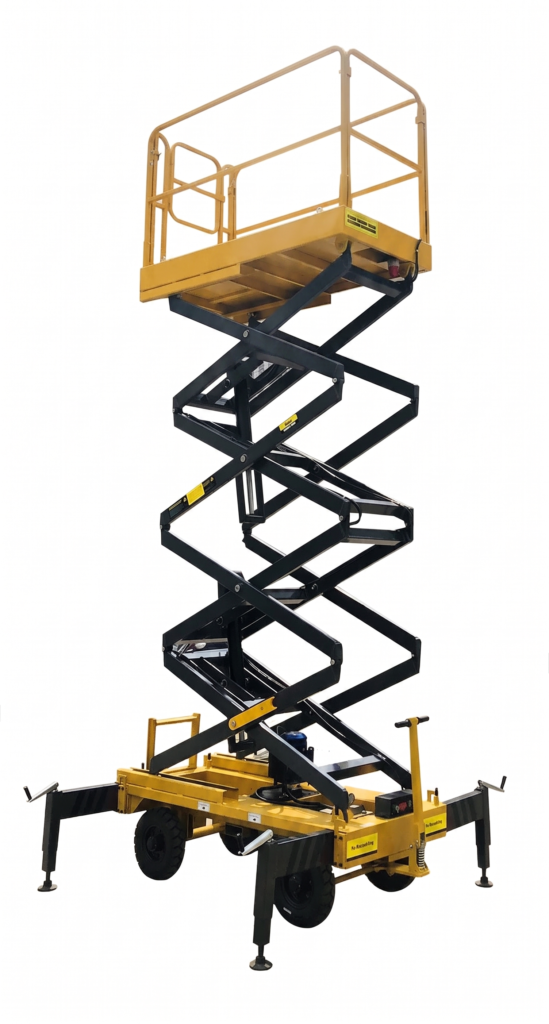
Mobile multi-scissor lift table: This variant is designed for heavy lifting in fixed or semi-fixed positions rather than frequent travel. It runs on electro-hydraulic power with both three-phase AC and DC supply options, which gives it flexibility across different power supply configurations in manufacturing environments. The platform size and load capacity make it the better choice where the task involves sustained heavy work at height rather than repeated repositioning. Skega’s Mobile Multi-Scissor Lift Table is the relevant model here.
Slab scissor lift (standard indoor): The baseline configuration for enclosed, flat-floor environments. Designed for hard, level surfaces. Most indoor industrial and commercial applications fall into this category.
Buying forces this decision upfront, which is actually useful. You end up with a machine that is specified for your actual requirement rather than a general-purpose rental unit that approximates it. The difference between operating a machine built for your site and adapting to whatever arrives on a rental truck shows up in operator confidence, task time, and how comfortably the equipment fits through your doorways and into your aisles.
Why Battery Operated Scissor Lifts Are the Practical Standard Indoors
A battery operated scissor lift is the default specification for any indoor application. The operating cost arithmetic is straightforward.
Modern industrial battery packs in scissor lifts are typically deep-cycle lead-acid or lithium-ion units rated for a full eight-hour shift on a single charge. Charging overnight on a standard industrial power connection is sufficient for daily operation. There are no fuel purchase cycles, no exhaust ventilation requirements, and no fuel storage compliance obligations.
From a maintenance standpoint, electric drive systems have fewer moving parts than internal combustion alternatives. There is no engine, no fuel system, no exhaust treatment. The primary maintenance items are the hydraulic system, the battery, the drive motors, and the control electronics. With a planned maintenance schedule, electric scissor lifts routinely operate for a decade or longer before requiring significant capital expenditure.
The operational noise level of an electric unit is substantially lower than any combustion-powered platform. This matters in mixed environments where production or commercial activity continues while maintenance work happens overhead. A quieter machine means fewer disruptions and better communication between the operator on the platform and colleagues below.
Who Should Buy an Electric Scissor Lift
The decision to purchase depends on usage frequency and operational context. The answer is clearer than most procurement teams assume.
Buy if you use height access equipment more than once a week. Any facility where access equipment is a routine operational tool rather than an occasional requirement is a candidate for ownership. The breakeven point against rental costs typically falls between twelve and twenty-four months depending on rental rates and usage intensity. Beyond that point, rental is simply paying for someone else’s asset.
Buy if your facility has indoor work environments with air quality requirements. Pharmaceutical, food processing, clean room, and cold storage operations should own their own equipment to control maintenance standards, hygiene compliance, and availability.
Buy if rental availability has interrupted your maintenance schedule. This is a practical problem that facilities in industrial areas across India know well. When rental vendors cannot supply on short notice, planned maintenance gets deferred. Deferred maintenance becomes breakdowns. Breakdowns become production losses that cost far more than the price difference between owning and renting.
Buy if your workforce needs trained operators who know the specific equipment. Operator familiarity with a particular machine matters for safe and efficient work. Rental equipment changes. Every time a different unit arrives, the operator has to adapt to different controls, different dimensions, different turning radius. Owning a consistent fleet eliminates this variable.
Buy if you are a contractor with a recurring project pipeline. A contractor who runs three or four projects per year involving height access work is spending significant sums on rental across that pipeline. Ownership converts that variable cost into a depreciating asset with residual value.
The Real Economics of Electric Scissor Lift for Rent
The rental market for electric scissor lift for rent is designed to look affordable on a daily or monthly basis. The rate card is the primary tool of comparison. Total cost of dependency never appears on it.
Consider a facility that rents a scissor lift for eight days per month at the prevailing market rate in Gujarat. Across twelve months, the cumulative rental spend approaches or exceeds a significant fraction of the ownership cost. By year two, the facility has paid for the asset and owns nothing. By year three, it has paid for the asset twice.
Rental costs also include hidden components that are rarely totalled: delivery charges, return transport, damage deposit, mobilisation time billed against productive hours, and the cost of rental unavailability on days when the vendor cannot supply.
Ownership, by contrast, is a one-time capital outlay amortised over the operational life of the asset. A well-built electric scissor lift from a reputable scissor lift manufacturer in India will serve a facility for ten or more years with proper maintenance. Spread the purchase price across ten years of operational service and compare it against ten years of rental invoices. The arithmetic favours ownership by a wide margin.
What the Numbers Actually Look Like
Rental rates for electric scissor lifts in Gujarat are publicly listed on IndiaMART by vendors who operate across Ahmedabad, Surat, and the surrounding industrial belt. BIG Inframech in Ahmedabad lists scissor lift rental at ₹1,00,000 per month. Battery operated scissor lift rental deals covering Surat are listed at ₹60,000 per month on IndiaMART’s Surat material handling rental listings. The range across Gujarat vendors sits broadly between ₹60,000 and ₹1,00,000 per month for standard electric models in the eight-to-fourteen metre class, before transport is added.
That transport charge is worth naming separately. Most rental contracts in this category price delivery and retrieval outside the monthly rate. That cost depends on distance from the vendor depot and is quoted case by case. It is a real number that rarely makes it into any total-cost comparison a facility does internally, because it arrives on a separate invoice.
At ₹85,000 per month as a mid-range figure, a facility spending twelve full months on rental has spent ₹10,20,000. Year two brings that cumulative figure to ₹20,40,000. The facility owns nothing at that point, carries no asset on its books, and is still dependent on vendor availability the next time a job comes up.
On the purchase side, platform scissor lifts sold by Gujarat-based suppliers are listed on IndiaMART starting from ₹6,25,000 for a standard electric model. Higher-specification self-propelled units with greater platform height and load capacity run higher. The ownership cost is a one-time capital outlay. Maintenance, which for an electric unit means periodic hydraulic, battery, and motor checks, costs a fraction of the monthly rental figure annually.
A facility paying ₹85,000 per month in rent recovers the purchase cost of a ₹6,25,000 unit in under eight months of equivalent rental spend. After that, the asset works for the facility at essentially the cost of scheduled maintenance.
The comparison shifts for a contractor hired for a single three-week project with no further pipeline. Rental is the sensible call in that scenario and any manufacturer who says otherwise is being self-serving. The calculation tips toward ownership the moment height access becomes a recurrent operational requirement rather than a one-time project need.
What to Look for in a Scissor Lift Supplier
The quality of the equipment you buy is determined largely by who you buy it from. The scissor lift supplier selection matters as much as the specification selection.
Key questions to ask any supplier:
Manufacturing origin and quality control. Is the equipment manufactured in India under controlled conditions, or is it an imported product with limited local service capability? A scissor lift manufacturer in India who builds locally can provide faster spare parts support, local service technicians, and product customisation for Indian operating conditions including voltage supply, floor surface types, and load requirements.
After-sales service infrastructure. Who services the machine when something requires attention? A supplier with a local service team in your region is worth more than a supplier offering a lower price with no nearby support. In industrial operations, equipment downtime has a cost. Fast service response reduces that cost.
Compliance and safety standards. The equipment should comply with applicable Indian and international safety standards. Ask specifically about overload protection, emergency lowering systems, platform guardrail specifications, and tilt sensing mechanisms.
Spare parts availability. Proprietary components with no local supply chain create long maintenance wait times. Verify that commonly replaced parts are stocked locally before committing to a purchase.
When Renting an Electric Scissor Lift Actually Makes Sense
We sell equipment. We have no financial interest in telling anyone to rent. But having watched facilities spend on rental for years longer than they should, we have also watched the reverse: buyers who purchased equipment for a one-off project and then stored it indefinitely. That is a different kind of waste.
Renting makes clear sense in three situations.
The first is a single-project deployment with no recurring requirement. A construction contractor brought in to fit out a specific floor over four weeks, with no follow-on project pipeline, is a genuine candidate for rental. The capital is better deployed elsewhere and the logistical overhead of owning equipment you will use once is real.
The second is when the required specification falls outside what your facility would use again. A twelve-metre rough-terrain platform for an outdoor project in a facility that otherwise only works indoors is worth renting rather than purchasing.
The third is when cash flow genuinely constrains the capital outlay and the rental period bridges a gap while the business scales. This is a legitimate short-term position. It becomes a structural problem when the bridge stretches to two or three years and the rental spend dwarfs what the purchase would have cost.
For most established manufacturing facilities, warehouses, and industrial operations in India with recurrent height access requirements, none of these three conditions apply. The equipment gets used weekly or more often. The specification is consistent. The cash flow is stable. In those cases, the rental arrangement persists because nobody has run the numbers and put them on a single page where a decision-maker can see them and because the rental vendor makes it easy to keep renewing.
About Skega Engineering Co. Pvt. Ltd.
Skega Engineering is a manufacturer and supplier of material handling equipment based in Sachin GIDC, Surat, Gujarat. The company designs and produces equipment for industrial, logistics, and commercial operations across India.
The scissor lift range at Skega includes the Mobile Multi-Scissor Lift Table and the Self-Propelled Scissor Lift. The Mobile Multi-Scissor Lift Table runs on electro-hydraulic power with both three-phase AC and DC supply options, and is built for heavy-duty lifting in confined or dynamic production environments. Overload protection and emergency stop functions are standard. The Self-Propelled Scissor Lift is designed for facilities where operators need to position and drive the platform independently, without a ground crew.
Beyond scissor lifts, Skega’s product range covers aerial work platforms, dock equipment, pallet trucks, stackers, hoists, cranes, conveyors, scaffolding, ladders, drum handling equipment, and trolleys. The company serves manufacturing plants, warehouses, logistics facilities, and construction sites.
Skega also distributes DINGLI aerial work platforms in India and supplies FREIHEIT aluminium scaffolding and safety ladders. This range allows the company to address access requirements across ground level, mid-level, and overhead work without the client needing multiple suppliers.
The manufacturing facility in Sachin GIDC positions Skega within one of Gujarat’s most active industrial zones, with direct access to the industrial clusters in Surat, Ahmedabad, and surrounding districts. Clients working in the textile machinery, chemical processing, pharmaceutical, logistics, and general fabrication sectors across Gujarat make up a significant portion of Skega’s customer base.
For industrial buyers evaluating ownership against rental, Skega can supply technical specifications, site-specific recommendations, and pricing information directly. There are no rental programmes. Skega sells equipment built to perform across the operational life of a facility.
Frequently Asked Questions
Is an electric scissor lift suitable for outdoor use?
Standard electric scissor lifts are designed for flat, hard floor surfaces. They are suited for indoor and paved outdoor areas. Rough terrain or soft ground requires a different category of platform entirely. For outdoor construction sites with uneven surfaces, discuss your specific requirements with a supplier before selecting a model.
What floor-bearing capacity is required for a scissor lift?
The floor must support the combined weight of the machine, the platform load, and appropriate safety margins. Most industrial scissor lifts in the six-to-ten metre class weigh between 1,500 kg and 3,500 kg. Verify floor-bearing ratings for your facility before specifying a model.
How long does a battery charge last in daily operation?
This depends on the battery capacity of the specific unit and the intensity of use. Most industrial models are rated for a full eight-hour shift on a single charge under normal operating conditions. Frequent travel on the drive motors or continuous lifting cycles will reduce this. Overnight charging on a standard power connection is sufficient to restore full capacity.
What maintenance does an electric scissor lift require?
Routine maintenance covers hydraulic fluid checks, battery health monitoring, drive motor inspection, platform safety rail inspection, and control system testing. A planned maintenance schedule conducted by a qualified technician every three to six months is standard practice for facilities using the equipment regularly. Owning the machine means you control the maintenance calendar. With rental equipment, that control sits entirely with the vendor.
What operator training is required?
Any person operating a scissor lift at height should be trained on the specific model they are using. Training covers pre-use inspection, safe driving and positioning on the ground, operation of the platform controls at height, emergency lowering procedures, and understanding load limits. Most industrial facilities build this training into their standard safety induction for maintenance personnel.
Can a scissor lift be used on a mezzanine floor?
Yes, provided the mezzanine floor is rated for the load. This is a common requirement in multi-level warehouses. Confirm the floor-bearing specification against the equipment’s operating weight before use.